







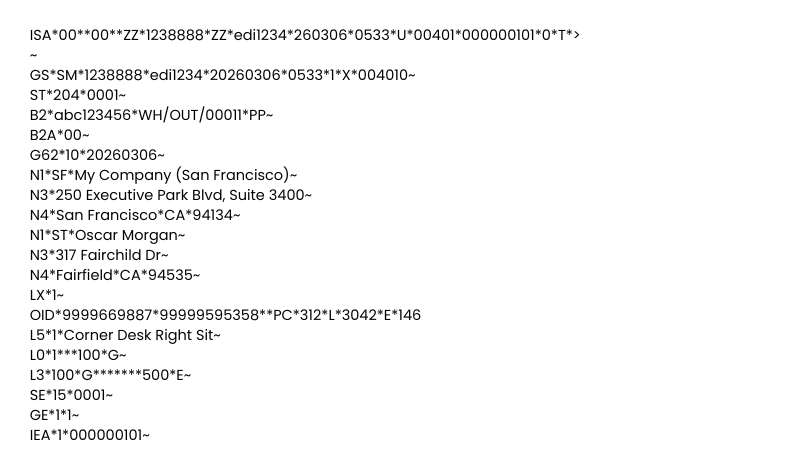
What is an EDI 204?
EDI 204 (Motor Carrier Load Tender) is a transportation EDI transaction used by shippers, brokers, or logistics providers to electronically tender freight loads to motor carriers. It communicates complete shipment details—such as pickup and delivery locations, schedules, equipment requirements, and cargo information—so the carrier can evaluate and accept or reject the load.
In modern supply chains, EDI 204 replaces manual load booking methods like emails, spreadsheets, and phone calls with a standardised digital message. It is typically generated from a Transportation Management System (TMS) or ERP when a shipment is ready to be assigned to a carrier.
EDI 204 is the starting point of the transportation EDI workflow and is followed by responses and execution updates such as EDI 990 (accept/reject), EDI 214 (shipment status), and EDI 210 (freight invoice).
Shipment Identification
- Load number, shipment ID, and reference numbers (PO, BOL, booking)
- Tender type (new, update, cancel)
Pickup and Delivery Information
- Pickup and delivery addresses
- Appointment dates and time windows
- Stop sequence and routing order
Equipment Requirements
- Trailer or container type
- Temperature control or special equipment needs
- Load configuration or capacity requirements
Parties Involved
- Shipper (origin) details
- Consignee (destination) details
- Bill-to or third-party logistics provider
Freight Details
- Commodity description
- Weight, volume, and pallet/carton counts
- Hazardous or special handling indicators
Instructions and References
- Shipping instructions
- Handling notes
- Routing or compliance requirements
These structured elements allow carriers to automatically create loads in their dispatch systems without manual re-entry.
EDI 204 operates within a standardized transportation EDI lifecycle that connects shippers, 3PLs, and carriers.
Step 1 – Load Creation
Step 2 – EDI 204 Transmission
Step 3 – Carrier Evaluation
The carrier’s system receives the tender and evaluates capacity, equipment, and scheduling feasibility.
Step 4 – Carrier Response (EDI 990)
The carrier accepts or rejects the load electronically.
Step 5 – Execution Updates (EDI 214)
Step 6 – Freight Billing (EDI 210)
After delivery, the carrier sends the freight invoice electronically.
This automated workflow enables end-to-end digital freight execution from booking to payment.
Implementing EDI 204 provides significant operational and business advantages in transportation management.
Faster Load Tendering
Loads are transmitted instantly to carriers, eliminating manual communication delays.
Reduced Errors
Structured data removes manual entry mistakes and misinterpretation of shipment details.
Automated Carrier Integration
Carriers can automatically create loads in dispatch systems without re-keying data.
Improved Planning Accuracy
Standardized shipment information ensures correct equipment and scheduling decisions.
Lower Administrative Costs
Automation reduces labor involved in booking, coordination, and follow-ups.
Stronger Carrier Collaboration
Digital tendering improves response time and reliability between partners.
EDI 204 Integration with Odoo by Vraja Technologies
- Automatic generation of EDI 204 from Odoo deliveries or shipments
- Mapping of Odoo shipment data to EDI 204 structure
- Direct transmission to carriers or VAN/EDI providers
- Automated tracking of carrier responses (EDI 990)
- Integration with shipment status (EDI 214) and freight billing (EDI 210)
- Support for multi-carrier and 3PL workflows
- Native Odoo integration approach
- Scalable for shippers, 3PLs, and brokers
- Custom partner mapping and compliance
- End-to-end transportation EDI automation
- Implementation, testing, and partner onboarding support
Vraja Technologies helps organizations transform Odoo into a fully integrated transportation and EDI-enabled ERP platform.