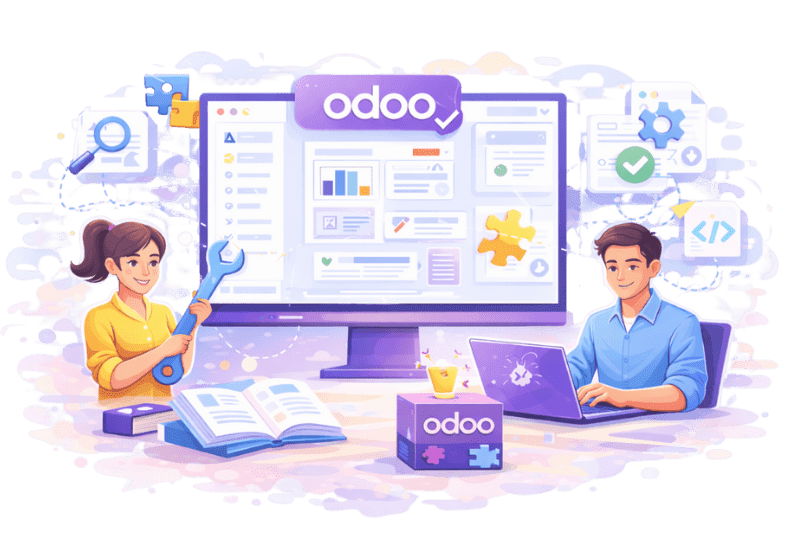
As an Odoo Expert specializing in complex shipping and API integrations, Vraja Technologies delivers bespoke Odoo modules and customisations that drive efficiency and competitive advantage.
Adapt these three columns to fit your design need. To duplicate, delete or move columns, select the column and use the top icons to perform your action.
Deep Integration & API Customization (Vraja's Niche)
Our experts connect the carrier APIs to your Odoo ERP and configure it to your unique workflows
Odoo UI/UX and Dashboard Customization
We provide comprehensive testing, user training, & launch the module. Post-launch, you get dedicated support for smooth operation.
E-commerce & Website Customization
We provide comprehensive testing, user training, & launch the module. Post-launch, you get dedicated support for smooth operation.
Why Customize Your Odoo ERP?
Customizing your Odoo system provides critical benefits that generic software cannot match.
Tailor to Unique Business Processes
No ERP fits every business perfectly. We mold Odoo to match the unique workflows, systems, and procedures that set your business apart, ensuring a perfect fit, not a compromise.
Enhanced Efficiency & Profitability
Custom features are designed specifically to eliminate bottlenecks, reduce manual data entry, and streamline operations, translating directly to higher productivity and profitability.
Future-Proof Flexibility
Our customized solutions are built with scalability in mind, giving you greater control and ensuring your Odoo system remains agile as your business grows and evolves.
Cost-Effective Long-Term Solution
While customization involves an initial investment, the long-term benefits – like improved processes, higher efficiency, and reduced manual work – translate into significant savings for your business.
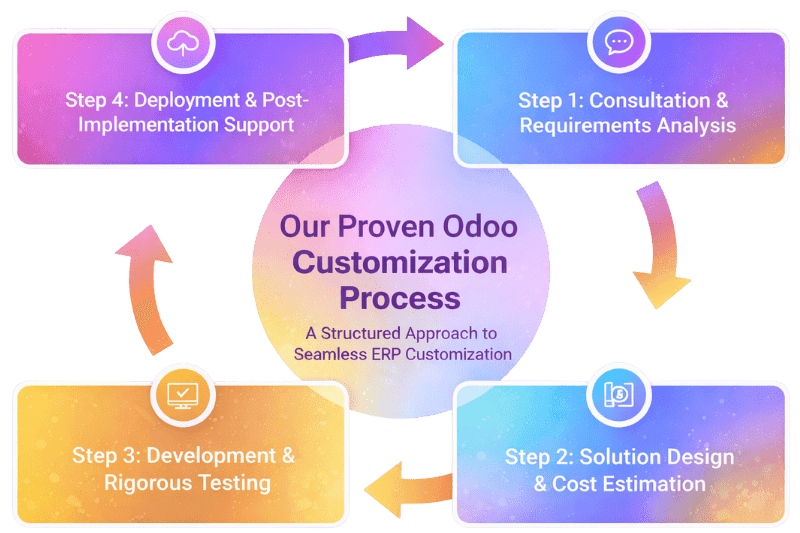
Our Proven Odoo Customization Process
Our experts follow a standardized methodology to ensure quality, transparency, and a successful deployment.
Step 1: Consultation & Requirements Analysis: In-depth feasibility study and detailed requirement gathering to fully understand your unique challenges, objectives, and desired functionalities.
Step 2: Solution Design & Cost Estimation: Our team designs the optimal custom module or integration architecture and provides a transparent cost estimate and delivery plan.
Step 3: Development & Rigorous Testing: Utilizing best practices, our certified Odoo developers implement the custom code, followed by comprehensive Unit, Functional, and User Acceptance Testing (UAT).
Step 4: Deployment & Post-Implementation Support: We manage the smooth, low-impact deployment to your live environment and provide continuous support and maintenance service
Unlike generalists, we have proven, specialized expertise in complex logistics, shipping carrier integrations, and critical third-party API connectivity– essential for modern commerce.
Our team comprises highly skilled and certified Odoo developers dedicated to delivering excellence, high-quality code, and maintainable, scalable solutions.
From initial consultancy to migration, training, and ongoing technical support, we are your “lighthouse” through every stage of your Odoo journey, ensuring your system remains up and running 24/7.
Know Before You Decide
Frequently Asked Questions
How much does it cost to customize Odoo?
Odoo customization costs vary significantly based on scope and complexity.Vraja Technologies provides transparent fixed-scope quotes after a free discovery call, with no hidden charges.
Is Odoo customization expensive?
Odoo customization is cost-effective relative to the business value it delivers. The key comparison is not the upfront cost vs zero, but the cost vs the ongoing losses from manual workarounds, inefficient processes, and generic ERP compromises. A $2,000 customization that saves a 5-person team 2 hours daily pays for itself in under 3 months. Vraja Technologies structures projects to deliver the highest-impact customizations first, ensuring fast ROI even on modest budgets.
What is the difference between Odoo Studio and custom module development?
Odoo Studio generates configuration stored in the database — it is faster to deploy but harder to migrate, version-control, or maintain across upgrades. Custom module development produces Python and XML files that live in your codebase, are version-controlled with Git, and follow Odoo’s standard upgrade path. For long-term, scalable Odoo systems, custom modules are the more robust foundation. Vraja Technologies builds all custom work as proper modules following Odoo’s best practices, ensuring upgrade-readiness and maintainability.
What are the most useful Odoo customizations for growing businesses?
The highest-ROI Odoo customizations across industries are: (1) Custom approval workflows — replacing email chains with automated, traceable approvals in Sales, Purchase, or HR; (2) Automated document generation — custom PDF quotations, invoices, and packing slips branded to your business; (3) Custom dashboards and KPI reporting — real-time visibility into the metrics that matter to your team; (4) Third-party integrations — connecting Odoo with your CRM, e-commerce platform, shipping carriers, or payment gateways; (5) Industry-specific module extensions — custom fields, views, and logic tailored to your sector’s workflows. Vraja Technologies has delivered all of these for clients across manufacturing, logistics, and e-commerce.
What are the best Odoo customizations for e-commerce businesses?
E-commerce businesses get the most value from these Odoo customizations: custom product configurator logic for complex SKUs, automated B2B pricing rules and customer-specific pricelists, real-time inventory sync between Odoo and Shopify or Magento, custom order status tracking portals for customers, automated fulfillment and shipping label generation, and tailored invoice and packing slip templates. Vraja Technologies specializes in Odoo e-commerce integrations that create a seamless data flow from online order to warehouse fulfillment.
What Odoo customizations do manufacturing companies typically need?
Manufacturing companies most commonly require: custom Bill of Materials (BoM) workflows, advanced production routing and work centre scheduling, custom quality control checkpoints in manufacturing orders, integration with MES (Manufacturing Execution Systems) or PLM tools, custom costing models for standard vs actual cost accounting, and real-time shop floor dashboards. Vraja Technologies has experience configuring and customizing Odoo Manufacturing (MRP) for discrete and process manufacturing environments.
Does Odoo customization affect future upgrades?
Poorly written customizations can break during Odoo version upgrades — this is one of the biggest risks in DIY or low-quality development. Vraja Technologies follows Odoo’s official development guidelines and module structure to ensure all custom code is upgrade-safe. We use inheritance patterns instead of core overrides, maintain separate custom module namespaces, and provide upgrade impact assessments before major version migrations. Our clients regularly upgrade from Odoo 14 to 16 to 17 without losing their customizations.
Who maintains custom Odoo modules after development is complete?
Custom modules require ongoing maintenance for bug fixes, compatibility updates with Odoo point releases, and enhancements as business needs evolve. Vraja Technologies provides structured post-development support through AMC (Annual Maintenance Contract) packages that cover: bug resolution with SLA response times, minor feature enhancements per month, compatibility testing after Odoo updates, and dedicated support channels. Without a maintenance contract, custom modules can degrade or break silently as the underlying Odoo platform evolves.
Can Vraja Technologies take over maintenance of custom modules built by another developer?
Yes. Vraja Technologies offers custom module takeover services. Our process is: (1) Code audit — we review the existing module for quality, security issues, and technical debt; (2) Documentation — we map the module’s logic and business rules; (3) Test suite creation — we build a regression test suite before making any changes; and (4) Ongoing maintenance — we assume responsibility for bug fixes and enhancements under a defined SLA. We handle takeovers from freelancers, previous agencies, and in-house development teams.
How long does Odoo customization take?
Customization timelines depend on complexity: Simple UI changes (adding fields, modifying views, basic automations) take 1–5 business days. A single custom module with defined business logic takes 2–6 weeks. A full custom module suite with reporting and workflow automation takes 6–16 weeks. A complex third-party API or shipping carrier integration (FedEx, UPS, EDI) takes 4–12 weeks, including API testing and UAT. Vraja Technologies provides a detailed timeline in the Solution Design deliverable at the start of every project.
Is Odoo Studio worth it?
Odoo Studio is worth it when your customization needs are primarily UI-focused — adding fields, adjusting views, building simple dashboards, or creating basic automated emails. It is not worth relying on Studio alone if you need API integrations, complex workflow automation, or custom reporting with multi-model aggregations. For most growing businesses, Studio handles 20–30% of customization needs, and professional development handles the rest. Vraja Technologies helps clients identify which needs Studio can resolve vs which require developer investment.
Certified Odoo Partner
Odoo Customization Services: Custom Modules, Workflows and API Integrations
Customize Odoo with code only when configuration, Odoo Studio or an existing app cannot do the job. Our Odoo customization services cover that code: installable modules that extend standard Odoo through inheritance, so they can be carried through version upgrades, plus integrations with carriers, EDI partners and ecommerce platforms.
This page is for operations heads, CTOs and IT managers who run Odoo or are about to, and need to know what to build, what to configure instead, how long it takes and what it costs. Vraja Technologies is a Certified Odoo Partner based in Rajkot, India, working with businesses worldwide.
Do You Need Odoo Customization, or Will Standard Odoo Do?
Most Odoo needs fall into one of five situations, and only some of them call for custom code. Match yours in the table below.
Your situation
Best route
Watch out for
Add a field, change a form layout or send an automatic email
Configuration or Odoo Studio
Studio needs Odoo Enterprise on the Custom plan
Logic across several models, new document types, approval chains with rules
Custom module
Runs on Odoo.sh or on-premise, not on Odoo Online
Exchange orders, labels, stock or documents with a carrier, marketplace or EDI partner
Existing connector, or a custom API integration
Check the Odoo Apps Store first and customize only the gap
Standard Odoo has the feature but your team works differently
Adjust the process first
Every custom module is code you maintain through each upgrade
A custom module broke after an upgrade, or its developer left
Module takeover and upgrade
Needs a code audit before anything changes
Definition
What Is Odoo Customization?
Odoo customization is any change that makes Odoo behave differently from its standard apps, from a new field on a form to a custom module that connects Odoo to a carrier’s API. There are four levels, and cost and upgrade effort rise with each one.
Level
What changes
Who does it
Where it lives
1Configuration
Settings and options Odoo already offers
Functional consultant or admin
Database settings
2Odoo Studio
Fields, views, automations and simple reports, built without code
Trained admin or consultant
Database
3Custom module
New models, business rules, reports and views written in Python and XML
Odoo developer
Git repository
4Integration or connector
Code that exchanges data with an outside system through its API
Odoo developer with API experience
Git repository, plus the outside system
Studio is a paid feature. Odoo’s Studio documentation states that installing it on the Standard pricing plan triggers an upgrade to the Custom plan. Studio changes live in the database rather than in a Git repository, so they are harder to review and to move between a test copy and production than code is.
Custom modules also need a hosting option that accepts them. Odoo’s documentation says Odoo Online is not compatible with non-standard apps, so custom modules run on Odoo.sh or on-premise.
What We Build
Which Odoo Customization Services Do We Provide?
We build five kinds of customization, and all of it is delivered as versioned code in installable modules.
Custom Odoo Module and App Development
New models, views, access rules, wizards, server actions and business logic, written in Python and XML, with Odoo’s OWL framework for front-end behavior. Typical builds are approval chains for Sales, Purchase or HR, commission and pricing rules, extra production steps and customer portal pages.
API and Third-Party Integration
Connectors between Odoo and the systems around it. Our public Clutch and GoodFirms profiles list shipping carriers (UPS, FedEx, DHL, GLS and DPD), EDI over ANSI X12 and EDIFACT, ecommerce platforms and payment gateways. Our packaged connectors are described under shipping carrier integrations.
Reports, Documents and Dashboards
Branded PDF quotations, invoices, packing slips and delivery slips, plus KPI dashboards that aggregate across models, so managers see live numbers instead of exported spreadsheets.
Workflow, UI and Portal Customization
Custom views and status bars, approval steps, automated actions, email templates and customer portals that show order or ticket status without a phone call to your team.
eCommerce and Website Customization
Changes to Odoo Website and eCommerce: shipping rates shown at checkout, customer-specific pricelists, product configurator logic for complex SKUs, and inventory sync with stores such as Shopify or Magento.
Upgrade-Safe by Design
How Do We Customize Odoo Without Breaking Future Upgrades?
We extend standard Odoo instead of editing it, which keeps customizations separate from core code and gives each upgrade a defined path. Models are extended with Odoo’s inheritance, views are changed with XPath inheritance, and each client’s code sits in its own module namespace under Git, with no edits to Odoo’s core files.
Upgrades still take work. If your database contains custom modules, Odoo requires their source code to be updated for the target version first, and the module update has to succeed for the upgrade to finish. Odoo’s upgrade platform handles standard data and code, not your modules. That is why we run an upgrade impact assessment before any major version migration.
Odoo supports its three latest major versions. With Odoo 20 released on September 24, 2026, those are 18, 19 and 20, and Odoo’s support table lists 17 as reaching its planned end of support in October 2026. If you run 17 or earlier and have custom modules, budget module upgrades into the move. Our Odoo migration service covers the database and the code together.
How We Work
What Is Our Odoo Customization Process?
Every project follows six steps, and the second one can end with the advice not to customize at all.
01
Scope the requirement
A free discovery call and feasibility check document the problem, the users and the systems involved.
02
Design the solution
We choose between configuration, Studio, an existing app and custom code, then issue a Solution Design with the architecture, a fixed-scope estimate and a delivery timeline.
03
Build the module
Certified Odoo developers write the code as an installable module under Git, using inheritance rather than core overrides.
04
Test the result
Unit, functional and user acceptance testing (UAT) run before go-live, with your team signing off in UAT.
05
Deploy to production
We release into your live environment with a low-impact deployment plan.
06
Support the module
Post-launch fixes and updates continue, under an Annual Maintenance Contract if you want defined response times.
Timelines
How Long Does Odoo Customization Take?
A simple view or field change takes 1 to 5 business days, a single custom module takes 2 to 6 weeks, and a complex carrier or EDI integration takes 4 to 12 weeks.
Scope
04 wks8 wks12 wks16 wks
Typical
Simple UI changes
Add fields, modify views, basic automations
1–5 business days
Single custom module
One module with defined business logic
2–6 weeks
Full module suite
Several modules with reporting and workflow automation
6–16 weeks
Third-party API or carrier integration
FedEx, UPS or EDI connection, including API testing and UAT
4–12 weeks
Four things stretch these ranges:
1Requirements that change after design sign-off
2Delays in getting a carrier’s or partner’s sandbox credentials
3Data that must be migrated or cleaned first
4Changes requested after UAT has started
The Solution Design from step 2 gives the timeline for your project specifically.
Pricing Guide
How Much Does Odoo Customization Cost?
Published 2026 market ranges run from about $500 for a field or view change to $25,000 or more for multi-module work, and most single-module projects land between $3,000 and $25,000. Ranges differ by source, so treat them as a budgeting guide, not a quote.
Scope
Typical market range (USD)
Typical timeline
Simple changes: fields, views, basic automation
$500–$2,000
Days
Mid-scope: workflow automation, dashboards, basic API integration
Hourly rates quoted in 2026 guides run about $25 to $60 for offshore teams in India and Eastern Europe, and $100 to $200 or more for US-based partners. Price is driven by the number of outside systems you connect, the number of models and user roles involved, the volume of data to migrate, how many reports you need, and how deep the testing goes.
We quote fixed-scope after the discovery call, so the number you approve is tied to a written scope. To check whether a build is worth it, use this formula: payback in months equals build cost divided by hours saved per month times loaded hourly cost. A $2,000 build that saves each of five people 2 hours a day (about 210 hours a month) pays back in roughly one month at a $10 loaded hourly cost.
Quick Wins
Which Odoo Customizations Deliver the Fastest Payback?
Approval workflows, branded documents, dashboards, integrations and industry-specific fields usually pay back fastest, because each removes work that people repeat every day. What that looks like depends on the industry.
Ecommerce and retail
Product configurator logic for complex SKUs
B2B pricing rules and customer-specific pricelists
Inventory sync between Odoo and Shopify or Magento
Custom modules need maintenance after launch, and we offer it through an Annual Maintenance Contract (AMC) with defined response times. An AMC covers:
✓Bug fixes with SLA response times
✓A set of minor enhancements each month
✓Compatibility testing after Odoo updates
✓A dedicated support channel
Without maintenance, a module can fail quietly when Odoo changes underneath it. Details are on our Odoo support page.
Can We Take Over Modules Another Developer Built?
Yes. A takeover runs in four steps:
1A code audit for quality, security and technical debt
2Documentation of the module’s logic and business rules
3A regression test suite built before any change is made
4Ongoing maintenance under a defined SLA
We take over modules from freelancers, agencies and in-house teams.
Straight Answers
When Is Custom Odoo Development Not the Right Choice?
Custom code is the wrong answer more often than vendors admit. Skip it in these cases:
Standard Odoo already covers the requirement and only your habits differ.Change the habit and keep the upgrade path clean.
You plan to stay on Odoo Online.Custom modules cannot run there, so Studio is your main tool.
You need a one-time report or export.A functional consultant can build it in Studio or with Odoo’s own tools for less than a module costs.
Your requirements still change every week.Pay for discovery first, through our Odoo consultancy, and build once the process settles.
You need staff on site at your location.Our team is based in Rajkot, India, and most client work runs remotely, so raise this before scoping.
Why Vraja
Why Work With Vraja Technologies for Odoo Customization?
Vraja Technologies is a Certified Odoo Partner in Rajkot, India, that builds Odoo modules, shipping and EDI integrations and ecommerce connectors for businesses worldwide. Here is what clients typically look for, and what we provide:
01
Integration depth
Carrier modules and connectors published on the Odoo Apps Store, and custom API work for UPS, FedEx, DHL, GLS and DPD.
02
Independent reviews
Client reviews on Clutch and GoodFirms cover a DPD France carrier module, GLS Freight label debugging for another Odoo partner, and an API connector for a rug manufacturer. More work is in our case studies.
03
Upgrade-safe builds
Inheritance patterns, separate module namespaces and an upgrade impact assessment before major migrations.
04
Defined support
An AMC with SLA response times for bug fixes and compatibility testing.
05
Takeover capability
Modules built by others are audited, documented and covered by a regression test suite before we change them.
06
Written estimates
A Solution Design with a fixed-scope estimate and timeline after a free discovery call.
Send us your requirement and we will tell you whether it needs custom code, Studio or an existing app.
Configuration vs customization, Studio, Odoo Online, upgrades and quoting.
What is the difference between Odoo configuration and Odoo customization?
Configuration uses options Odoo already provides, such as settings, user rights and pricelists. Customization changes behavior beyond those options, through Odoo Studio or code. Configuration migrates with Odoo’s standard upgrade, while every customization adds something that must be retested.
Does Odoo customization affect future upgrades?
Yes, and how much depends on how it was built. Code that extends Odoo through inheritance and stays out of core files is easier to carry forward, but Odoo still requires custom modules to be updated for the target version before a database upgrade can complete. Ask for an upgrade impact assessment before any major version move.
Can I customize Odoo Online?
You can configure it and, on a plan that includes Studio, adjust it with Studio. Custom modules cannot run there, because Odoo’s documentation states that Odoo Online is not compatible with non-standard apps. For custom code, host on Odoo.sh or on-premise.
Is Odoo Studio worth it?
Studio is worth it for fields, views, simple automations and basic reports built by a trained admin. It is the wrong tool for API integrations, logic that spans several models, or anything you want in version control. A sensible split is Studio for light edits and modules for the rest.
Do I need Odoo Enterprise to customize Odoo?
No. Odoo Community can be extended with custom modules. Studio is the part that requires Enterprise, and Odoo’s documentation says installing it on the Standard pricing plan triggers an upgrade to the Custom plan.
Should I customize Odoo before or after upgrading to a newer version?
Build on the version you will run in production. If a move to a newer version is planned within the next year, upgrade first or build against the target version, so you do not pay to port the module twice. Odoo supports its three latest major versions, which are now 18, 19 and 20.
What technology is used to build custom Odoo modules?
Server logic is written in Python, views and data in XML, and front-end behavior in JavaScript with Odoo’s OWL framework, on a PostgreSQL database. Our modules follow Odoo’s official module structure and development guidelines.
What should I prepare to get an accurate quote?
Send a short description of the process you want to change, who uses it, sample data or screenshots, your Odoo version and hosting type, and API documentation for any outside system involved. With that, we return a Solution Design with a fixed-scope estimate after the discovery call.
Can you customize an app I bought from the Odoo Apps Store?
For apps published by Vraja Technologies, yes: write to support@vrajatechnologies.com or request a demo, and extra features are quoted as custom work rather than included in the app price. For other publishers’ apps, check the license first.