







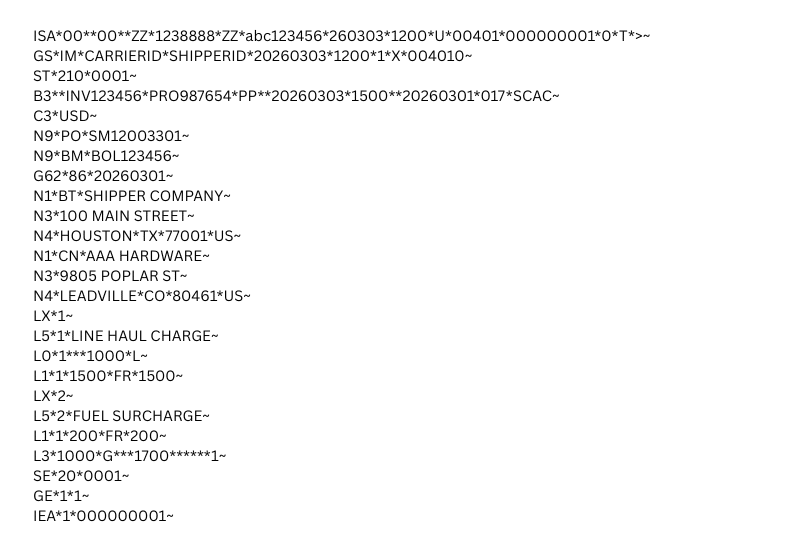
What is an EDI 210?
EDI 210 (Motor Carrier Freight Details and Invoice) is a transportation EDI transaction used by carriers to electronically send freight invoices to shippers, brokers, 3PLs, or consignees after shipment delivery. It communicates detailed billing information related to transportation services, including freight charges, surcharges, shipment references, and payment terms.
EDI 210 replaces traditional paper, email, or fax freight invoices with a standardized electronic document based on ANSI X12 formats. It is typically sent once a shipment is completed and serves as the official request for payment of transportation charges. Within the transportation EDI workflow, EDI 210 follows shipment execution and status updates (EDI 214) and enables automated freight billing and reconciliation.
Key Components of EDI 210
An EDI 210 contains structured freight invoice data that allows ERP or accounting systems to automatically process carrier charges.
Invoice Identification
- Invoice number and date
- Bill of Lading (BOL) or PRO number
- Shipment or load references
Parties Information
- Carrier (SCAC) details
- Shipper and consignee information
- Bill-to party
Delivery and Proof
- Delivery date and time
- Proof of delivery or tracking references
Shipment Details
- Pickup and delivery locations
- Shipment weight, quantity, and equipment
- Shipping method and route
Payment Terms
- Total amount due
- Currency
- Payment conditions and remittance details
Freight Charges
- Line-haul charges
- Fuel surcharge
- Accessorial fees (liftgate, detention, etc.)
- Taxes and surcharges
These standardized elements allow automated matching of freight invoices to shipments and contracts.
EDI 210 operates within the transportation billing cycle between carriers and shippers.
Step 1 – Load Tender (EDI 204)
The shipper or broker sends shipment details to the carrier.
Step 2 – Shipment Execution & Status (EDI 214)
The carrier transports the goods and sends status updates.
Step 3 – Delivery Completion
Shipment is delivered and proof of delivery is recorded.
Step 4 – Freight Invoice (EDI 210)
The carrier sends the EDI 210 with final charges and payment terms.
Step 5 – Invoice Acknowledgment (EDI 997)
The shipper confirms receipt of the invoice.
Step 6 – Payment Processing
ERP/accounting systems validate and schedule payment automatically.
EDI 210 ensures that freight billing is directly linked to shipment execution data for accurate reconciliation.
Benefits of Using EDI 210
Faster Freight Invoicing
Carriers send EDI invoices immediately after load delivery.
Automated Invoice Processing
ERP systems can automatically capture and post charges.
Reduced Billing Errors
Standardized data eliminates manual entry mistakes.
Improved Dispute Resolution
The detailed charge breakdown simplifies your validation.
Accelerated Payment Cycles
Electronic invoices shorten approval and payment time.
Better Financial Visibility
Organizations gain clear insight into freight costs and liabilities.
EDI 210 Integration with Odoo by Vraja Technologies
- Automatic import of carrier EDI 210 invoices into Odoo
- Mapping of freight charges to shipments or deliveries
- Validation against EDI 204 and EDI 214 data
- Automated posting to accounting and landed costs
- Multi-carrier and 3PL connectivity
- End-to-end transportation EDI automation
- Native Odoo integration architecture
- Automated freight invoice capture
- Shipment-to-invoice matching
- Partner-specific EDI mapping and compliance
- Real-time transportation cost visibility
- Implementation, testing, and onboarding support
Vraja Technologies helps organizations transform Odoo into a fully connected transportation and financial EDI platform, ensuring accurate and automated freight billing across the supply chain