




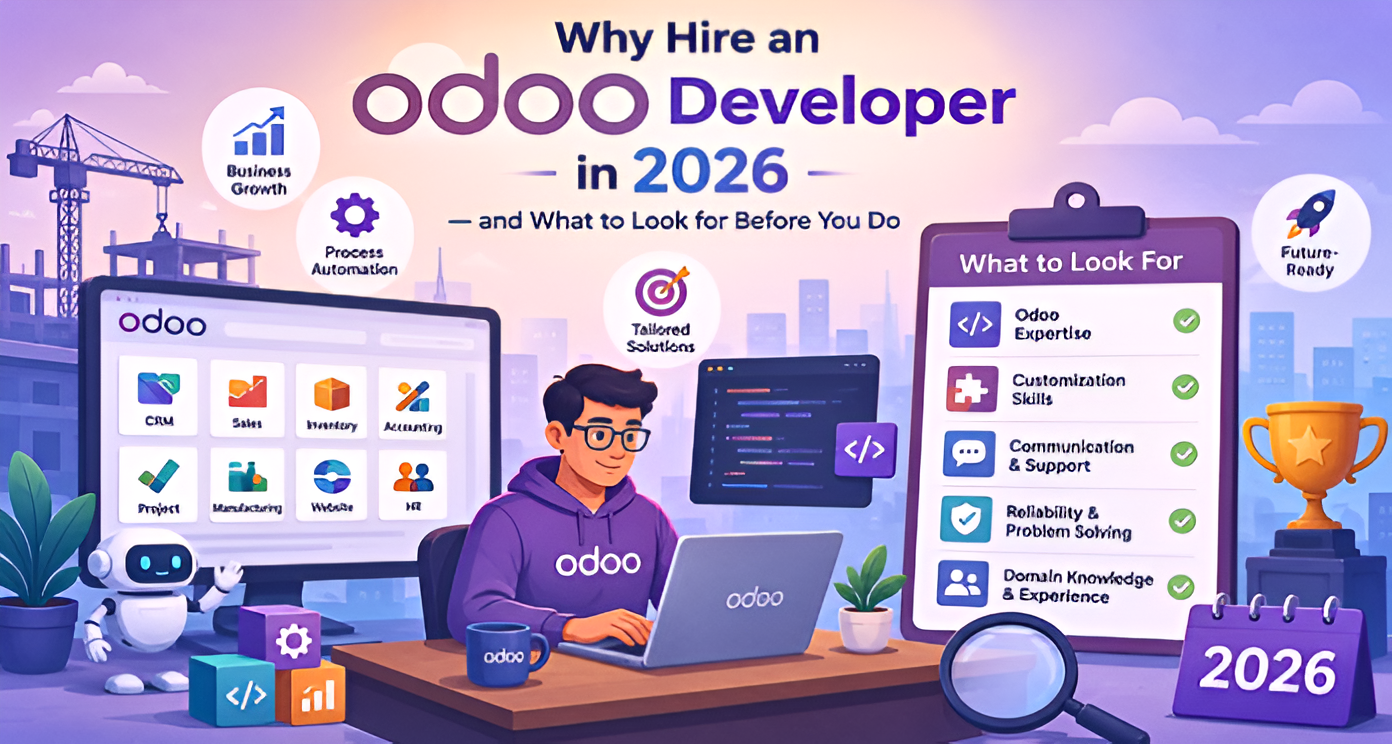
Why Hire an Odoo Developer in 2026 — and What to Look for Before You Do
In 2026, Odoo is more powerful than ever – Odoo 17 is widely deployed, Odoo 18 is live, and Odoo 20 is already generating buzz. More power means more ways to get implementation wrong. This guide cuts through the noise and tells you exactly why hiring a skilled Odoo developer matters, what to look for, and what red flags to avoid.
Why 2026 Is the Year to Finally Get Odoo Right
Odoo has matured dramatically. The platform now covers end-to-end business operations – and the gap between a basic install and a properly implemented system is wider than ever.
Businesses that invested in proper Odoo implementation 2–3 years ago are already compounding those gains: cleaner data, automated workflows, fewer headcount. Businesses that didn’t? They’re still switching between spreadsheets and three different SaaS tools.
💡 The Real Cost of Waiting
Every month your operations run on disconnected tools costs you in manual data entry, delayed decisions, and missed revenue. Hiring an Odoo developer isn’t an expense – it’s a compounding investment.
What Does an Odoo Developer Actually Do?
There’s a lot of confusion here. “Developer” doesn’t just mean someone who writes Python code. A good Odoo developer (or team) typically covers:
- Odoo Implementation- Setting up modules, configuring workflows, migrating your existing data
- Odoo Customization- Building features Odoo doesn’t have out-of-the-box for your specific business logic
- Third-Party Integrations- Connecting Odoo with your eCommerce store, shipping carriers, EDI systems, payment gateways
- Odoo Migration- Moving from an older version (e.g., Odoo 15 → 17 or 18) without data loss
- Ongoing Odoo Support- Bug fixes, performance tuning, new feature rollouts as your business grows
- Odoo Consultancy- Advising on which modules to use, how to structure processes, what not to over-engineer
Many businesses start thinking they just need “a quick customisation” – and quickly realise they need all of the above. That’s why working with a certified Odoo partner beats hiring a one-person freelancer for anything beyond a minor tweak.
7 Real Reasons Businesses Hire an Odoo Developer in 2026
1. Your Business Has Outgrown Off-the-Shelf Odoo
The default Odoo setup works for simple businesses. Once you have custom pricing rules, multi-warehouse logic, carrier-specific shipping automation, or complex B2B workflows – you need a developer who can write custom Odoo modules and extend existing ones without breaking core functionality.
2. You're Connecting Odoo to Other Systems
Need Odoo to talk to Shopify, Amazon, QuickBooks, ShipStation, FedEx, or your 3PL? These integrations require API knowledge, error handling, and data mapping expertise. Odoo integration done badly results in duplicate orders, lost inventory records, and accounting nightmares
3. You're Migrating from an Older ERP
Migrating from SAP, QuickBooks, Tally, or an older Odoo version? Data migration is the most underestimated part of any ERP project. A specialist Odoo developer will map your data correctly, validate it, and ensure nothing critical gets lost in translation.
4. You Want to Automate Manual Processes
If your team is manually copying data between systems, generating reports by hand, or approving orders one by one – an Odoo developer can build automated workflows, scheduled actions, and approval flows that eliminate hours of repetitive work per week.
5. Your Implementation Went Wrong
This one is more common than people admit. A rushed or poorly scoped Odoo implementation often leaves businesses with a system that technically works but doesn’t match how the business operates. A skilled developer can audit, fix, and rebuild the parts that are causing pain.
6. You Need Odoo-Specific App Development
Sometimes the Odoo App Store has exactly what you need. Sometimes it doesn’t. Custom Odoo app development – built specifically for your industry or workflow – is a niche skill that generic developers simply don’t have.
7. You're Scaling Internationally
Multi-currency, multi-language, multi-company Odoo setups are complex. Businesses expanding to the US, UK, Europe, or Middle East need developers who understand localisation, tax compliance, and entity structures – not just the technical side.
“The right Odoo developer doesn’t just build what you ask for – they tell you what you should be asking for.”
Freelancer vs. Odoo Development Company - Honest Comparison
This is a question we get asked constantly. Here’s an honest breakdown:
| Factor | Freelancer | Odoo Development Company |
|---|---|---|
| Cost | Lower upfront | Slightly higher, more value |
| Availability | Inconsistent | Dedicated hours / SLA |
| Full-stack coverage | Usually 1 skill set | Dev + Functional + QA |
| Knowledge transfer risk | High (if they leave) | Low — team-based delivery |
| Complex projects | Often under-scoped | Proper project management |
| Post-launch support | Unreliable | Structured support plans |
| Certified Odoo Partner | Rarely | Yes (with verified track record) |
What to Look For Before You Hire an Odoo Developer
Not all Odoo developers are created equal. Before signing any contract, verify these:
- Real case studies- Not testimonials alone. Actual before/after examples of businesses they’ve helped, with specific outcomes.
- Industry experience- An Odoo developer who’s worked in eCommerce won’t automatically understand 3PL logistics or construction workflows. Relevant industry experience matters.
- Technical + functional capability- You need someone who understands both the code AND the business process. Pure developers often miss workflow design; pure consultants can’t build.
- Version expertise- Make sure they work with the Odoo version you’re on or targeting (Odoo 16, 17, 18).
- Support model after go-live- What happens when something breaks at 9pm? Ask upfront.
- Transparent communication- Weekly updates, clear timelines, documented requirements. If a developer can’t articulate their process, run.
How AI Is Changing Odoo Development in 2026 - And Why It Makes a Good Developer Even More Valuable
There’s a question we hear more often now: “Can’t AI just build this for us?” It’s a fair question. And the honest answer is – AI has genuinely made parts of Odoo development faster. But it’s made the developer’s role more important, not less. Here’s why.
1. AI-Powered Workflow Automation - Done Right
Odoo already has powerful automation tools – scheduled actions, server actions, approval flows. In 2026, skilled Odoo developers are layering AI on top of these to build workflows that don’t just automate steps, they make decisions.
- Smart reorder rules- AI analyses sales velocity and lead times to trigger purchase orders automatically, without manual review
- Intelligent invoice matching- AI flags discrepancies between POs, receipts and vendor bills before they become accounting errors
- Automated lead scoring in CRM- AI ranks incoming leads by conversion likelihood so your sales team focuses on the right ones
- Predictive maintenance triggers- for manufacturing clients, AI-driven scheduling actions flag equipment issues before downtime happens
These aren’t hypothetical. They’re being built and deployed right now — but only by developers who understand both the Odoo data model and how to integrate external AI APIs or use Odoo’s native automation framework correctly.
2. Odoo Website Design - Built in Days, Not Weeks
The Odoo Website Builder has always been capable. What’s changed in 2026 is how fast a skilled developer can deliver a polished, conversion-optimised Odoo website when they’re using AI-assisted tools in their workflow.
What this means for you as a business: shorter feedback cycles. Instead of waiting 3 weeks to see a first draft, you’re reviewing a working prototype in days and spending your time on decisions that actually matter – content, products, customer journey — not waiting for a developer to push code.
AI tools help developers generate boilerplate QWeb templates, suggest responsive CSS, and even write initial JavaScript for custom interactions. But the developer still decides the architecture, ensures Odoo compatibility, and makes sure the website integrates cleanly with your inventory, pricing, and customer data.
3. Faster Project Completion - What AI Actually Speeds Up
Let’s be specific, because “AI makes development faster” is vague. Here’s exactly where AI cuts time in a real Odoo project:
⚡ Module Scaffolding & Boilerplate
Setting up a new custom Odoo module used to take hours of writing repetitive manifest files, model definitions, and view structures. AI-assisted coding tools now generate accurate scaffolding in minutes – freeing developers to focus on the actual business logic.
🔍 Code Review & Bug Detection
AI tools can scan custom module code for common Odoo anti-patterns, deprecated method calls, and security vulnerabilities before they reach production. This means fewer post-launch bugs and faster QA cycles.
📄 Technical Documentation
Good documentation is often the first thing cut when projects run long. AI-assisted documentation tools mean developers can generate accurate, readable technical docs as they build – so your team actually knows how to use what was built.
🔗API Integration Mapping
Integrating Odoo with third-party APIs – shipping carriers, payment gateways, eCommerce platforms — involves a lot of field mapping and data transformation. AI tools now assist with generating the initial mapping layer, cutting integration time by 30–40%.
How Vraja Technologies Approaches This Differently
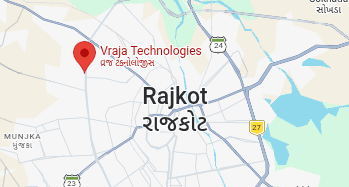
We’re a certified Odoo partner based in Rajkot, India – serving clients across the USA, UK, and Europe. Here’s what makes our approach different:
- No outsourcing.Every developer on your project is in-house. You get the same team from kickoff to go-live to ongoing support.
- Industry-specific experience.We work deeply in eCommerce, logistics & 3PL, wholesale, agriculture, and construction – not generic ERP across every industry.
- Odoo App Store presence.We’ve built and published apps on the official Odoo App Store, which means our code meets Odoo’s quality standards – not just ours.
- Flexible hiring models.Need a developer for 10 hours this month? Or a full-time dedicated resource? We offer hourly ($30/hr) and monthly plans (80 hrs @ $2,200/month, 160 hrs @ $4,500/month).
- Transparent project management.Clear timelines, weekly updates, documented scope. No surprises.
- Post-launch support.We’re not done at go-live. We offer structured Odoo support for the long haul.
Real clients. Real results. From ShipStation integrations and Swiss Post API modules to full Odoo ERP rollouts for logistics firms across Europe – you can read the full stories in our case studies.
Ready to Hire an Odoo Developer You Can Actually Trust?
Vraja Technologies is a certified Odoo partner with 20+ in-house developers, real case studies across USA, UK & Europe, and flexible hiring plans that match your budget.
FAQs:
How much does it cost to hire an Odoo developer in 2026?
Odoo developer rates range from $25–$85/hour depending on location, experience, and whether you hire a freelancer or a certified partner. Vraja Technologies offers transparent rates starting at $25/hour, with monthly plans for consistent workloads.
What is an Odoo certified partner?
An Odoo certified partner is a company officially recognised by Odoo S.A. for demonstrated expertise in implementing and customising Odoo ERP. Certified partners have passed technical exams and have a verified track record of successful projects.
How long does Odoo implementation take?
Basic Odoo implementation typically takes 2–6 weeks. Complex, multi-module implementations with integrations and data migration can take 2–4 months. Proper scoping at the start is the biggest factor in staying on timeline.
Can I hire an Odoo developer on a part-time or hourly basis?
Yes. Many certified Odoo partners, including Vraja Technologies, offer flexible hourly hiring for on-demand tasks and monthly plans for ongoing development needs.
What version of Odoo should I use in 2026?
Odoo 19 is the most widely implemented stable version in 2026. Odoo 20 is available for new projects. If you’re on Odoo 18 or 19, this is the right time to plan a migration to benefit from newer features and continued support.
Do I need a developer to use Odoo?
For basic setups in small businesses with simple workflows, Odoo’s built-in configuration tools may be enough. However, any business with custom processes, third-party integrations, or multi-company/multi-warehouse requirements will need a developer for proper implementation.
What industries does Odoo work best for?
Odoo works well across manufacturing, eCommerce & retail, wholesale & distribution, logistics & 3PL, construction, agriculture, and service businesses. The key is industry-specific configuration, not just a generic rollout.
Can AI replace an Odoo developer in 2026?
No. AI tools make Odoo developers faster and more efficient – but they can’t replace the business analysis, architectural decisions, and Odoo-specific expertise that make an implementation succeed. A developer using AI will deliver your project faster and at lower cost. AI without a developer will produce code that doesn’t match your actual business needs.
How does AI speed up Odoo development?
AI accelerates specific parts of Odoo development: module scaffolding, boilerplate code generation, API integration mapping, bug detection, and documentation. Tasks that previously took 6–8 hours can be completed in 3–4 hours. Over a full project, this reduces go-live time and overall cost without sacrificing quality.
Can AI automate workflows in Odoo?
Yes — when set up by an experienced Odoo developer. AI-assisted automation in Odoo covers smart reorder rules, intelligent invoice matching, lead scoring in CRM, and predictive scheduling actions. These require both Odoo expertise and knowledge of AI API integration to implement correctly.
How fast can an Odoo website be built in 2026?
With modern AI-assisted development tools, an experienced Odoo developer can deliver a first working prototype of an Odoo website in 2–3 days. A fully custom, production-ready Odoo website typically takes 2–4 weeks depending on complexity, integrations, and content.