





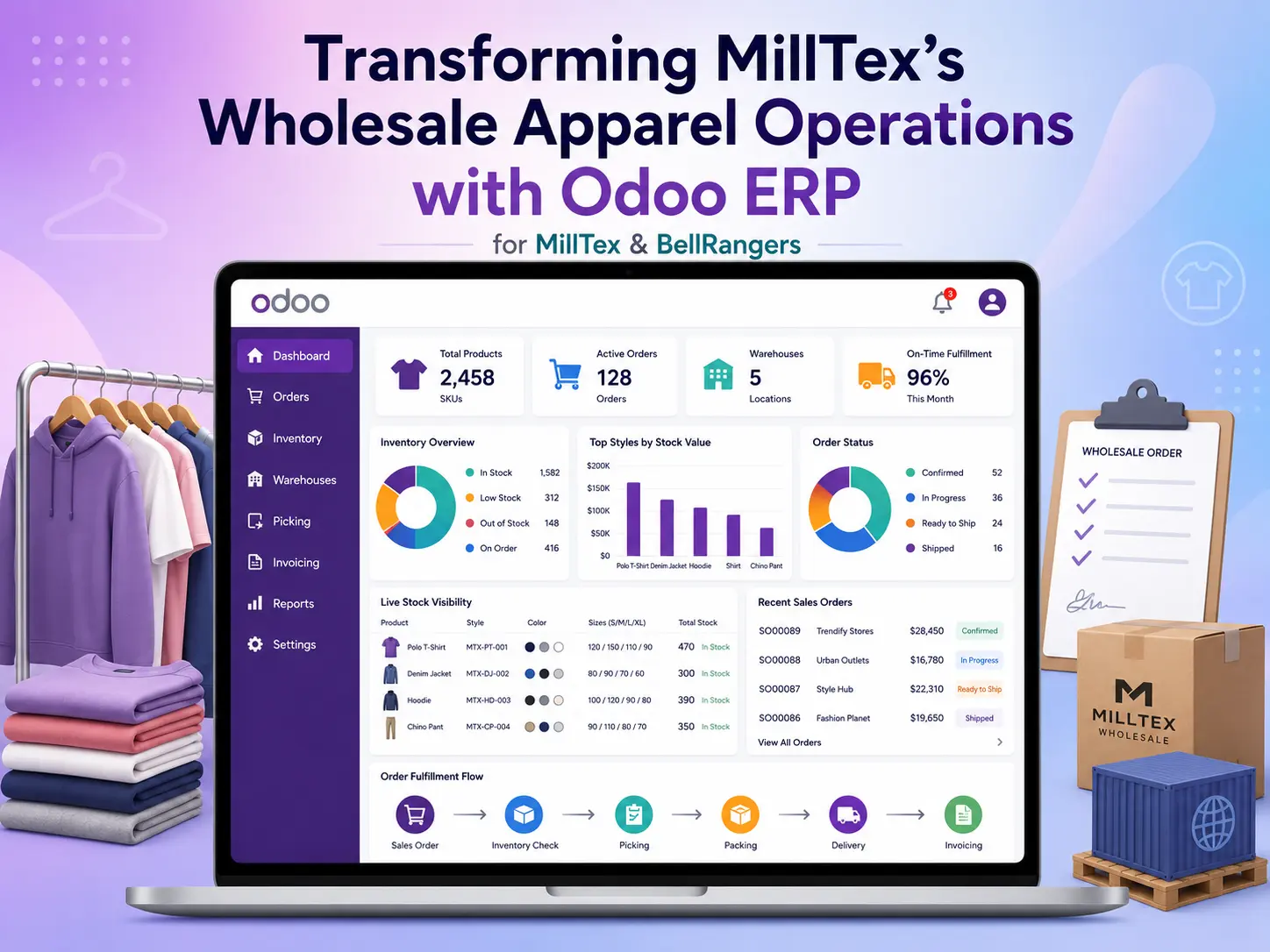
Transforming MillTex’s Wholesale Apparel Operations with Odoo ERP
How Vraja Technologies unified MillTex and BellRangers workflows, streamlined order fulfillment and logistics, and delivered real-time, variant-level inventory visibility to customers
Leading manufacturing and wholesale company MillTex was unable to effectively manage customer orders, inventory, and logistics due to a number of operational issues. The business needed to optimize the way it handled warehouse pick operations, produced commercial invoices, managed product inventory, and requested freight rates.
Milltex, a growing business in the textile industry, was facing increasing operational challenges as its order volume and logistics complexity expanded. Like many scaling companies, their existing processes—largely manual and disconnected—began to slow down efficiency and impact decision-making. To overcome these limitations, Milltex partnered with Vraja Technologies to implement a tailored Odoo ERP solution focused on automation, visibility, and long-term scalability.By implementing a customized Odoo ERP solution, Milltex was able to streamline logistics, automate key processes, and significantly improve operational efficiency.
Project Overview
MillTex is a manufacturing and wholesale apparel business managing a large product catalogue with multiple variations, including different sizes, colours, and styles.
As the company expanded its operations across MillTex and BellRangers, managing customer orders, warehouse activities, inventory availability, commercial documentation, and freight processes became increasingly complex.
The business needed more than a standard ERP implementation. It required a centralized and customized Odoo solution capable of supporting its complete operational workflow while also improving the experience offered to wholesale customers.
Vraja Technologies worked with the company to transform its Odoo environment into an integrated operational platform covering:
- Customer and sales order management
- Product and variant inventory
- Multi-warehouse stock visibility
- Warehouse picking and fulfilment
- Commercial invoice generation
- Freight-rate request management
- Customer-facing live inventory visibility
- Downloadable inventory reports
The result was a connected Odoo ecosystem that improved internal efficiency while giving customers faster and more accurate access to inventory information.
About the Client
MillTex operates in the manufacturing and wholesale apparel industry.
Its catalogue includes products with numerous combinations of size, colour, style, and other attributes. This makes inventory management significantly more complex than managing products with only one stock-keeping unit.
The company also manages operational workflows associated with MillTex and BellRangers. These workflows involve sales teams, warehouse employees, logistics staff, and wholesale customers.
As order volume and product complexity increased, the company needed a scalable system that could connect all these activities without relying heavily on manual coordination.
The Business Challenges
1. Disconnected Order and Operational Workflows
Customer orders, warehouse operations, inventory availability, shipping activities, and documentation were not managed through a sufficiently connected workflow.
Employees had to move between different processes and manually coordinate information between departments. This increased the risk of delays, data inconsistencies, and operational errors.
The business needed a centralized workflow in which every department could work from the same order and inventory information.
2. Complex Apparel Variant Management
A single apparel product could be available in multiple:
- Sizes
- Colours
- Styles
- Warehouses
- Stock quantities
Customers were not interested only in knowing whether a product template was available. They needed to know the exact availability of each product variant.
For example, showing that a particular shirt was available was not sufficient. Customers needed to see whether the required colour and size combination was currently in stock.
Managing and communicating this level of inventory detail manually was difficult and time-consuming.
3. Limited Real-Time Inventory Visibility
Wholesale customers regularly contacted the MillTex team to confirm stock availability before placing orders.
The sales team had to manually check Odoo and respond to questions such as:
- Is this product currently available?
- Which sizes are in stock?
- Which colours are available?
- How many units can be ordered?
- Is the product available in another warehouse?
These repeated enquiries consumed valuable employee time and slowed down the customer’s purchasing decision.
4. No Convenient Bulk Inventory Download
Wholesale customers often needed to review many products at the same time.
Checking products individually on the website was inefficient, especially for resellers and other business customers preparing larger orders.
The company required a downloadable inventory report that customers could use to review product and variant availability in bulk.
5. Inefficient Warehouse Picking Operations
Warehouse teams needed a more structured process for handling customer orders and preparing products for shipment.
Without an optimized picking workflow, employees could spend unnecessary time identifying products, confirming quantities, and coordinating order fulfilment.
This affected processing speed and increased the possibility of picking mistakes.
6. Manual Commercial Invoice Preparation
Commercial invoices are an important part of wholesale and logistics operations, particularly for shipments requiring detailed product and transaction information.
Preparing these documents manually created additional administrative work and increased the possibility of incorrect or inconsistent information.
MillTex needed commercial invoices to be generated using accurate information already available in Odoo.
7. Disconnected Freight-Rate Requests
Freight-rate enquiries were another important part of the order fulfilment process.
The logistics team needed a more efficient way to request and manage freight-rate information without moving order and shipment details between disconnected systems.
The objective was to make freight handling a natural part of the Odoo fulfilment workflow.
The Odoo Solution Delivered by Vraja Technologies
Vraja Technologies implemented and customized Odoo to connect MillTex’s sales, inventory, warehouse, website, and logistics operations.
Instead of treating each issue as an independent customization, the solution was designed as one connected operational workflow.
1. Centralized Sales and Order Management
Odoo became the central platform for managing customer and sales order information across the company’s operations.
Sales teams could manage customer details, ordered products, variant selections, quantities, prices, delivery information, and order status from one system.
This created a shared source of information for sales, warehouse, and logistics teams.
Once an order was confirmed, the required information could flow through the fulfilment process without repeatedly entering the same data.
2. Variant-Level Inventory Management
The inventory structure was configured to manage apparel products at the individual variant level.
Each combination of size, colour, and style could maintain its own:
- Internal reference
- Inventory quantity
- Warehouse availability
- Sales availability
- Product information
This allowed MillTex to track the exact stock position of each sellable product combination.
The company could therefore distinguish between situations such as:
- A product being available in one colour but not another
- One size being out of stock while other sizes remained available
- Stock being available in one warehouse but unavailable in another
This provided a more accurate foundation for order processing and customer communication.
3. Multi-Warehouse Inventory Visibility
The solution provided visibility into stock quantities across the company’s warehouse operations.
Authorized users could review where inventory was located and determine which stock was available for customer orders.
This improved coordination between sales and warehouse teams and reduced dependency on manual stock confirmation.
By maintaining inventory information centrally in Odoo, MillTex gained a clearer view of product availability across its operations.
4. Live Inventory Visibility on the Website
A customized live inventory feature was developed for the company’s website.
Inventory information from Odoo was made available to customers at the product and variant level.
Customers could view availability based on combinations such as:
- Product
- Size
- Colour
- Style
- Available quantity
When inventory changed in Odoo because of a sale, receipt, delivery, adjustment, or warehouse movement, the updated information could be reflected in the customer-facing inventory view.
This gave wholesale customers access to more reliable stock information without requiring assistance from the MillTex sales team.
5. Product Search and Inventory Filtering
To help customers work with a large apparel catalogue, inventory information was made searchable and easier to filter.
Customers could locate relevant products and review available variants without checking every product individually.
This was particularly valuable for wholesale buyers placing larger orders across multiple sizes, colours, and styles.
The improved search experience helped customers identify available products more quickly and reduced unnecessary communication with the sales department.
6. Downloadable Inventory Reports
A downloadable inventory report was provided for wholesale customers who needed to review stock information in bulk.
The report could include relevant information such as:
- Product name
- Internal product reference
- Variant details
- Size
- Colour
- Style
- Available quantity
- Warehouse-related availability where applicable
Customers could download the report, review available products, and use it while preparing purchase requirements.
This created a more practical self-service experience for resellers and other B2B customers.
7. Optimized Warehouse Picking
The warehouse workflow was improved to make order preparation more structured and efficient.
Confirmed orders could generate the required warehouse operations in Odoo, allowing employees to work from organized picking information.
The warehouse team could clearly identify:
- Products to pick
- Required variants
- Ordered quantities
- Source locations
- Remaining quantities
- Fulfilment status
This helped reduce confusion when handling products with similar descriptions but different sizes, colours, or styles.
The improved workflow supported faster and more accurate order fulfilment.
8. Automated Commercial Invoice Generation
Commercial invoice preparation was integrated into the Odoo workflow.
Instead of manually recreating information already stored in the system, commercial documents could be generated using relevant order, customer, product, quantity, pricing, and shipment data.
This improved consistency across documents and reduced repetitive administrative work.
It also helped ensure that commercial invoice information remained connected to the original customer order and fulfilment process.
9. Streamlined Freight-Rate Requests
The freight-rate request process was incorporated into the order and logistics workflow.
Order and shipment information available in Odoo could be used during the freight-rate request process, reducing the need to manually transfer details between systems.
This allowed the logistics team to manage freight activities more efficiently while maintaining a clear connection between the customer order, shipment, and selected freight arrangement.
The Complete Operational Workflow
The customized Odoo workflow connected the major operational stages:
At the same time, updated inventory information was made available through the customer-facing website and downloadable inventory reports.
This created a continuous flow of information between internal operations and the wholesale customer experience.
Business Results
Centralized Business Operations
Sales, inventory, warehouse, logistics, and customer-facing inventory processes became connected through Odoo.
Employees gained access to consistent information without depending on disconnected systems or repetitive data entry.
Improved Inventory Accuracy
Variant-level stock management helped the company maintain more accurate inventory information for products with different sizes, colours, and styles.
Better Warehouse Efficiency
Structured picking information helped warehouse employees locate and prepare the correct product variants more efficiently.
Fewer Repetitive Inventory Enquiries
Customers could check product availability directly instead of contacting the sales team for every inventory question.
This allowed employees to focus on sales, customer relationships, and operational priorities.
Faster Wholesale Purchasing Decisions
Live inventory visibility and downloadable reports gave wholesale customers the information needed to prepare orders more quickly.
Improved Customer Experience
Customers received greater transparency regarding stock availability and could use self-service inventory tools whenever needed.
More Consistent Commercial Documentation
Generating commercial invoices from Odoo reduced repetitive work and improved consistency between orders, shipments, and commercial documents.
Scalable Operational Foundation
The customized solution created a stronger foundation for handling additional products, variants, warehouses, customers, and order volumes as the business grows.
Why This Project Matters
Wholesale apparel operations involve significantly more complexity than standard product sales.
Every product can have many variations, and each variation may have a different quantity, location, and availability status. When this information is not properly connected across sales, inventory, warehouse, logistics, and the website, both employees and customers experience delays.
The MillTex transformation demonstrates how Odoo can be extended beyond basic ERP functionality.
With the right implementation and customization, Odoo can become a complete operational platform that connects internal processes with the customer purchasing experience.
Conclusion
By combining centralized order management, variant-level inventory tracking, optimized warehouse fulfilment, commercial invoice generation, freight-rate workflows, and live website inventory visibility, Vraja Technologies helped MillTex create a more connected and scalable wholesale operation.
The solution improved internal coordination while giving customers direct access to accurate and useful inventory information.
Rather than operating as separate processes, sales, inventory, warehouse, logistics, and customer service now work together through a unified Odoo environment.
This transformation enabled MillTex and BellRangers to serve wholesale customers more efficiently while building a stronger foundation for continued growth.