

Amount-based
Pilots get an annual budget for approved uniforms and supplies
- Staff receive
- A monetary budget
- Company controls
- Spending limit
Manage Company-Funded Pilot Supplies, Aviation Equipment, and Employee Purchasing in One System
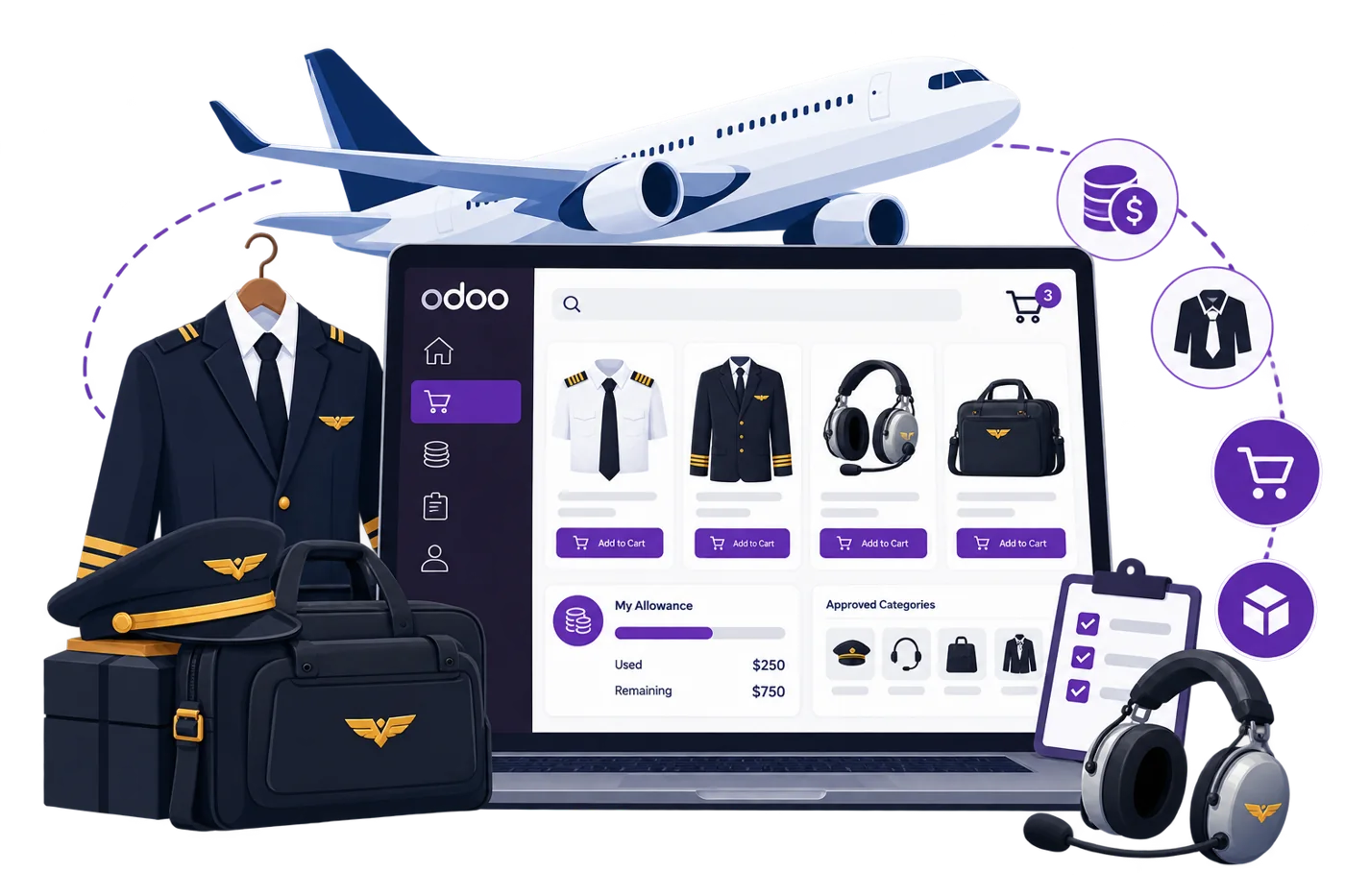
Airlines, flight schools, aviation organizations, and pilot supply retailers often need to manage purchasing programs for approved uniforms, flight bags, headsets, accessories, and other work-related products.
Vraja Technologies provides an Odoo-based Employee Allowance & Credit Management solution that helps businesses assign purchasing benefits, control eligible products, enable employee self-service ordering, and track company-funded purchases.
Whether you're an airline providing purchasing allowances to pilots or an aviation supplier serving multiple corporate customers, the solution can be configured around your eligibility rules, purchasing workflows, and billing requirements.
Choose amount-based for a pilot supplies budget, unit-based for fixed quantities of crew uniform items, and points-based for choice across approved apparel and accessories.
Pilots get an annual budget for approved uniforms and supplies
Flight crew get fixed quantities of uniform items
Staff select approved aviation products using a points balance
The availability of unit-based, points-based and advanced policy features depends on the selected Odoo implementation.
Aviation organizations manage people across roles, airports, bases and departments. Pilots need approved uniforms, flight bags and authorized accessories. Cabin crew need branded apparel and uniform accessories. Airport ground staff wear different operational workwear. When these purchases are funded through allowances, administrators must control eligibility, set limits and track how benefits are used.
Pilots, cabin crew, ground staff and airport teams need different approved products
HR and purchasing teams spend time assigning budgets and keeping separate records
Staff can select products outside the company's approved purchasing program
Administrators need visibility into purchased products and remaining balances
Airlines and airport service providers must manage staff across different bases or organizational units
Staff may need extra approved apparel before their next scheduled entitlement
Returned uniforms or cancelled orders need matching allowance adjustments
Aviation suppliers must separate employee payments from purchases billed to corporate customers
Three things set an aviation program apart from a generic uniform program:
The approved-product list works as a brand and standards control, not just a spending control.
Flight bags and accessories sit alongside uniforms, which is why a monetary budget often suits pilots while unit-based entitlements suit crew uniforms.
The allowance follows the employee record, while base-specific eligibility and reporting are assessed during implementation.
Each role gets its own approved products and its own limit, set up once and applied at checkout.
Yes. Allowance policies can be configured around employee groups, departments or job roles when advanced eligibility functionality is included.
These are possible allowance-funded products. Each organization's purchasing policy decides which items qualify.
You define eligible products or categories for the program. For example, a company can let pilots use assigned credit for approved uniform shirts, trousers, jackets, flight bags and selected accessories. Products outside the eligible range do not qualify for the company-funded allowance, and further restrictions by employee group can be configured where required.
Staff log in to an Odoo-powered purchasing website, review their allowance and select eligible products. At checkout the system evaluates the allowance and eligibility rules and applies available credit to qualifying items. Where co-payment is permitted, any uncovered amount is collected through the configured payment process, so administrators do not calculate every order by hand.
Authorized administrators review allocations, used credit, remaining balances and orders through the configured company dashboard. The ledger records allocations, deductions, expiry, refunds, restorations and manual adjustments.
For example, an airline administrator can check a pilot's remaining uniform allowance and open the purchases behind it. Reporting filters by employee, company, date range or allowance period can be provided where supported.
Match the model to what you fund and the restrictions you need.
It gives eligible pilots or aviation staff a fixed budget for approved products during a defined period, so they can pick different items while staying within it.
The pilot can use the remaining $150 toward qualifying products during the allowance period.
Example: an airline gives an eligible pilot an annual allowance of $400 for approved uniforms and supplies.
It defines how many units of selected products an employee can buy in a period. Instead of a budget, the organization controls quantities, which suits airlines that want standard counts of approved uniform items.
Example: an annual flight crew uniform entitlement.
It gives staff a number of points to spend on eligible products at configured point values, which supports flexible purchasing from a defined set of approved products.
Example: an aviation organization allocates 20 annual points to an eligible employee, who selects approved apparel and accessories worth 8 points. The remaining balance is 12 points.
Unit-based and points-based allowances, advanced conversion rules and product-specific eligibility depend on the selected implementation.
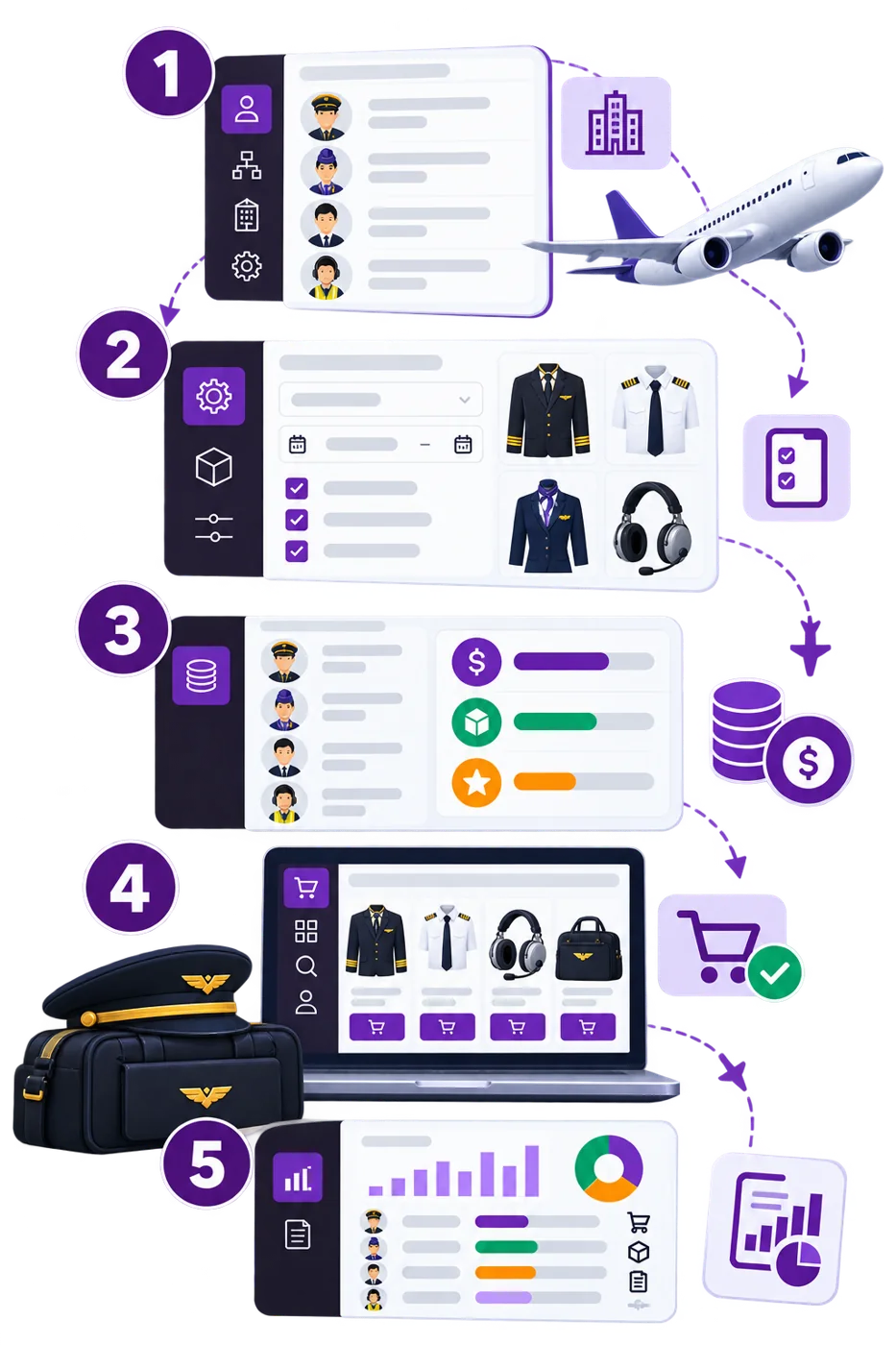
An aviation program runs in five steps, connecting employee records, purchasing policies, allowance allocation, online orders and reporting.
Create or import employee information and associate employees with their companies. Maintain departments, job roles and other eligibility attributes where required.
Define the allowance model, purchasing limits, approved products, validity periods and eligibility rules. Different groups can have separate policies where advanced configuration is implemented.
Assign budgets, quantity entitlements or points to eligible pilots, cabin crew and airport staff, manually, through structured imports or through scheduled rules where configured.
Staff open the Odoo purchasing website, select qualifying products and place orders. The system evaluates the allowance and product restrictions at checkout.
Purchasing and allowance transactions are recorded in Odoo, and authorized administrators review purchases, used allowances, remaining balances and orders.
A January renewal, a pilot who needs an extra uniform shirt and a wrong-size return are the situations an airline program plans for. Each follows your policy, and the full set of options is on our employee allowance management page.
an airline allocates an annual uniform allowance that renews at the start of each calendar year. Anniversary-based renewal is available when the advanced functionality is included.
an airline sets a designated annual ordering period for standard flight crew uniforms, and allowance use outside it is restricted.
where an exception workflow is implemented, a pilot who needs an additional approved uniform item before the next renewal can request extra credit or quantities, and an administrator approves or rejects the request.
alerts can be configured for new allocations, upcoming expiry and periodic summaries.
unused benefits can expire or carry forward, and advanced configurations support rollover caps.
when a qualifying purchase is returned or cancelled, the configured refund workflow restores the relevant allowance.
The solution can be configured for prepaid funding or periodic consolidated billing.
an airline or aviation organization funds an agreed allowance in advance. Eligible purchases consume the allowance, and transactions are recorded according to the configured financial workflow.
a uniform or pilot supply vendor serves several airline or aviation customers. Eligible company-funded purchases build up over the agreed billing period and go into one consolidated invoice, with employee-paid amounts recorded separately.
Invoice timing, accounting entries, tax treatment and reconciliation depend on the agreed financial configuration.
The most common fits are pilot programs, cabin crew entitlements, ground staff workwear, flight training organizations, new-hire and leaver handling, and multi-base operations.
An airline gives eligible pilots an annual budget for approved uniforms, flight bags and authorized accessories. Pilots buy through the portal, and administrators monitor credit usage and balances.
An airline allocates fixed quantities of shirts, trousers, jackets and other approved apparel to eligible cabin crew. With unit-based functionality, the system tracks purchased and remaining quantities.
An airport service company gives employees benefits for approved uniforms, high-visibility clothing and operational workwear, with eligibility rules defining what qualifies for each group.
A flight training organization gives eligible instructors and staff allowances for approved uniforms, flight bags, apparel and other authorized supplies, bought through the configured purchasing website.
When an airline hires new pilots or cabin crew, structured spreadsheets import employee and allowance data, and scheduled allocation rules can be configured where supported. When someone leaves or becomes inactive, lifecycle rules restrict purchasing access and future allocations while keeping the historical records.
An airline or aviation service provider operating across several airports configures the solution around employee-company relationships and user access controls. Location-specific purchasing requirements and reporting structures are evaluated during implementation.
An implementation follows six steps, and the effort depends mainly on the number of bases, roles and allowance models.
Confirm roles, approved products, allowance model, billing arrangement and reporting needs.
Set up the relevant apps, including the website, Sales and Invoicing.
Build the role, group and product rules your policy needs.
Import employee records and allocations using the agreed fields and validation rules.
Run orders, split payments, returns and invoicing before deployment.
Deploy, then check reports and balances against your first allocation cycle.
Things that make a project larger: several bases with separate eligibility or reporting, many roles with different product lists, unit-based or points-based models, and consolidated billing for a supplier. A scoping call gives you a timeline and estimate for your setup.
Skip it if you have very few employees, only occasional uniform purchases or a simple arrangement that you can maintain manually.
The solution suits airlines, aviation service providers and suppliers that manage recurring purchasing benefits, several employee groups or company-funded product programs.
It does not replace aviation safety management, aircraft inventory systems, pilot licensing, flight operations or aviation regulatory compliance software.
Confirm the allowance models, ordering restrictions, renewal rules and integration requirements during implementation planning.
Vraja Technologies is a Certified Odoo Partner that configures and customizes Odoo solutions around operational requirements. Aviation organizations differ in pilot supply programs, approved uniform products, employee roles, and billing arrangements, so the work starts with your requirements. Our team can help with:
Yes. Odoo can be configured to give eligible pilots purchasing allowances for approved uniforms, flight bags, accessories, and other authorized products.
Yes. Eligible staff log in to an Odoo-powered purchasing website, browse approved products and apply available allowances at checkout.
Yes. Advanced eligibility configurations support separate allowances and product rules for pilots, cabin crew, ground staff, and other groups.
Yes. Product or category eligibility rules determine which items qualify for company-funded purchasing.
Yes. Unit-based allowances can define permitted quantities for approved uniform products when the functionality is included in the implementation.
Yes. Configured policies can support expiry or carry-forward, including capped rollover where the advanced functionality is available.
Where exception-request functionality is enabled, staff can request additional credit or quantities for administrator review.
Qualifying returns or cancellations restore the applicable allowance under the configured refund rules, and partial restoration is supported.
Yes. Structured spreadsheet imports can be provided for employee and allowance data, and scheduled allocations can be configured where supported.
Yes, where co-payment is permitted. The configured checkout applies the available allowance to qualifying items and collects the rest.
The solution supports company-specific employee purchasing programs. Location-specific eligibility, access, and reporting requirements are assessed during implementation.
Yes. A configured consolidated billing workflow can accumulate eligible company-funded purchases and support periodic company invoicing.
No questions match your search.