

Amount-based
Workers get a yearly budget and choose from approved workwear
- Workers receive
- A monetary budget
- Company controls
- Spend limit
Odoo manufacturing employee allowance management lets a factory give each production, maintenance and warehouse worker a workwear budget, a quantity entitlement or a points balance, limit it to approved uniforms and protective gear, and track every purchase in one system. Workers order through an online portal, and HR and procurement see what each plant spent and what remains. If you have a small workforce and one standard uniform, spreadsheets may still be enough.
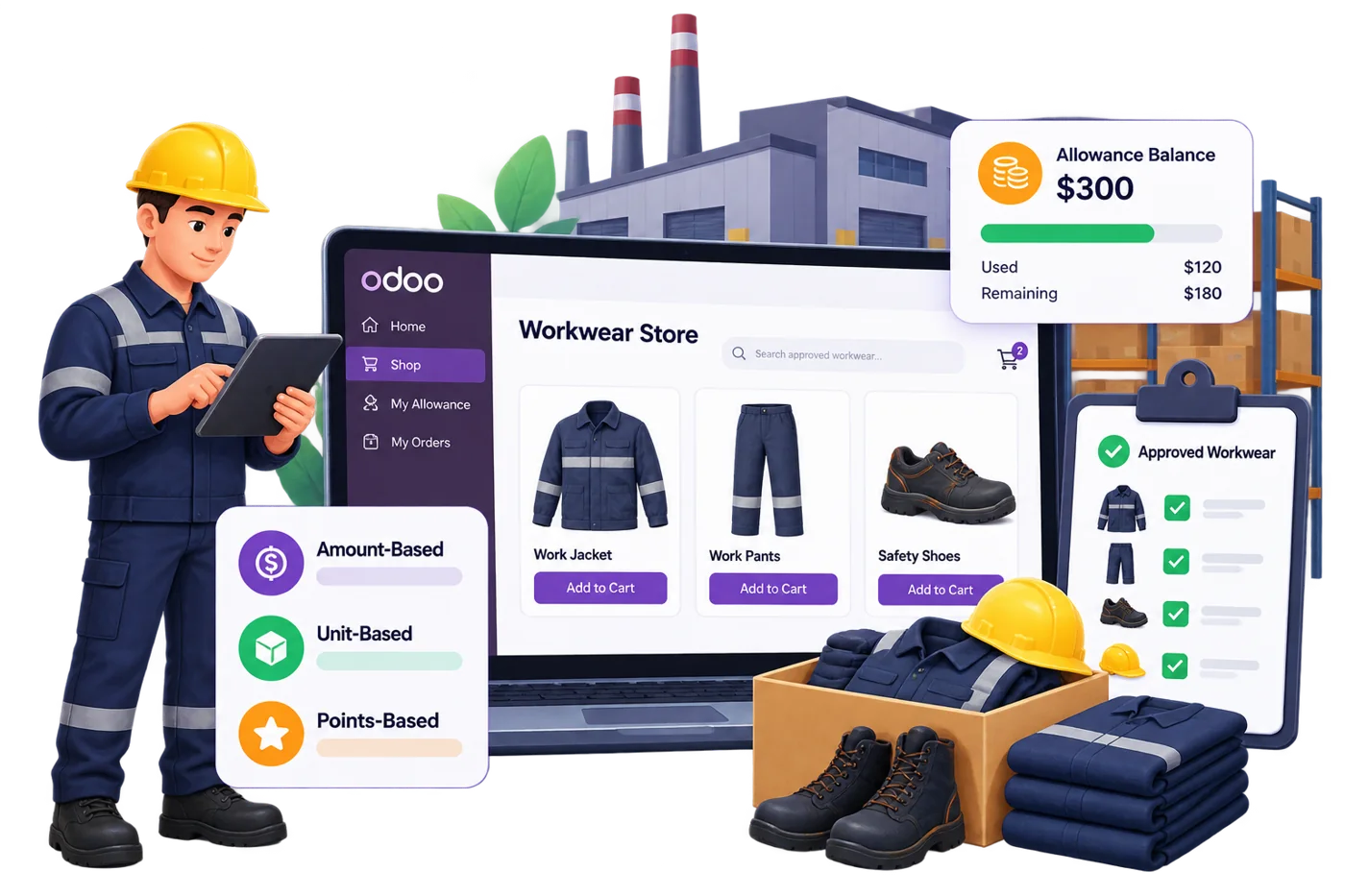
This page is for manufacturers with several departments, different workwear requirements and company-funded purchasing. Vraja Technologies, a Certified Odoo Partner, configures the solution around your workforce, approved products and allowance policy. For the general solution behind it, see our Odoo employee allowance management page.
Choose amount-based for flexible workwear budgets, unit-based for fixed quantities of items, and points-based for one shared points system across the workforce.
Workers get a yearly budget and choose from approved workwear
Workers get fixed quantities (4 shirts, 3 trousers, 2 jackets)
Workers spend a common points balance on approved items
Amount-based is the core model. Unit-based and points-based models, along with advanced eligibility and renewal controls, depend on the selected Odoo implementation.
Workwear requirements differ by department, shift and facility, and tracking them by hand does not scale. Production workers need factory uniforms, maintenance technicians need protective workwear, and warehouse employees need safety footwear and high-visibility clothing.
Keeping limits, eligibility and allowance records accurate across a large workforce creates six recurring problems.
Production, maintenance, warehouse and quality control teams need different approved clothing and equipment
Budgets and quantity entitlements in spreadsheets need constant updates and verification
Without eligibility rules, workers can spend allowances on items outside their workwear categories
The company must track how many uniforms, jackets or workwear items each worker bought in the allowance period
Manufacturers with more than one factory need consistent purchasing policies and the right access to company-level records
HR and procurement struggle to see allocated allowances, purchases, used credit and remaining balances
Three things set a manufacturing workwear program apart from a generic uniform program:
Replacement cycles matter more than in an office program, so counting how many items each worker has bought per period is often the real control.
Safety footwear and high-visibility clothing usually have to meet your site's requirements, so the approved-product list does real work here.
Each plant may have its own departments and rules, while HR still needs one view across all of them.
Each role gets its own approved products and its own limit, set up once and applied automatically at checkout.
Yes. Allowance policies can be linked to employee groups, departments or job responsibilities where advanced eligibility functionality is implemented, so each role can have its own entitlement.
You define which products or categories qualify for allowances, and the system applies those restrictions at purchase. For example, a production worker may get company-funded access to factory uniforms and protective clothing, while other categories require personal payment. That keeps allowances from going to non-approved products.
Eligible workers log in to the Odoo website, check their available allowance, browse approved workwear and place orders. The allowance is applied at checkout, and any uncovered amount goes through the configured employee payment workflow.
Administrators monitor purchasing activity tied to each worker's allowance. Transactions can be recorded against orders, including allocated credit, used allowances, remaining balances and applicable adjustments. That gives clearer records across departments and facilities.
Match the model to how your workwear policy is written: a budget, a count of items, or a pool of points.
It gives workers a set purchasing budget for approved industrial workwear. It works well when workers need flexibility to choose among approved products.
The worker can use the remaining $100 on eligible products during the allowance period.
Example: a manufacturer allocates $250 a year to each eligible production worker.
It defines how many approved workwear items a worker can buy in a period. It manages entitlements without relying only on monetary allowances.
Example: annual entitlements for eligible production workers.
It gives workers a set number of purchasing points. Eligible products carry assigned point values or use an agreed conversion rate. It suits manufacturers that want one common points system instead of individual monetary budgets.
Example: a company gives workers 30 annual points. A worker buys an approved item worth 10 points, and 20 points remain.
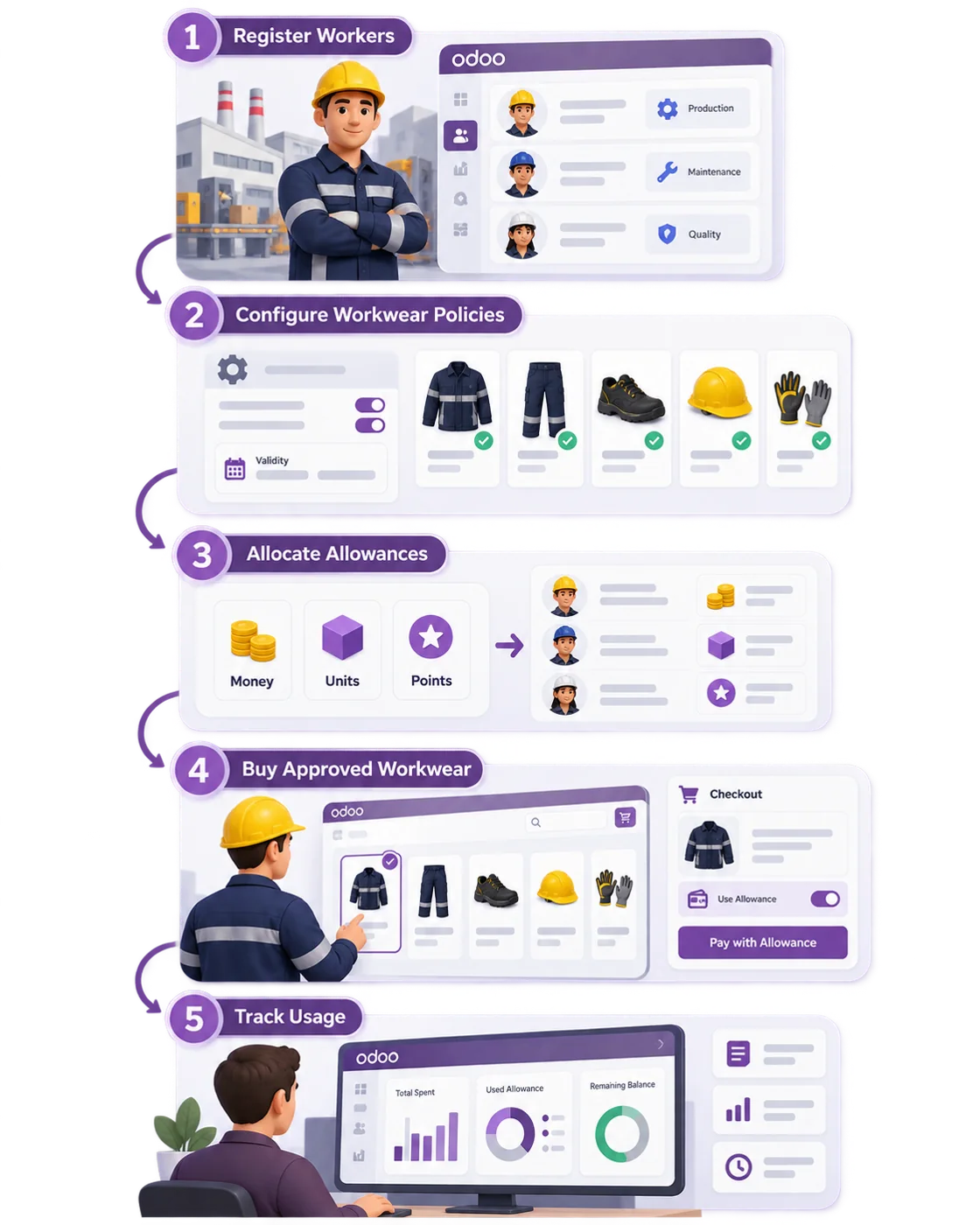
A factory program runs in five steps, connecting employee records, workwear policies, purchasing and allowance tracking.
Create or import employee records and link workers to the relevant company. Maintain departments, job roles or other eligibility information where required.
Define the allowance type, approved industrial workwear, purchasing limits and validity periods. Different employee groups can get different policies when advanced eligibility rules are configured.
Assign monetary credit, unit-based entitlements or points to eligible workers, manually, through structured imports or through configured automated processes.
Workers log in to the Odoo purchasing website, select eligible products and apply their allowance at checkout. Any amount not covered is paid through the configured payment process.
Purchases and allowance transactions are recorded in Odoo. Authorized administrators review purchasing activity, used allowances and remaining balances.
A fresh entitlement every year, a worker whose jacket wears out early and a wrong-size return are the situations a factory program plans for. Each follows your policy, and the full set of options is on our employee allowance management page.
allowances renew after a defined period, for example every year. Unused balance can expire or carry forward under the rules you set, depending on the supported implementation features.
where an exception workflow is enabled, a worker who has used the allocated quantity can request additional items, and an administrator approves or rejects the request.
when a qualifying purchase is returned or cancelled, the configured refund workflow restores the applicable allowance, and the ledger links the restoration to the original order.
The most common fits are production uniforms, maintenance workwear, warehouse entitlements, new-hire allocation, periodic replacement and multi-plant purchasing.
A manufacturer gives production workers an annual entitlement for factory uniforms. Workers order approved shirts, trousers and jackets, and the company tracks how much of each entitlement is used.
Technicians need protective jackets, industrial clothing and other approved workwear for their responsibilities. The company configures eligible categories and allocates benefits to that group.
Warehouse employees may receive allowances for high-visibility clothing, uniforms and approved safety footwear. A quantity-based model defines how many eligible items they can buy each period.
A new production worker receives an initial allowance. After registration and allowance assignment, the worker orders approved products through the portal.
A company renews allowances after a defined period, for example a fresh entitlement every year. Renewal and carry-forward rules follow company policy and the supported implementation features.
A manufacturer with several plants manages workwear purchasing for workers at different facilities. The solution adapts to the company structure, with access and reporting permissions set to your requirements.
An implementation follows six steps, and the effort depends mainly on the number of plants, roles and allowance models.
Confirm departments, approved workwear and safety gear, allowance model and reporting needs.
Set up the relevant apps, including the website, Sales and Invoicing.
Build the role, department and product rules your policy needs.
Import employee records and allocations using the agreed fields and validation rules.
Run orders, split payments and returns before deployment.
Deploy, then check reports and balances against your first allocation cycle.
Things that make a project larger: several plants with separate rules, eligibility by role as well as department, unit-based or points-based models, and renewal rules. A scoping call gives you a timeline and estimate for your setup.
Keep central issue if workers have no choice in what they receive, or if your workforce is small enough to manage uniform records by hand without errors.
An allowance system pays off when allowances recur, roles need different entitlements and HR or procurement need visibility across many workers or plants.
Review plant-level purchasing rules, access restrictions and reporting during implementation, since advanced models depend on the selected build.
Vraja Technologies is a Certified Odoo Partner that implements and customizes Odoo solutions to each client's requirements. Manufacturers differ in workwear needs, purchasing policy, workforce structure and operations, so the work starts with your requirements. What you can expect:
It helps companies allocate purchasing benefits for factory uniforms, industrial workwear, protective clothing and other approved products, while tracking allowance usage and worker purchases.
Yes. Policies can be configured for groups such as production, maintenance, warehouse and quality control when the advanced eligibility rules are included.
Yes. Eligible workers log in to the Odoo website, select approved workwear and complete purchases through the allowance-based checkout process.
Yes. Unit-based allowances can set quantity entitlements for approved products such as uniforms, trousers, jackets or other industrial workwear.
Yes. You can configure product or category eligibility rules so allowances apply only to approved products.
Yes. Allowances can be set with validity periods and renewal rules. Advanced renewal and carry-forward conditions depend on the selected implementation.
Yes, when the configured checkout process supports split payment. The allowance covers eligible items and the worker pays the remaining amount.
Yes. Authorized administrators can review allowance allocation, usage, balances and order information through the configured reporting features.
Yes. It can be configured around your company and employee structure. Review plant-level purchasing rules, access restrictions and reporting needs during implementation.
Yes, for qualifying returns. The configured refund rules restore the applicable allowance and link the restoration to the original order.
Yes. We configure and customize allowance policies, eligible products, purchasing workflows and Odoo integrations to your requirements.
No questions match your search.