





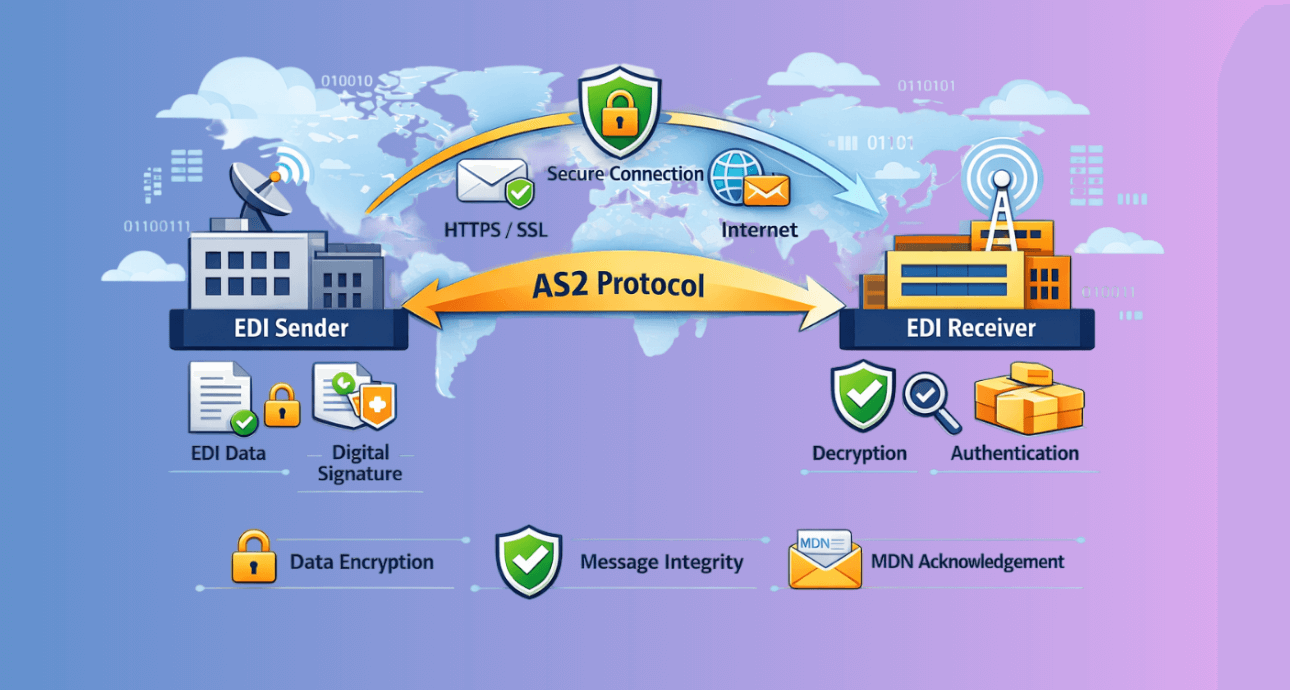
AS2 Protocol Explained: Secure EDI Communication Standard
AS2 (Applicability Statement 2) is the global standard for secure Electronic Data Interchange (EDI) over the internet. It enables businesses to exchange documents such as purchase orders, invoices, and shipping notices directly and safely—without relying on costly intermediaries.
Think of AS2 as a digital armoured truck for business data. Every file is encrypted, digitally signed, and acknowledged with legally verifiable proof of delivery. This ensures that sensitive supply chain transactions reach the intended partner securely, intact, and compliant with global EDI requirements.
Think of AS2 as a digital armoured truck for business data. Every file is encrypted, digitally signed, and acknowledged with legally verifiable proof of delivery. This ensures that sensitive supply chain transactions reach the intended partner securely, intact, and compliant with global EDI requirements.
Today, most large retailers and logistics networks—including Amazon, Walmart, and Target—mandate AS2 connectivity for EDI integration.
What is AS2 in EDI?
AS2 (Applicability Statement 2) is a secure communication protocol that transports EDI documents over HTTP or HTTPS using encryption and digital signatures.
While AS2 can technically transmit any file type, it is almost exclusively used for EDI formats such as:
- ANSI X12
- EDIFACT
- XML EDI
- CSV / flat files (EDI-mapped)
Unlike email or FTP transfers, AS2 guarantees:
- Confidential data exchange
- Verified sender identity
- Tamper-proof transmission
- Legally binding delivery confirmation
👉 Learn more about EDI integration : EDI Integration Services
How AS2 Works: Step-by-Step Workflow
AS2 operates on a secure request-response model over HTTP/S. Below is the technical journey of an EDI document such as a purchase order or invoice.
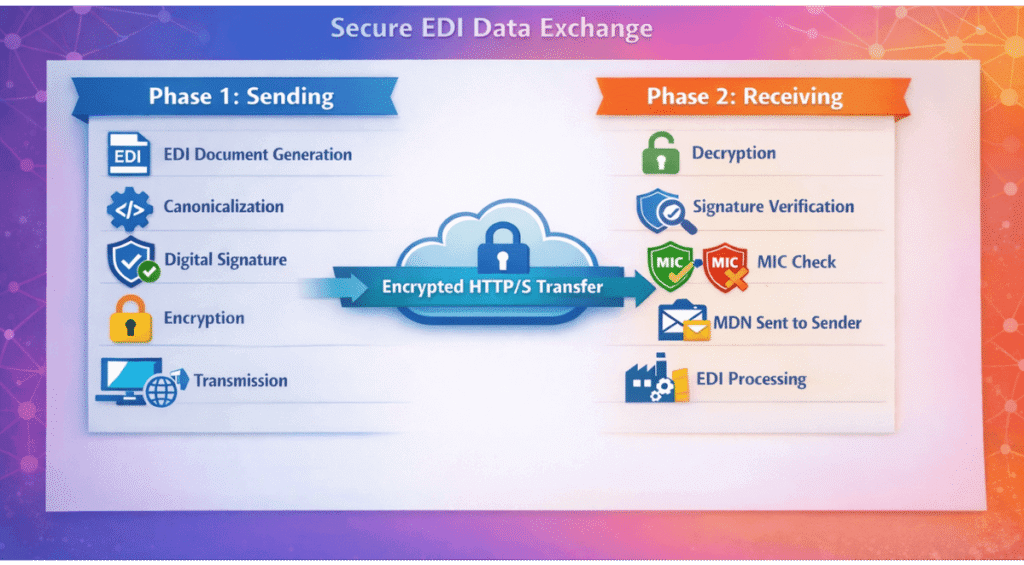
Phase 1: Sending the AS2 Message
1. Document Generation
The AS2 process begins when a business application such as an ERP, warehouse system, or EDI translator generates an outbound document for a trading partner. These documents are typically standardised EDI transactions like
purchase orders (850),
invoices (810), or
advance ship notices (856), structured in ANSI X12, EDIFACT, or XML formats.
At this stage, the file is still readable and unsecured. The role of the AS2 layer is to transform this business document into a cryptographically protected payload suitable for secure internet transmission.
Before applying cryptographic functions, the document is normalised to ensure formatting consistency across systems. This process typically converts line endings to CRLF, removes trailing spaces, and standardises character encoding such as UTF-8 or ASCII. Canonicalisation is essential because cryptographic hashes are extremely sensitive to formatting differences. Even minor variations like line ending styles could cause sender and receiver to compute different integrity hashes for the same document, leading to validation failures.
After normalisation, the sender calculates a Message Integrity Check (MIC) using a cryptographic hash algorithm, most commonly SHA-256. The MIC acts as a unique mathematical fingerprint of the document. Any change to the file—even a single character—produces a completely different MIC value. This hash will later be returned by the receiver in the MDN receipt, allowing both parties to confirm that the document remained unchanged during transmission.
The sender then digitally signs the document using its private key. Technically, the previously calculated hash of the document is encrypted with the sender’s private key and attached as the signature. This step provides strong authentication because only the sender possesses that private key. It also establishes non-repudiation, meaning the sender cannot deny sending the document. The signature proves both the origin of the message and that the content existed in that exact form at the time of signing.
Once signed, the message is encrypted using the receiver’s public certificate. AS2 uses asymmetric encryption, meaning only the receiver’s private key can decrypt the message. This guarantees confidentiality during internet transmission. Even if the message were intercepted, its contents would remain unreadable. The signed document is now enclosed within an encrypted S/MIME envelope, forming the secure AS2 payload ready for transport.
The encrypted AS2 payload is transmitted to the trading partner using an HTTP or HTTPS POST request directed to the partner’s AS2 endpoint URL. Standard AS2 headers such as AS2-From, AS2-To, Message-ID, and Disposition-Notification-To identify the sender, receiver, and requested acknowledgment behavior. At this point, the message leaves the sender’s environment fully secured, protected against interception, tampering, or impersonation during transit across the public internet.
Phase 2: Receiving and Verifying the AS2 Message
7. Decryption
Upon arrival at the receiver’s AS2 server, the first operation is decryption. The receiver uses its private key to decrypt the S/MIME envelope that was encrypted with its public certificate by the sender. Because only the intended receiver possesses this private key, successful decryption confirms that confidentiality has been preserved and that the message was addressed correctly. After decryption, the receiver obtains the original EDI document along with the sender’s digital signature.
The receiver validates the digital signature using the sender’s public certificate. This verification confirms that the message truly originated from the declared trading partner and that the document has not been altered since it was signed. If signature validation fails, the message is rejected and a failure MDN is generated. Successful verification establishes cryptographic trust between partners and ensures protection against spoofing or impersonation.
The receiver recalculates the MIC using the same hashing algorithm applied by the sender.
Steps:
- Canonicalize received document
- Compute hash
- Compare with sender MIC
If both MIC values match:
✔ No corruption
✔ No alteration
✔ Transmission intact
If MIC differs:
✖ Message tampered or damaged
✖ MDN error returned
This step mathematically proves message integrity across the internet.
10. MDN Generation (Electronic Receipt)
After successful validation, the AS2 gateway passes the EDI document to internal systems such as:
- ERP
- EDI translator
- Warehouse system
- Integration middleware
At this point, business processing begins (order creation, invoice posting, etc.).
Core Security Components of AS2
AS2 achieves enterprise-grade security through three cryptographic pillars:
Security Component | Technology Used | Business Value |
| Confidentiality | Asymmetric Encryption | Only intended partner can read data |
| Authenticity | Digital Signatures | Verifies sender identity |
| Integrity | Hashing (MIC) | Ensures the file is unchanged |
The AS2 Certificate System Explained
AS2 relies on exchanging public certificates between trading partners.
Your Private Key
- Stored securely on your AS2 server
- Used to sign outgoing messages
- Used to decrypt incoming messages
Your Public Certificate
- Shared with partners
- Used by them to encrypt messages for you
Partner Public Certificate
- Shared with you
- Used by you to encrypt messages for them
This certificate exchange establishes trusted, secure communication channels between businesses.
The MDN: Proof of Delivery and Non-Repudiation
The Message Disposition Notification (MDN) is a digitally signed electronic receipt generated by the receiver after processing an AS2 message. It confirms whether the message was successfully received, decrypted, authenticated, and validated. Unlike FTP or email acknowledgements, the MDN includes cryptographic proof of integrity and delivery, making it a legally reliable confirmation of EDI exchange.
An MDN includes the original message ID, processing status (success or failure), receiver identity, timestamp, and the MIC calculated by the receiver. It is digitally signed using the receiver’s private key. Because the MDN contains the receiver-calculated MIC and signature, it provides verifiable evidence that the exact document sent by the sender was received intact and readable.
After completing decryption, signature verification, and MIC validation, the receiver’s AS2 server generates the MDN. The MDN records whether processing succeeded or failed and embeds the MIC calculated from the received document. The MDN is then digitally signed by the receiver to ensure authenticity and non-repudiation. This signed receipt is returned to the sender as formal confirmation of delivery.
A synchronous MDN is returned immediately within the same HTTP connection used to transmit the AS2 message. The sender sends the AS2 POST request, and the receiver responds with the MDN in the same session. This provides real-time delivery confirmation and is commonly used for standard-size EDI transactions where processing is quick.
An asynchronous MDN is returned later through a separate AS2 connection. The receiver first accepts and processes the message, then initiates a new AS2 transmission back to the sender containing the MDN. This approach is used for large files, high-volume environments, or scenarios where validation and processing take longer.
The MDN provides non-repudiation of receipt, meaning the receiver cannot deny having received the document. Because the MDN contains the MIC of the received file and is digitally signed by the receiver, it serves as cryptographic proof that the message arrived intact and was successfully decrypted. In EDI disputes, the MDN acts as legal evidence that documents such as purchase orders or invoices were delivered and readable.
Why AS2 is the Preferred EDI Protocol
Traditional EDI used Value-Added Networks (VANs) charging per document or character.
AS2 runs over the internet → zero transmission fees.
Documents transmit in seconds instead of hours.
Benefits:
- Faster order fulfillment
- Immediate confirmations
- Real-time supply chain visibility
Major retailers require AS2 connectivity for suppliers and logistics partners.
Examples include:
- Amazon
- Walmart
- Target
Without AS2, EDI onboarding with these partners is often impossible.
AS2 uses:
- PKI certificates
- SHA-256 hashing
- Asymmetric encryption
- Digital signatures
This meets enterprise security and compliance requirements.
AS2 vs FTP vs VAN: Comparison
Feature | AS2 | FTP/SFTP | VAN |
| Security | High | Medium | High |
| Real-Time | Yes | No | No |
| Proof of Delivery | Yes (MDN) | No | Limited |
| Cost | Low | Low | High |
| Retail Compliance | Yes | No | Yes |
AS2 provides VAN-level security without VAN-level cost.
When Should You Implement AS2?
You should implement AS2 if your business:
- Works with large retailers
- Uses EDI documents (850, 810, 856, etc.)
- Needs secure B2B data exchange
- Wants to eliminate VAN fees
- Requires audit-grade delivery proof
AS2 Integration with ERP and EDI Systems
AS2 typically integrates with:
- ERP systems (Odoo, SAP, NetSuite)
- EDI translators
- 3PL / WMS platforms
- Carrier networks
- Retail supply chains
Businesses using Odoo EDI commonly deploy AS2 for retailer integrations.
👉 Learn how AS2 fits into your ERP : EDI Integration Services
Conclusion
AS2 has become the global standard for secure EDI communication because it combines:
- Encryption
- Digital signatures
- Integrity validation
- Legal delivery proof
- Internet-based transport
It replaces expensive VAN networks while meeting the strict security requirements of global retailers and supply chains.
For any business operating in modern B2B commerce, AS2 is no longer optional—it is the foundation of compliant, secure, and real-time EDI integration.



03 Comments
dutasteride progress reddit
14/05/2026dutasteride progress reddit
dutasteride progress reddit
auro metronidazole pronunciation
24/05/2026auro metronidazole pronunciation
auro metronidazole pronunciation
sildenafil food interaction details
16/07/2026sildenafil food interaction details
sildenafil food interaction details