





What is a Value Added Network (VAN) in EDI? | VAN vs Peppol Guide
In Electronic Data Interchange (EDI), businesses exchange structured documents such as purchase orders, invoices, shipping notices, and acknowledgements with trading partners. However, directly connecting each supplier, logistics partner, or customer to your internal ERP system would be complex, costly, and risky from a security perspective.
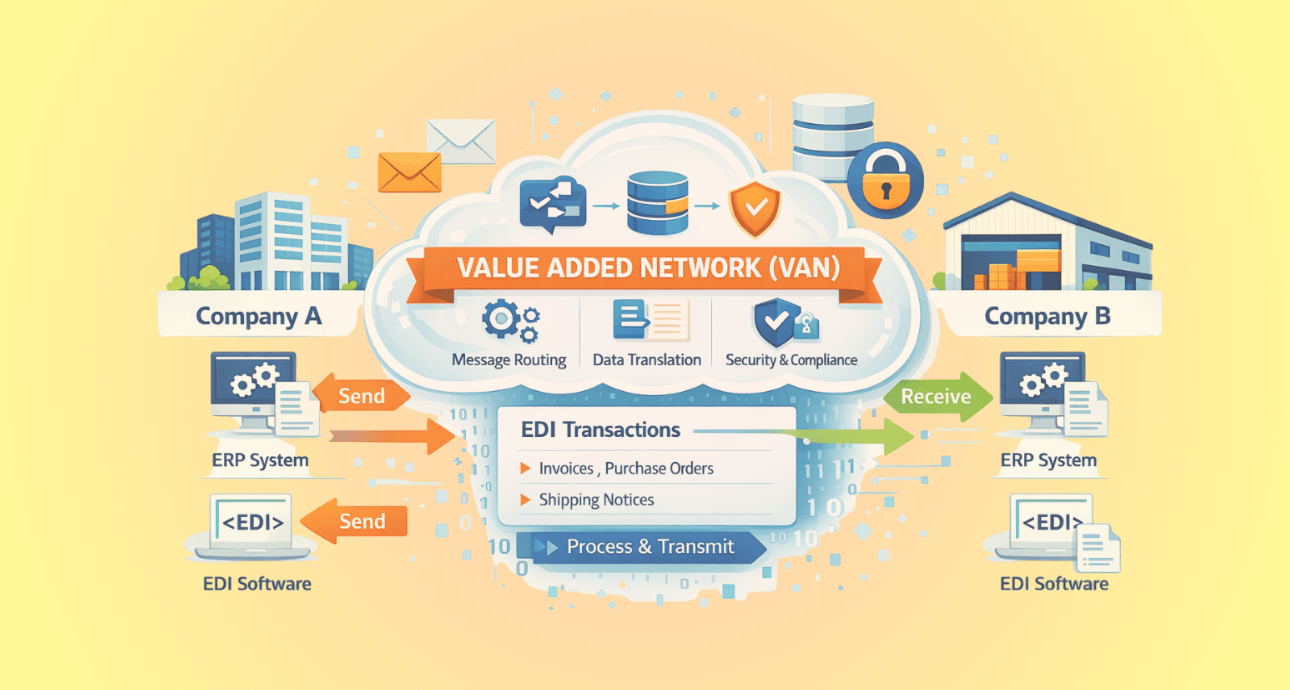
A Value Added Network (VAN) solves this problem by acting as a secure intermediary for business document exchange. Instead of companies connecting directly to each other’s servers, they connect once to a VAN provider, which manages routing, delivery, tracking, and protocol compatibility across the EDI network.
You can think of a VAN as a private digital post office for EDI documents. Each company has a secure mailbox in the VAN environment where it drops outgoing files and collects incoming ones. The VAN ensures those documents reach the correct partner using the appropriate communication protocol and format.
How a Value Added Network (VAN) Works in EDI
A VAN provides a managed communication layer between trading partners, eliminating the need for multiple direct integrations. Each participant maintains only one connection — to the VAN — while the VAN handles partner connectivity behind the scenes.
For Odoo EDI integrations, the most common interaction with a VAN happens through SFTP. Odoo generates EDI documents and transfers them securely to the VAN server. The VAN then delivers those documents to trading partners using their preferred protocol such as AS2, FTP, API, or other EDI channels.
A typical VAN EDI flow looks like this:
- Odoo generates an EDI file (PO, invoice, ASN, etc.)
- The file is uploaded to the VAN via SFTP
- The VAN routes and delivers the document
- The partner receives it via their protocol
Because the VAN handles protocol and routing differences, businesses do not need to maintain separate connections or communication standards for each partner.
Key Benefits of Using a VAN for EDI
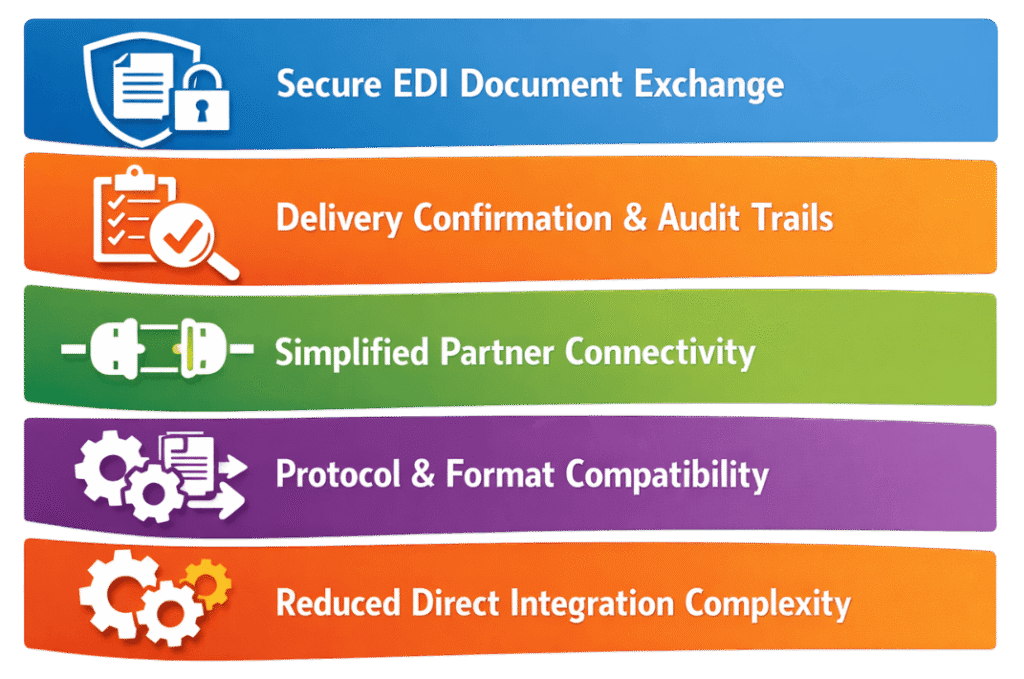
Value-added networks remain widely used in retail, manufacturing, logistics, and supply chain industries because they provide reliability, security, and visibility across partner communications.
One major advantage is document tracking. VAN providers maintain detailed audit trails showing when a document was sent, delivered, received, and sometimes opened. This provides verifiable proof of exchange and reduces disputes about missing or delayed documents.
Security is another core benefit. VANs provide encrypted transmission channels, controlled access environments, and private network routing. This protects sensitive business data without exposing ERP systems directly to external partners.
VANs also simplify onboarding. When new trading partners already use the same VAN provider, connections can be established quickly without building new integrations.
Key advantages include the following:
VAN Pricing and Cost Model
While VANs reduce technical complexity, they introduce ongoing operational costs. Most VAN providers use a subscription plus usage pricing structure. Businesses typically pay a monthly service fee along with charges based on data volume, often measured in kilo-characters or document size.
Additional costs may include partner onboarding, document mapping, and cross-network routing. For organisations exchanging large volumes of EDI transactions, these usage-based charges can become significant over time and are often a reason companies evaluate alternatives such as Peppol.
Limitations of Traditional VAN Networks
Traditional VAN networks were designed for closed trading ecosystems, which can create friction in modern digital supply chains. One common issue is interconnect fees. If trading partners use different VAN providers, those networks must interconnect, and some providers charge additional fees for this cross-network communication.
Vendor lock-in is another limitation. Large retailers or logistics hubs may require suppliers to use a specific VAN provider, reducing flexibility and increasing dependency on proprietary networks.
VANs can also become a central point of failure. Because all document exchange flows through the VAN, service outages can disrupt supply chain communication and document visibility across partners.
Peppol vs VAN: The Modern Interoperability Alternative
To overcome the limitations of closed VAN networks, the Peppol framework was introduced. Peppol is not a VAN provider but an open interoperability network that allows standardised electronic document exchange between any connected organisations globally.
Peppol operates using a decentralised “four-corner model”. Each organisation connects to a certified access point provider, and those access points communicate across the network. This removes the need for bilateral agreements or VAN interconnects between trading partners.
The result is a connect-once model: once connected to Peppol, a business can exchange compliant documents with any other participant on the network without additional setup.
Why Businesses Are Moving from VAN to Peppol
Peppol adoption is increasing because it reduces dependency on proprietary EDI networks and simplifies international e-invoicing. Governance by openPEPPOL ensures all access point providers follow common standards and validation rules.
Organisations benefit from predictable costs, open connectivity, and global interoperability. Once connected to a Peppol Access Point, businesses can exchange documents with any Peppol participant without interconnect fees or multiple integrations. This significantly lowers long-term EDI infrastructure costs compared to traditional VAN models.
Peppol has also expanded beyond Europe into Asia-Pacific and other regions, making it increasingly relevant for global digital trade. Modern ERP platforms such as Odoo are now introducing native Peppol support, further reducing reliance on traditional VAN providers.
Choosing Between VAN and Peppol for EDI
Both VAN and Peppol remain relevant in modern EDI architectures. VAN is typically suitable in legacy trading ecosystems where partners already rely on established networks or require protocol translation services. Peppol is more suitable for standardised e-invoicing, cross-border interoperability, and modern ERP-driven integrations.
Many organisations now use hybrid EDI architectures that combine both approaches – Peppol for compliant e-invoicing and VAN connectivity for partners still operating on traditional EDI networks.
Conclusion: VAN in Modern EDI Strategy
A Value Added Network (VAN) has long been the backbone of secure electronic data interchange, providing structured communication, security, and visibility between trading partners. However, open interoperability frameworks like Peppol are transforming how organisations exchange business documents by removing network barriers and reducing cost dependencies.
For Odoo users implementing EDI integrations, understanding the role of VAN and Peppol is essential to designing a scalable, future-ready digital supply chain communication strategy.



02 Comments
viagra reddit experience
27/04/2026viagra reddit experience
viagra reddit experience
sildenafil citrate uses
30/04/2026sildenafil citrate uses
sildenafil citrate uses