




AI for Small Businesses: Real Value, Practical Use Cases, and the Truth Behind the Hype
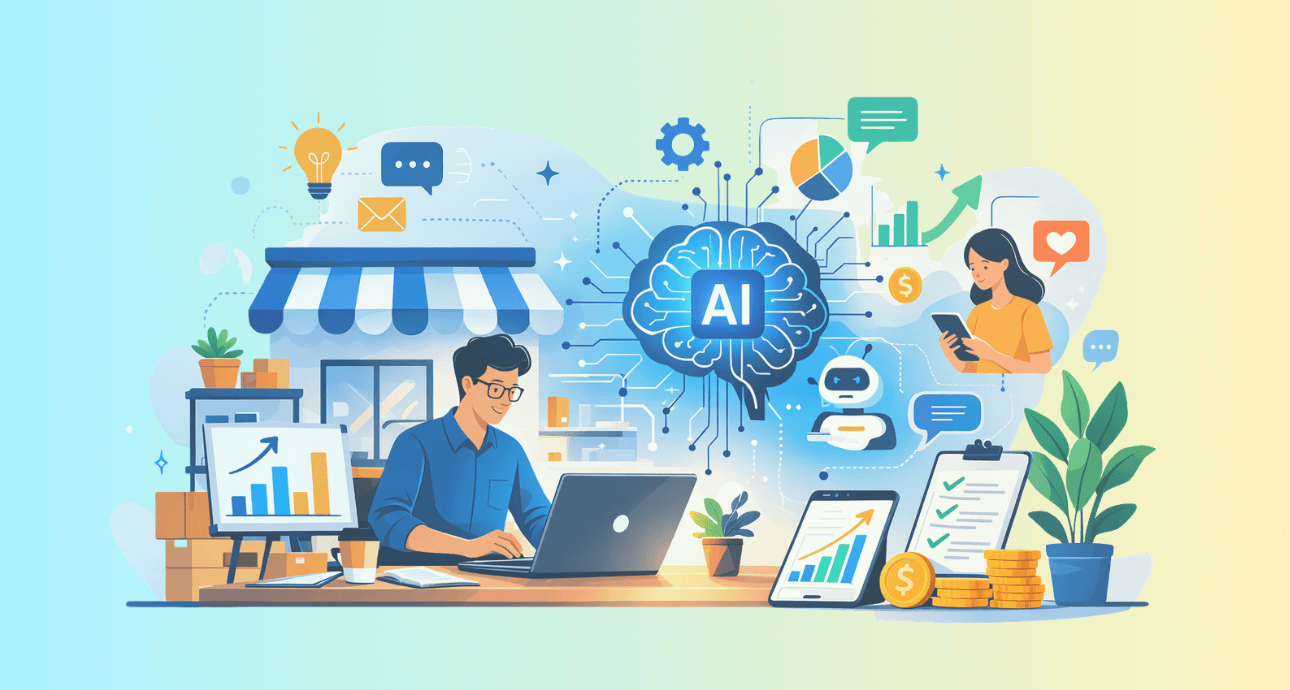
Artificial Intelligence (AI) is one of the most discussed technologies in business today. From automation to analytics, AI is often presented as a revolutionary force that will transform how companies operate. However, for small and medium enterprises (SMEs), the reality is more practical than dramatic.
AI is not a magic system that runs businesses independently. Instead, it is a set of tools that help people work faster, reduce manual effort, and make better decisions using data. Today, SMEs already use AI-powered tools such as ChatGPT for writing, Canva for visual content, Grammarly for language improvement, Google Analytics for performance tracking, and HubSpot for customer management.
These tools show that AI is already part of everyday business operations — not future technology.
AI Adoption in SMEs: From Experiment to Essential
AI is no longer limited to large enterprises. It has already become mainstream among SMEs, including in India.
- 78% of Indian SMBs are using or experimenting with AI
- 93% report revenue growth from AI adoption
- Top use cases: chatbots, marketing optimization, and content creation
Additionally, nearly 9 in 10 Indian SMEs are investing in or planning AI adoption, showing that AI has moved from optional innovation to core business infrastructure.
This shift confirms an important reality:
👉 SMEs are not adopting AI because of hype — they are adopting it because it delivers practical value.
The Biggest Myth: AI Will Replace Jobs
One of the most common fears is that AI will eliminate jobs. In reality, AI mainly changes how work is done, not who does it.
AI is especially effective at repetitive, rule-based tasks such as:
- Drafting routine emails and content
- Entering and organizing data
- Creating invoices and reports
- Sorting documents
- Responding to common customer queries
By automating these tasks, employees can focus on higher-value work like strategy, creativity, and relationship building. Experts consistently note that AI systems still require human interpretation, decision-making, and oversight, especially in areas like finance, customer management, and operations.
The future of SMEs is therefore not AI replacing people, but people working more efficiently with AI support.
What AI Actually Delivers for SMEs Today
For most small and medium enterprises (SMEs), the real value of Artificial Intelligence lies in a few highly practical areas rather than broad transformation promises. In everyday business operations, AI delivers measurable impact primarily through process automation, data-driven insights, and improved customer engagement. These domains represent the most realistic and immediately beneficial applications of AI for SMEs today, as they directly address time constraints, limited resources, and operational inefficiencies commonly faced by growing businesses.
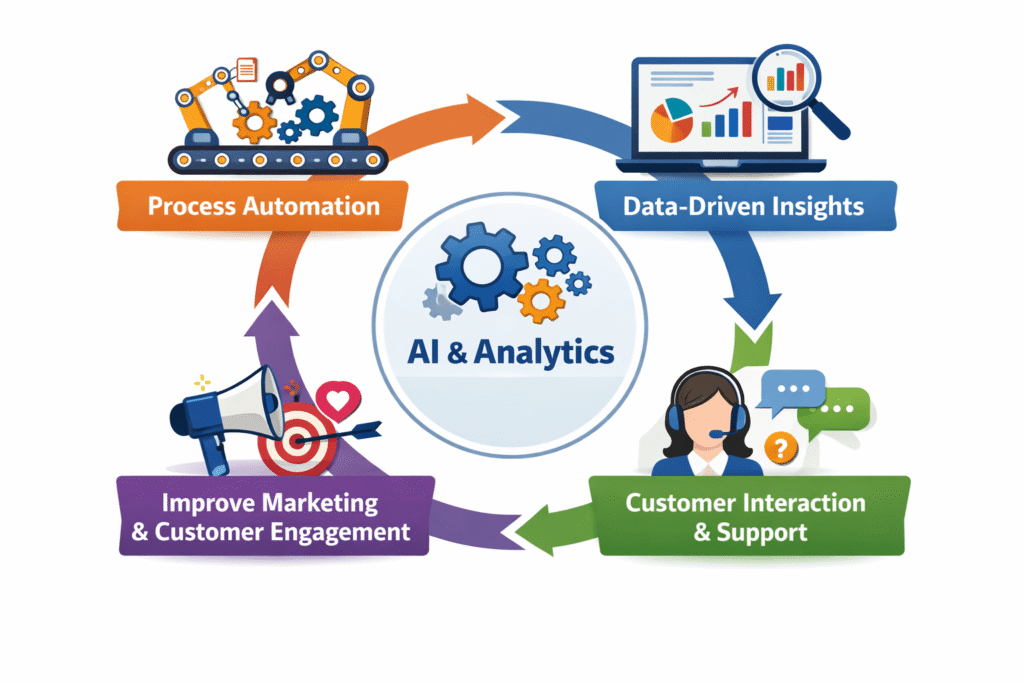
1. Process Automation
One of the most tangible benefits AI provides to SMEs is the automation of administrative and operational tasks that traditionally consume significant staff time. Modern AI systems can extract structured data from emails and automatically enter it into CRM or accounting platforms, generate purchase orders based on inventory thresholds, route documents through predefined workflows, and detect anomalies or errors in data entry.
By reducing repetitive manual activities, businesses not only save time but also improve accuracy and response speed. Organizations implementing such automation frequently report saving between 20 and 30 hours per week on routine administrative work while simultaneously lowering human error rates and improving service responsiveness. This makes automation one of the fastest-return AI investments for SMEs.
2. Data-Driven Insights
Beyond automation, AI significantly enhances the ability of SMEs to interpret and act on business data. AI-driven analytics tools can identify patterns across sales, customer behavior, marketing performance, and operational efficiency that are difficult to detect manually. For example, AI can reveal emerging customer segments, forecast demand trends, highlight underperforming products, or identify inefficiencies in business processes.
Even relatively simple AI analytics solutions enable SMEs to move from reactive reporting to proactive decision-making. Instead of relying solely on historical reports, businesses gain forward-looking insights that support planning, budgeting, and strategic adjustments. This shift from intuition-based to data-assisted decisions is one of the most meaningful ways AI improves SME competitiveness.
3. Improve Marketing and Customer Engagement
AI also enables SMEs to execute more sophisticated marketing and customer engagement strategies without expanding teams or budgets. AI-powered tools can generate website and social media content, optimize campaigns based on performance data, segment customers automatically, and personalize messaging at scale.
In markets such as India, SMEs using AI-assisted marketing tools report engagement improvements of 25–30 percent, demonstrating clear commercial impact. Importantly, AI does not replace marketing expertise; instead, it amplifies reach, accelerates content production, and enables data-driven targeting that was previously accessible mainly to larger enterprises.
4. Customer Interaction and Support
Customer service is another area where AI delivers immediate operational value. AI chatbots and virtual assistants can answer common questions, schedule appointments, route support tickets, and provide basic assistance around the clock. This ensures faster response times and consistent service availability without increasing staffing costs.
By handling routine enquiries, AI allows employees to focus on complex, high-value interactions that require human judgement and relationship management. The result is improved customer satisfaction combined with more efficient use of human resources—an important advantage for SMEs operating with lean teams.
AI Is Not Independent or Always Correct
Another misconception is that AI can run a business autonomously and always produce Despite its capabilities, AI cannot operate autonomously or guarantee accurate outcomes without human involvement. AI systems rely entirely on the quality of data, configuration, and objectives defined by people. If input data is incomplete, biased, or incorrect, the resulting outputs will also be flawed.
AI processes patterns in information but does not possess human judgment, contextual understanding, or emotional awareness. It cannot interpret nuanced business situations, assess ethical implications, or evaluate strategic trade-offs in the way experienced professionals can.
For this reason, human roles remain essential in defining goals, supplying reliable data, reviewing outputs, making final decisions, and monitoring ongoing performance. In practical SME environments, AI functions best as an intelligent assistant that augments human capability rather than replacing it.
AI Is No Longer Only for Large Enterprises
Another long-standing misconception is that AI adoption is expensive and limited to large corporations. In reality, AI has become increasingly accessible to SMEs due to cloud delivery models, subscription pricing, no-code automation platforms, and built-in AI features within existing business software.
By 2025, more than half of small businesses globally were already using AI, with adoption rates even higher among firms employing between 10 and 100 people
This shift is driven by:
- Affordable subscription tools
- Cloud-based software
- No-code automation platforms
- Built-in AI features in existing software
SMEs can now adopt AI gradually, starting with small workflows instead of large investments.
The Right Way for SMEs to Adopt AI
Experts consistently recommend a practical approach rather than large transformation projects. The most successful SMEs follow a simple path:
- Identify a specific business problem
- Apply AI to that one workflow
- Measure time or cost savings
- Expand gradually
This targeted implementation approach prevents wasted spending and ensures real return on investment.
Another key principle is to evaluate AI against simpler alternatives. If AI does not clearly improve cost, speed, or quality compared to existing methods, it may be hype rather than value.
The Real Role of AI in Small Businesses
AI’s real contribution to SMEs is practical and measurable:
- Reducing manual work
- Increasing productivity
- Improving consistency
- Supporting decisions with data
- Enabling small teams to do more
It does not replace leadership, creativity, or human expertise. Instead, it enhances them.
Where AI in ERP Creates Real SME Value
The strongest and most scalable SME impact emerges when AI is integrated directly into ERP systems such as Odoo. Unlike standalone tools, ERP platforms contain structured operational data across sales, inventory, finance, procurement, and logistics. Embedding AI within these workflows allows automation and intelligence to operate on real business transactions rather than generic datasets.
AI-enabled ERP can analyze historical sales to forecast demand, identify fast-moving products, anticipate seasonal fluctuations, and recommend pricing adjustments. This improves planning accuracy and inventory readiness without requiring specialized analytics teams.
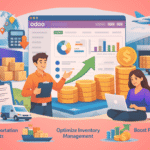
Inventory and supply chain management also benefit significantly. AI can predict stock shortages, optimize reorder quantities, detect slow-moving items, and recommend procurement timing. These capabilities reduce both stockouts and excess inventory—two major cost pressures for growing SMEs.
Financial operations gain predictive visibility when AI analyzes accounting and transaction data. Cash-flow projections, payment risk alerts, expense pattern detection, and profitability insights by product or customer move SMEs from static reporting to forward-looking financial management.
Operational workflows across orders, shipping, invoicing, and procurement become more efficient as AI classifies transactions, extracts document data, detects anomalies, and flags exceptions. This reduces manual intervention and improves process reliability.
The Vraja Perspective: AI Works Best Inside Business Systems
From the implementation experience of Vraja Technologies, SMEs consistently realize the greatest AI value when it is applied directly to operational workflows rather than isolated tools. In Odoo-based environments, AI can enhance order processing and shipping operations, predict logistics demand patterns, improve EDI and integration data quality, detect transactional anomalies, and automate document and communication flows.
This approach aligns AI with the execution layer of the business, ensuring that automation and insights directly influence real operations rather than remaining disconnected from them.
The Real Future: AI-Enabled ERP for SMEs
The SME technology landscape is shifting from standalone applications to connected platforms, from manual workflows to automated processes, and from static reports to predictive insights. AI-enabled ERP systems sit at the center of this transition by linking operational data with intelligent automation.
For SMEs, this evolution means faster operations, better decisions based on real data, reduced manual workload, and scalable growth infrastructure. Rather than replacing ERP users, AI enhances their capabilities, turning transactions into insights and workflows into automation.
Conclusion: AI in ERP Is Practical — Not Hype
Artificial Intelligence delivers real business value for SMEs when applied to structured operational data within ERP systems. It does not replace ERP platforms or human expertise; it strengthens both.
For growing SMEs using ERP solutions like Odoo, AI becomes a natural extension of business processes, enabling smarter planning, automation, and decision support. The future is therefore not AI replacing ERP users, but ERP users empowered by AI.


03 Comments
avanafil vs viagra
02/05/2026avanafil vs viagra
avanafil vs viagra
dapoxetine sildenafil online
04/05/2026dapoxetine sildenafil online
dapoxetine sildenafil online
can i use hsa for semaglutide for weight loss
15/05/2026can i use hsa for semaglutide for weight loss
can i use hsa for semaglutide for weight loss