





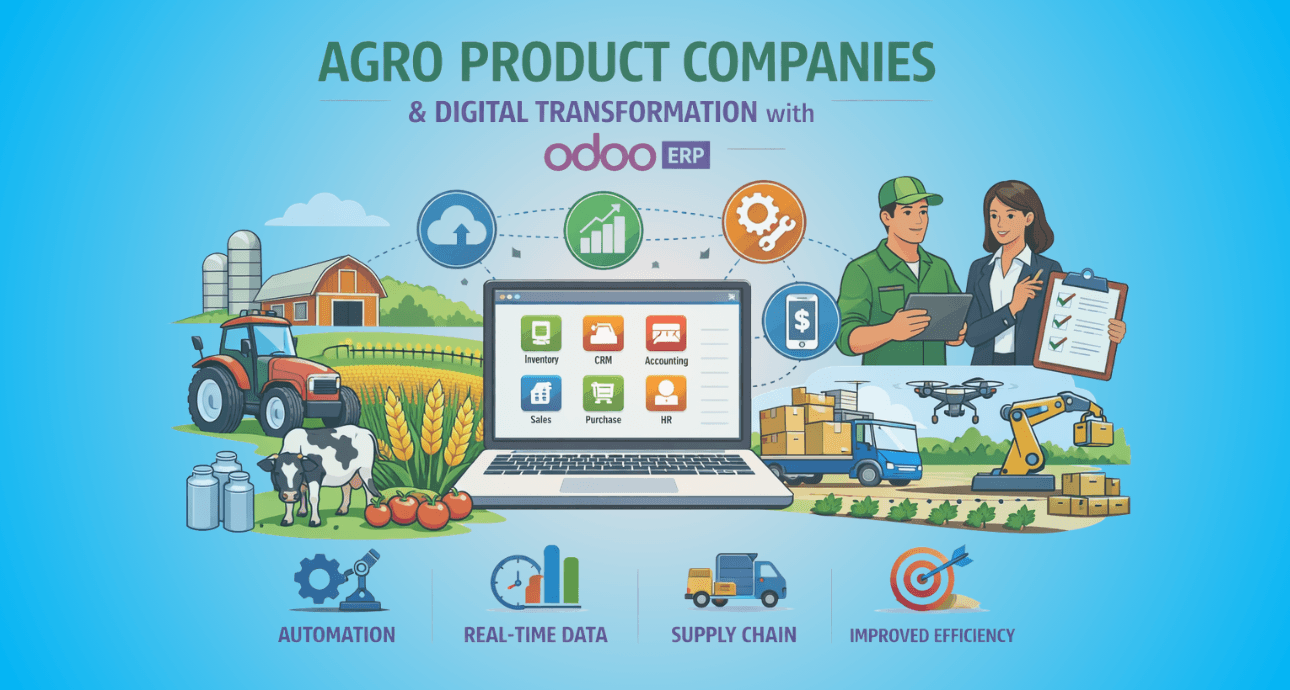
Agro Product Companies & Digital Transformation with Odoo ERP
The agro-product industry plays a vital role in the global economy, connecting farmers, processors, wholesalers, and exporters through a complex supply chain. From procurement and quality testing to storage, packaging, processing, and export logistics, agro businesses operate in an environment that is seasonal, quality-driven, and highly sensitive to market price fluctuations.
Despite this complexity, many agro companies still depend on spreadsheets, manual documentation, and disconnected systems. This often leads to inaccurate inventory records, procurement mismatches, compliance risks, and operational inefficiencies.
Modern ERP platforms like Odoo provide a centralized solution to manage procurement, inventory, accounting, logistics, and manufacturing processes within a single system. As discussed in our blog on Advantages and Disadvantages of Odoo ERP, Odoo’s modular architecture allows businesses to streamline operations while maintaining flexibility for industry-specific workflows.
However, implementing ERP in agro businesses comes with unique challenges due to the nature of agricultural procurement, seasonal inventory patterns, and quality control requirements, such as the need for real-time data tracking and compliance with food safety regulations.
Why Agro Product Companies Need ERP Transformation
Agricultural supply chains involve multiple stakeholders and dynamic variables that traditional systems struggle to manage effectively. Agro businesses must handle:
- Procurement from numerous small-scale farmers
- Product quality variations
- Seasonal procurement cycles
- Strict batch traceability requirements
- Processing yield variability
- Commodity price fluctuations
Without a centralized system, managing these variables becomes increasingly difficult.
ERP systems help agro businesses digitize their entire workflow, providing real-time insights into procurement, warehouse operations, processing yields, and financial performance.
Businesses exploring ERP transformation often begin with strategic planning and consulting. Companies can explore structured ERP planning services through
https://vrajatechnologies.com/odoo-consultancy to align their operational workflows with ERP capabilities.
Key Challenges Agro Product Companies Face When Implementing Odoo ERP
While Odoo offers powerful supply chain management capabilities, agro companies often encounter industry-specific implementation challenges.
1. Complex Procurement from Farmers
Unlike standardized procurement environments, agro companies purchase raw materials from multiple farmers and local suppliers. Each batch may vary in:
- Moisture content
- Weight variations
- Quality grades
- Harvest conditions
- Market pricing
These variations require ERP systems to handle flexible procurement workflows.
During Odoo implementation, companies must configure:
- Vendor master data structures
- Quality grading systems
- Procurement pricing logic
- Integration with weighbridge systems
If procurement workflows are not properly designed, companies may experience purchase rate mismatches and inaccurate inventory valuation.
Organizations implementing ERP for procurement optimization often benefit from working with experienced Odoo consultants who understand industry workflows.
2. Batch Traceability and Quality Control
Traceability is critical in agro industries due to food safety regulations and export compliance standards.
Products such as rice, wheat, spices, cotton, and pulses must be traceable back to their original batch or supplier.
Odoo supports lot and serial tracking, allowing companies to track products across procurement, storage, processing, and distribution.
However, ERP implementation must include:
- Proper lot tracking configuration
- Quality checkpoints during goods receipt
- Quality inspections during processing
- Warehouse staff training for scanning processes
Without proper traceability workflows, agro companies risk regulatory violations and export shipment rejection.
ERP customization may be required to configure advanced quality workflows. Businesses requiring technical customization can explore
https://vrajatechnologies.com/hire-odoo-developer for building industry-specific features.
3. Seasonal Inventory and Warehouse Management
Agricultural procurement occurs primarily during harvest seasons, leading to large inventory inflows within short time periods. Sales and exports then occur gradually throughout the year.
This creates challenges for warehouse management, including:
- Managing large stock volumes efficiently
- Designing warehouse storage structures
- Configuring FIFO or FEFO inventory removal methods
- Maintaining accurate stock valuation
Improper warehouse configuration can lead to slow system performance and inaccurate stock reports.
Odoo’s inventory module can effectively manage high-volume operations when implemented with optimized workflows and warehouse structures.
4. Yield Variability in Agro Processing
Agro processing industries convert raw materials into refined products, often with variable yields.
Examples include:
- Paddy to rice
- Wheat to flour
- Oil seeds to edible oil
- Cotton to fiber
Unlike traditional manufacturing, agro processing involves natural variability in yield and by-product generation.
During ERP implementation, companies must configure:
- Production Bills of Materials (BOM)
- Expected yield percentages
- Scrap and wastage tracking
- By-product management
Incorrect yield configuration can result in inaccurate profitability calculations and unreliable production analytics.
Businesses developing customized ERP workflows for such processes often rely on experienced Odoo development teams.
5. Pricing Volatility and Market Fluctuation
Commodity prices in the agro industry change frequently due to:
- Market demand and supply
- Government agricultural policies
- Export regulations
- Seasonal production cycles
Manual pricing adjustments create operational delays and increase the risk of pricing errors.
Odoo enables companies to implement:
- Automated pricelist structures
- Dynamic margin calculations
- Real-time procurement cost tracking
- Integrated accounting workflows
These capabilities allow businesses to adjust pricing strategies quickly while maintaining profitability.
Businesses looking to integrate ERP with external systems or automate data exchange can also explore advanced integration capabilities discussed in
https://vrajatechnologies.com/blog/1/odoo-ai-agent-integration-in-2025-the-future-of-erp-edi-and-customization-79.
Business Impact After Successful Odoo Implementation
When agro product companies successfully implement Odoo ERP, the transformation goes far beyond simply digitizing processes. It fundamentally changes how the organization manages procurement, inventory, production, logistics, and financial decision-making. Instead of relying on fragmented spreadsheets or manual tracking, businesses gain a centralized, real-time system that connects every department and operational activity.
Below are the key business impacts agro companies typically experience after implementing Odoo.
Significant Reduction in Inventory Discrepancies
Inventory inaccuracies are one of the most common operational challenges in agro businesses. Products are often stored across multiple warehouses, subject to moisture changes, quality grading, and seasonal storage variations. When stock data is managed manually or across disconnected systems, discrepancies between physical stock and system records become frequent.
With Odoo ERP, inventory management becomes highly structured and automated. The system tracks product movements from procurement to warehouse storage, processing, and final sale. Features such as lot tracking, automated stock movements, and barcode scanning ensure accurate product traceability.
As a result, many agro companies experience a 15–25% reduction in inventory discrepancies, improving stock accuracy and reducing losses due to mismanagement or incorrect reporting. Businesses also gain greater confidence in their stock data when making procurement or sales decisions.
Companies exploring modern inventory management capabilities often adopt Odoo because of its flexible and modular architecture, as discussed in
https://vrajatechnologies.com/blog/1/advantages-and-disadvantages-of-odoo-erp-39.
Improved Procurement Transparency and Supplier Management
Procurement in the agro industry is highly dynamic. Businesses purchase raw materials from numerous farmers or local suppliers, often with varying product quality and fluctuating market prices.
Before ERP adoption, procurement decisions are frequently based on manual negotiation records, paper-based purchase receipts, or spreadsheets. This lack of transparency can lead to pricing inconsistencies, duplicate purchases, and poor supplier performance tracking.
After implementing Odoo ERP, procurement workflows become fully digitized. Companies can track:
- Supplier purchase history
- Quality grading for each procurement batch
- Procurement prices over time
- Vendor performance metrics
- Purchase approval workflows
This level of transparency allows procurement managers to make more informed sourcing decisions and maintain stronger relationships with reliable suppliers. Over time, companies can identify high-performing vendors and negotiate better procurement agreements.
Organizations planning ERP-based procurement optimization often begin by consulting experienced Odoo specialists through
https://vrajatechnologies.com/odoo-consultancy.
Faster and More Efficient Warehouse Operations
Warehousing in agro companies can be extremely complex due to seasonal procurement cycles. During harvest seasons, warehouses must handle large inflows of raw materials within short timeframes, requiring efficient stock handling and storage allocation.
Without an integrated ERP system, warehouse operations often rely on manual documentation, which slows down product movement and increases the risk of human error.
Odoo ERP enables agro companies to implement advanced warehouse management processes, including:
- Automated stock receipts and transfers
- Barcode-based product scanning
- Warehouse location management
- Batch and lot tracking
- Real-time stock updates
These capabilities significantly improve warehouse efficiency by reducing manual entry and enabling faster product identification and movement.
As a result, warehouse teams can handle higher inventory volumes while maintaining operational accuracy and system performance.
Reduced Wastage During Processing and Storage
Agro products are naturally sensitive to environmental conditions such as moisture, temperature, and storage duration. Improper tracking or delayed processing can lead to spoilage and wastage, directly affecting profitability.
ERP systems allow agro companies to monitor product movement and processing stages in real time. With proper lot tracking and production planning, businesses can ensure that older batches are processed or sold first, minimizing storage losses.
Additionally, Odoo’s manufacturing and processing modules allow companies to track:
- Yield percentages during processing
- Scrap and wastage levels
- By-product generation
- Production efficiency metrics
This level of visibility helps managers identify inefficiencies in the processing workflow and optimize operations accordingly.
Companies requiring specialized production workflows often extend Odoo with customized logic developed by experienced developers available through
https://vrajatechnologies.com/hire-odoo-developer.
Improved Compliance with Export and Quality Standards
Many agro companies operate in export markets where strict quality and traceability standards must be followed. Governments and international buyers often require full traceability of agricultural products from farm procurement to final shipment.
Without a structured digital system, maintaining this level of documentation becomes difficult and time-consuming.
Odoo ERP simplifies compliance by maintaining detailed records of:
- Procurement batches
- Quality inspection results
- Processing stages
- Warehouse storage locations
- Shipment details
If a quality issue arises, companies can quickly trace the affected batch and identify all related transactions.
This level of traceability not only ensures compliance with export regulations but also builds trust with international buyers and regulatory authorities.
Accurate and Real-Time Financial Reporting
Financial management in agro businesses can be challenging due to fluctuating procurement prices, yield variability, and multi-stage production processes.
When accounting data is not integrated with procurement, inventory, and manufacturing operations, financial reports often lack accuracy or timeliness.
With Odoo ERP, accounting becomes fully integrated with operational data. Every transaction—from procurement to processing, warehousing, and sales—automatically updates the financial system.
This integration enables businesses to generate accurate reports such as:
- Product profitability analysis
- Real-time inventory valuation
- Procurement cost tracking
- Sales performance analytics
- Cash flow monitoring
As a result, finance teams spend less time reconciling data and more time analyzing business performance.
Transition from Reactive to Proactive Decision-Making
One of the most important impacts of ERP adoption is the shift from reactive management to proactive business planning.
Without ERP systems, managers often make decisions based on outdated reports or incomplete data. This leads to delayed responses to market changes or operational issues.
Odoo provides real-time dashboards and reporting tools that give management teams immediate visibility into key business metrics such as:
- Current inventory levels
- Procurement costs and trends
- Production efficiency
- Sales performance
- Financial health
This visibility enables leaders to anticipate supply chain disruptions, optimize procurement strategies, and plan production based on accurate demand forecasts.
Over time, ERP-driven insights help agro businesses build a more agile and data-driven organization capable of adapting quickly to changing market conditions.
Long-Term Strategic Growth
Beyond operational improvements, ERP systems also create a strong digital foundation for long-term business growth.
As agro companies expand into new markets, add processing capabilities, or increase export operations, Odoo’s modular structure allows them to scale their ERP system accordingly.
Businesses can integrate additional capabilities such as:
- eCommerce platforms
- logistics integrations
- automated data exchange with partners
- advanced analytics and AI-driven forecasting
These digital capabilities allow agro companies to remain competitive in an increasingly technology-driven agricultural ecosystem.
The Future of Agro Businesses with ERP
The agricultural industry is increasingly adopting digital technologies to improve efficiency and sustainability.
ERP platforms like Odoo enable agro companies to integrate procurement, manufacturing, logistics, and accounting into a single digital ecosystem.
As ERP technologies evolve with automation and AI-driven analytics, businesses can further optimize supply chain planning and operational efficiency.
Organizations planning ERP adoption can begin by consulting experts through
https://vrajatechnologies.com/odoo-consultancy or reach out via
https://vrajatechnologies.com/contactus .
Frequently Asked Questions (FAQ)
Why do agro-product companies need ERP systems?
Agro companies manage complex supply chains involving procurement from farmers, seasonal inventory, processing variability, and export compliance. ERP systems help centralize these operations and provide real-time visibility into business performance.
How does Odoo help with agro inventory management?
Odoo enables businesses to manage warehouse operations, lot tracking, batch traceability, and automated inventory valuation methods such as FIFO or FEFO.
Can Odoo handle agricultural batch traceability?
Yes. Odoo supports lot and serial tracking, allowing agro businesses to trace products across procurement, storage, processing, and distribution stages.
Is Odoo suitable for agro processing industries?
Yes. Odoo’s manufacturing module allows companies to configure production workflows, yield percentages, scrap tracking, and by-product management.
How long does Odoo implementation take for agro companies?
Implementation timelines vary depending on business size and complexity, but a structured ERP implementation typically ranges from 3 to 6 months.

04 Comments
20mg tadalafil reviews
28/04/202620mg tadalafil reviews
20mg tadalafil reviews
revatio uses
03/05/2026revatio uses
revatio uses
flagyl side effects diarrhea
24/05/2026flagyl side effects diarrhea
flagyl side effects diarrhea
generic tadalafil nz
29/05/2026generic tadalafil nz
generic tadalafil nz