






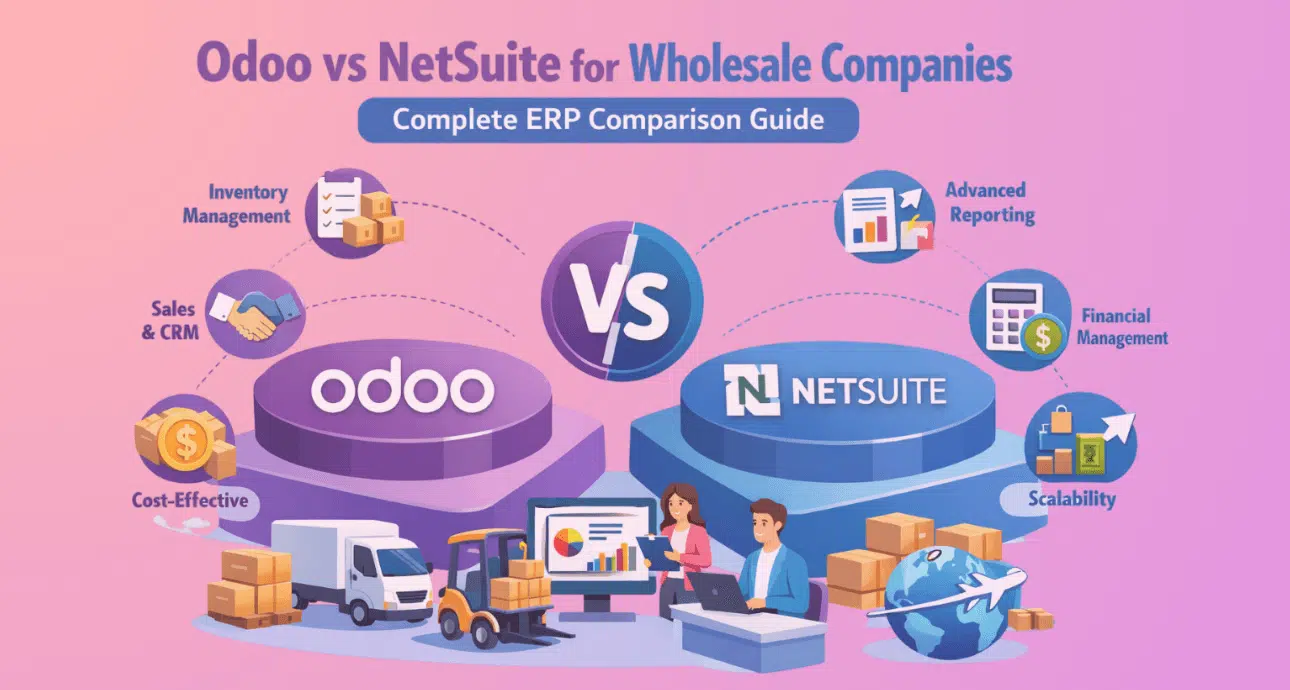
Odoo vs NetSuite for Wholesale Companies: Complete ERP Comparison Guide
Wholesale and distribution businesses operate on tight margins, high inventory volumes, and complex supply chains. Managing purchasing, stock levels, pricing tiers, customer orders, logistics, and financials across multiple channels requires a robust ERP system.
Two of the most widely adopted ERP solutions in the wholesale industry are Odoo and NetSuite (an enterprise ERP developed by Oracle). Both platforms provide end-to-end business management capabilities, yet they differ significantly in flexibility, cost structure, scalability, and ideal business size.
This comprehensive guide compares Odoo vs NetSuite for wholesale companies across inventory, financials, customization, pricing, deployment, and real-world distribution use cases — helping you choose the right ERP for your wholesale or distribution business.
Understanding ERP Needs in Wholesale & Distribution
Wholesale businesses have unique operational challenges compared to retail or manufacturing. ERP systems must support high-volume transactions, complex pricing structures, and multi-warehouse logistics.
Typical wholesale ERP requirements include:
- Multi-warehouse inventory management
- Bulk order processing and fulfillment
- Customer-specific pricing and discounts
- Procurement and supplier management
- Logistics and shipment tracking
- Financial control and margin analysis
- Integration with eCommerce, EDI, and 3PL systems
Both Odoo and NetSuite address these needs, but their approach and depth differ based on target market and architecture.
What is Odoo ERP for Wholesale Companies?
Odoo is a modular ERP platform designed to integrate all business processes into a unified system. Its open architecture allows companies to implement only the modules they need — such as sales, inventory, purchase, accounting, CRM, and warehouse management — and expand gradually.
For wholesale distributors, Odoo offers strong operational capabilities with flexibility and cost efficiency. Its intuitive interface reduces training time for warehouse and sales teams, while its modular design allows custom workflows tailored to specific distribution models.
Wholesale companies commonly use Odoo to manage:
- Inventory across multiple warehouses
- Purchase planning and supplier coordination
- Sales orders and bulk pricing
- Customer credit and invoicing
- Shipping and logistics integration
Because Odoo supports both cloud and on-premise deployment, it suits wholesalers with varying IT strategies — from startups to established regional distributors.
What is NetSuite ERP for Wholesale Enterprises?
NetSuite is a fully cloud-native ERP suite designed for mid-market and enterprise organizations with complex operations. It delivers integrated financials, CRM, inventory, procurement, and eCommerce in a single centralized environment accessible globally.
Wholesale enterprises choose NetSuite primarily for its advanced financial consolidation, multi-entity management, and international scalability. It supports multi-subsidiary operations, multi-currency transactions, and global compliance requirements — making it suitable for multinational distribution networks.
NetSuite is often implemented by large wholesale companies that require:
- Global inventory visibility
- Consolidated financial reporting
- Complex pricing and contracts
- Multi-country operations
- Enterprise compliance controls
While powerful, NetSuite typically involves higher licensing and implementation costs compared to Odoo.
Odoo vs NetSuite: Detailed ERP Comparison for Wholesale Businesses
Inventory & Warehouse Management
Inventory accuracy and warehouse efficiency are central to wholesale success. ERP systems must track stock across locations, manage replenishment, and ensure timely fulfillment.
Odoo Inventory for Wholesale
Odoo provides real-time inventory tracking across multiple warehouses with configurable routes and replenishment rules. Distributors can manage stock transfers, batch or serial tracking, and automated reorder points. Barcode scanning and warehouse automation features improve picking accuracy and reduce operational errors.
Odoo is particularly effective for small to mid-size distributors needing flexible warehouse workflows without heavy enterprise complexity.
NetSuite Inventory for Wholesale
NetSuite offers enterprise-grade inventory management with multi-location visibility and demand planning. It supports global distribution networks and advanced replenishment algorithms. Companies with international warehouses and high-volume SKU catalogs benefit from NetSuite’s centralized inventory control.
👉 Wholesale insight:
Odoo provides strong and customizable warehouse management for SMB distributors, while NetSuite excels in large-scale, multi-country distribution environments.
Wholesale Pricing, Orders & Customer Management
Wholesale sales involve negotiated pricing, volume discounts, and long-term customer agreements.
Odoo Wholesale Sales
Odoo allows businesses to create multiple price lists, customer-specific pricing, discount structures, and promotions. Sales teams can quickly convert quotations into orders and manage backorders efficiently. Integration with B2B portals and eCommerce platforms enables omnichannel wholesale sales.
This flexibility makes Odoo suitable for distributors with varying customer tiers and dynamic pricing strategies.
NetSuite Wholesale Sales
NetSuite supports complex pricing models, contract pricing, partner channels, and enterprise order workflows. It integrates CRM and ERP data to manage large accounts and long-term contracts effectively. Enterprises with structured pricing agreements benefit from NetSuite’s advanced configuration.
👉 Wholesale insight:
Odoo is easier to configure and adapt for flexible pricing, while NetSuite supports large enterprise contract pricing structures.
Financial Management & Profitability Control
Wholesale businesses depend heavily on margin tracking, cost control, and financial visibility.
NetSuite Wholesale Sales
Odoo integrates accounting directly with inventory and sales operations, allowing real-time profitability analysis. Businesses can track costs, margins, receivables, and payables in one system. Financial reporting is suitable for SMEs and regional distributors.
NetSuite Financials
NetSuite is known for advanced financial capabilities including multi-entity consolidation, revenue recognition, compliance, and multi-currency accounting. Large global wholesalers rely on NetSuite for centralized financial governance and reporting across subsidiaries.
👉 Wholesale insight:
Odoo covers most SME financial needs, while NetSuite leads in complex multinational finance management.
Customization & Workflow Flexibility
Wholesale processes vary widely depending on industry, region, and distribution model.
Odoo Customization
Odoo’s open architecture allows extensive customization of workflows, modules, reports, and automation. Businesses can adapt ERP behavior to unique processes such as custom pricing logic, warehouse routing, or supplier integration. Development costs are generally lower due to its open ecosystem.
NetSuite Customization
NetSuite customization is performed via SuiteScript and structured configuration layers. While powerful, it requires specialized expertise and often higher costs. Enterprises with standardized processes may benefit, but smaller distributors may find it restrictive.
👉 Wholesale insight:
Odoo offers greater flexibility and lower customization cost for evolving wholesale workflows.
Deployment & Integration Ecosystem
Wholesale ERPs must connect with logistics providers, eCommerce platforms, and external systems.
Odoo Deployment & Integration
Odoo supports both cloud and on-premise deployment, giving wholesalers infrastructure flexibility. Its APIs enable integration with shipping carriers, EDI networks, marketplaces, and 3PL providers. Many distributors use Odoo to connect ERP with warehouse or logistics systems.
NetSuite Deployment & Integration
NetSuite is cloud-only with a tightly integrated suite. It offers enterprise integration tools suitable for large IT environments. Companies seeking standardized cloud ERP often prefer NetSuite.
👉 Wholesale insight:
Odoo offers deployment freedom and custom integrations; NetSuite provides standardized enterprise cloud architecture.
Cost Comparison: Odoo vs NetSuite for Wholesale Companies
ERP cost is a major factor in wholesale technology decisions.
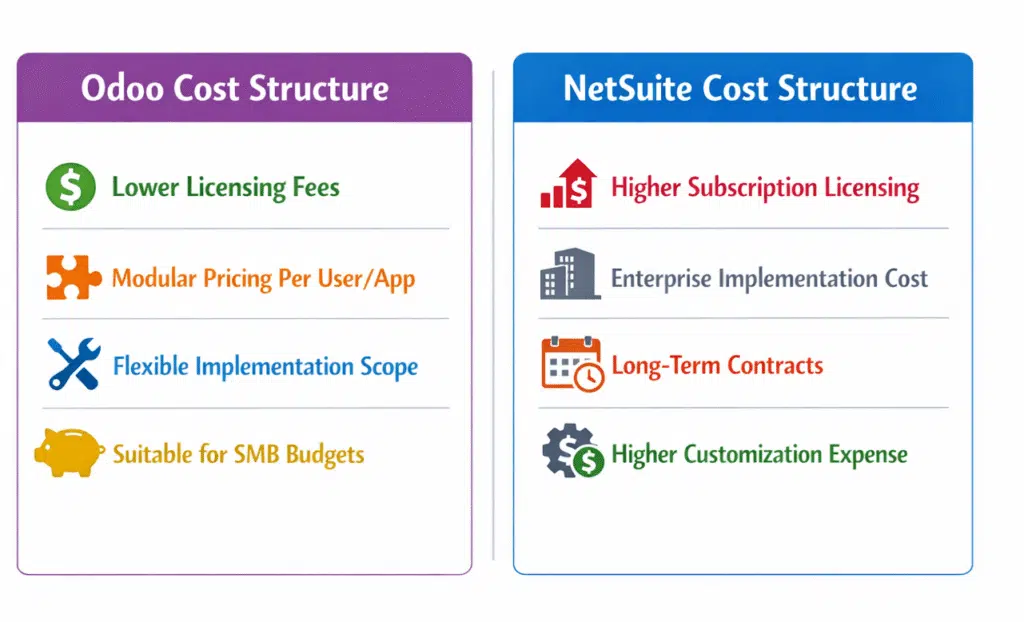
Odoo Cost Structure
- Lower licensing fees
- Modular pricing per user/app
- Flexible implementation scope
- Suitable for SMB budgets
NetSuite Cost Structure
- Higher subscription licensing
- Enterprise implementation cost
- Long-term contracts
- Higher customization expense
👉 ROI perspective:
For most small and mid-size wholesale distributors, Odoo delivers significantly lower total cost of ownership compared to NetSuite.
Odoo vs NetSuite for Wholesale — Feature Comparison
Wholesale ERP Capability | Odoo | NetSuite |
| Inventory & Warehouse Management | ✔ | ✔ |
| Multi-warehouse & Locations | ✔ | ✔ |
| Lot / Serial / Batch Tracking | ✔ | ✔ |
| Purchase & Vendor Management | ✔ | ✔ |
| Sales & Order Management | ✔ | ✔ |
| Accounting & Financials | ✔ | ✔ |
| Manufacturing Integration | ✔ | ✔ |
| eCommerce Integration | ✔ | ✔ |
| EDI / Logistics Integration Flexibility | ✔ | ✖ |
| Custom Workflow Automation | ✔ | ✖ |
| Custom Module Development | ✔ | ✖ |
| User Interface Simplicity | ✔ | ✖ |
| Built-in Advanced Financial Controls | ✖ | ✔ |
| Global Compliance & Multi-subsidiary | ✖ | ✔ |
| Enterprise Reporting Depth | ✖ | ✔ |
| Licensing Cost Efficiency | ✔ | ✖ |
| Implementation Flexibility | ✔ | ✖ |
Real-World Wholesale Scenarios: Which ERP Fits Better?
A company with 1–3 warehouses, hundreds of SKUs, and regional customers needs inventory control, pricing flexibility, and accounting integration.
Best fit: Odoo
Reason: affordable, customizable, and sufficient operational depth.
A business expanding internationally with multiple entities and currencies needs consolidated financial reporting and global inventory visibility.
Best fit: NetSuite
Reason: strong multi-entity and global finance capabilities.
A distributor with unique pricing rules, logistics integrations, or industry-specific processes requires ERP flexibility.
Best fit: Odoo
Reason: open architecture and easier customization.
A large organization with subsidiaries across continents, strict compliance requirements, and complex contracts needs enterprise governance.
Best fit: NetSuite
Reason: enterprise financial and compliance framework.
Advantages of Odoo for Wholesale Companies
- Affordable ERP for distributors
- Flexible pricing and workflows
- Strong inventory and warehouse tools
- Modular scalability
- Custom integration capability
- User-friendly interface
Advantages of NetSuite for Wholesale Enterprises
- Enterprise-grade financial management
- Global multi-entity support
- Advanced demand planning
- Native cloud architecture
- Integrated enterprise suite
Odoo vs NetSuite: Key Differences Summary
How to Choose the Right ERP for Your Wholesale Business
When selecting between Odoo and NetSuite, evaluate:
- Company size and growth stage
- Number of warehouses and countries
- Financial complexity
- Custom workflow needs
- Budget and ROI expectations
- Integration requirements
Small and mid-size distributors typically benefit from Odoo’s flexibility and affordability, while large multinational wholesalers gain value from NetSuite’s enterprise capabilities
Final Verdict: Odoo vs NetSuite for Wholesale (Vraja Technologies Perspective)
Both Odoo and NetSuite are powerful ERP systems, but they serve different segments of the wholesale market.
From Vraja Technologies’s implementation experience across wholesale, distribution, and logistics companies, the choice usually depends on operational complexity versus flexibility needs.
For most small and mid-sized wholesalers, Odoo delivers the best balance of:
- Cost efficiency
- Custom workflow support
- Integration capability
- Faster ROI
- Scalable modular growth
Large global wholesalers with multi-entity financial structures and standardized processes often benefit from NetSuite’s enterprise architecture.
However, many wholesale businesses initially consider NetSuite due to brand perception, but later adopt Odoo because it provides comparable operational functionality at significantly lower cost and with greater customization freedom.
With the right implementation partner and industry-specific configuration, Odoo can successfully support complex wholesale operations including:
- Multi-warehouse distribution
- EDI automation
- 3PL and shipping integration
- Bulk order workflows
- Tiered pricing and customer segmentation
For wholesalers seeking flexibility, integration readiness, and long-term scalability without enterprise ERP cost overhead, Odoo is often the more practical and future-ready choice.
Concluding Recommendation
For wholesale businesses evaluating ERP:
- Choose NetSuite if financial governance and global consolidation dominate requirements.
- Choose Odoo if operational agility, integration flexibility, and scalability are strategic priorities.
From a wholesale transformation standpoint, Odoo delivers a more adaptable, cost-efficient, and integration-ready ERP foundation for the majority of modern distribution businesses.



04 Comments
levitra manufacturer
01/05/2026levitra manufacturer
levitra manufacturer
stendra price in usa
04/05/2026stendra price in usa
stendra price in usa
semaglutide nome commerciale per dimagrire
15/05/2026semaglutide nome commerciale per dimagrire
semaglutide nome commerciale per dimagrire
avanafil contraindication criteria
24/07/2026avanafil contraindication criteria
avanafil contraindication criteria