



Odoo Development Company vs In-House Team: Which Is Better?
For most US companies with 20 to 500 employees, an Odoo development company is the better choice for implementation, customization, and migration. An in-house team is better only when Odoo is a core, daily-changing system with a steady workload of at least one full-time developer. The strongest option for many businesses is a hybrid: a partner builds and migrates, and a small internal owner runs day-to-day operations.
This guide is written for business owners, CTOs, and IT managers deciding between an Odoo development company and a team on payroll. It compares cost, control, expertise, speed, and risk, and ends with a scorecard you can use today. Vraja Technologies builds and supports Odoo systems for clients in the US and abroad, so we have seen both models succeed and fail.
Which Is Better: An Odoo Development Company or an In-House Team?
An Odoo development company is better when you need speed, broad expertise, and flexible capacity. An in-house team is better when you need deep, continuous control and have enough work to keep specialists busy.
The reason is utilization. Odoo projects are spiky: heavy during implementation, migration, and upgrades, then lighter during steady operation. A salaried team is paid for the average month. A partner is paid for the busy months.
Quick verdict by company situation
| Your situation | Better choice |
|---|---|
| First Odoo implementation | Odoo development company |
| Migrating from Odoo 14, 15, or 16 or from another ERP | Odoo development company |
| Under 100 employees, standard workflows | Odoo development company |
| Heavy custom modules, daily change requests | In-house or hybrid |
| Odoo is the core of a software product you sell | In-house |
| Strict data-handling or security rules requiring internal staff | In-house or hybrid |
| Mid-size company, ongoing roadmap | Hybrid |
What Is an Odoo Development Company?
An Odoo development company is a specialist firm that plans, configures, customizes, integrates, migrates, and supports Odoo ERP for clients, usually through a team of developers, functional consultants, and project managers.
Odoo is an open-source, modular Enterprise Resource Planning (ERP) and business management software suite. It combines all essential company operations—such as accounting, CRM, inventory, manufacturing, human resources, and e-commerce—into a single integrated platform. Because the platform is modular and built on Python and PostgreSQL, most real-world deployments need some configuration or custom code, and that is the work these firms do.
What do Odoo development services include?
Odoo development services typically cover six areas:
- Discovery and implementation: mapping your processes to Odoo apps, data setup, training, and go-live.
- Customization: custom modules, workflows, reports, and views.
- Integration: connecting Odoo to payment gateways, shipping carriers, tax engines, eCommerce stores, and third-party APIs.
- Migration: moving from legacy systems or older Odoo versions.
- Support and maintenance: bug fixes, performance tuning, backups, and security patches.
- Upgrades: moving to each new annual Odoo release.
Our Odoo development services at Vraja Technologies cover all six, so one team owns the work from discovery through long-term support.
What Does an In-House Odoo Team Look Like?
A realistic in-house Odoo team has at least two to three people, because one developer cannot cover development, functional configuration, DevOps, and backup.
A typical minimum setup includes a senior Odoo developer, a functional consultant or business analyst who knows Odoo apps, and part-time DevOps or hosting support. Add a project owner on the business side. If you rely on a single hire, you carry key-person risk: when that person leaves, your institutional knowledge leaves too.
How Do the Costs Compare?
An in-house team is usually cheaper per hour of work only when it is fully utilized. When utilization drops below roughly 60 to 70 percent, a development partner is typically cheaper.
The cost gap comes from fully loaded employment cost. The US Bureau of Labor Statistics reports that software developers earned a median annual wage above $130,000 in recent data, and employer benefits add a significant share on top of wages. Recruiting, equipment, software licenses, and management time add more.
How Do They Compare Control, Expertise, Speed, and Scalability?
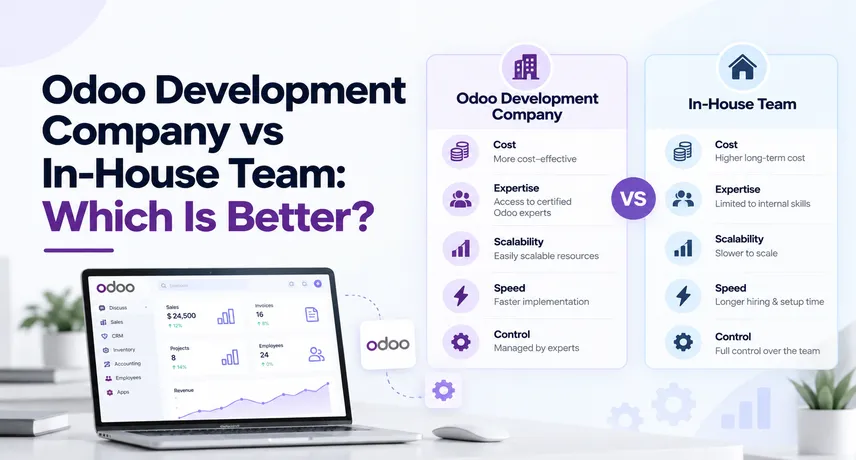
| Factor | Odoo development company | In-house team |
|---|---|---|
| Cost structure | Variable, project or retainer based | Fixed, payroll based |
| Expertise breadth | Wide: developers, functional, DevOps, QA | Limited to who you hire |
| Time to start | Days to a few weeks | Months to recruit |
| Scalability | Add or remove capacity quickly | Slow to scale up or down |
| Control | Shared; depends on contract | Full |
| Business knowledge | Built over time | Deep from day one |
| Continuity risk | Low if documented | High for small teams |
| Best for | Projects, migrations, variable workload | Continuous, high-volume work |
When Should You Hire an Odoo Development Company?
Hire an Odoo development company when your work is project-based, your timeline is short, or you lack Odoo-specific experience.
Choose a partner if any of these apply:
- You are running a first implementation or an ERP replacement.
- You need a migration completed within a defined window.
- You need skills you cannot justify full time, such as integrations, performance tuning, or accounting localization.
- You want predictable delivery with accountability written into a contract.
If you only need extra hands, you can hire Odoo developers on a dedicated basis. This model gives you a consistent developer who works inside your team without the cost of a permanent hire. Companies that hire an Odoo developer this way often use it as a bridge before deciding whether to build an internal team.
When Does an In-House Odoo Team Make Sense?
An in-house team makes sense when Odoo is a strategic, constantly evolving system and you can keep at least one developer fully busy for the long term.
Build in-house if most of these are true:
- You release changes weekly and need a same-day response.
- You have heavy proprietary logic that gives you a competitive advantage.
- Compliance or contract rules require employees to handle your data.
- You can offer Odoo specialists a real career path, so retention stays healthy.
- You already run an engineering organization with code review, testing, and DevOps practices.
Even then, keep a partner relationship for upgrades, audits, and peak workloads.
Is a Hybrid Model the Best Option?
For many mid-size US companies, yes. A hybrid model lets a partner handle implementation, migration, and upgrades while one internal owner manages priorities and daily operations.
A workable hybrid looks like this:
- The partner delivers implementation and migration.
- One internal Odoo owner (functional lead or technical lead) is trained during the project.
- The partner stays on a retainer for upgrades, complex development, and support.
- You hold the code repository and documentation from day one.
This structure limits fixed payroll, removes the single-point-of-failure risk, and keeps your business knowledge inside the company.
Who Should Handle Odoo Migration?
A specialist should handle migration in almost every case, because it requires rare skills for a short, intense period.
Migration includes data mapping, cleansing, custom module refactoring, testing, and a cutover plan. Odoo’s own upgrade documentation notes that custom code and data must be verified against each new version, which is why migrations with heavy customization carry the most risk. Hiring a full-time employee for a six-month project that then ends is expensive and unnecessary.
Our Odoo migration services follow a fixed sequence: audit, data mapping, test migration, user acceptance testing, cutover, and post-launch support. Whichever team you choose, insist on at least two full test migrations before go-live.
How Do You Evaluate an Odoo Implementation Company?
Evaluate an Odoo implementation company on verifiable experience, process transparency, and contract protections, not on price alone.
Ask these questions before signing:
- How many Odoo projects have you delivered in my industry, and on which versions?
- Can I speak to two US-based references?
- Who owns the custom code, and will you provide repository access?
- How do you handle upgrades and annual version changes?
- What is your testing and QA process?
- How will you manage time zone overlap with my team?
- What happens to my project if a developer leaves your team?
- How do you document customizations?
Check the firm’s profile on the Odoo Partner directory and independent review sites, and request a fixed-scope discovery phase before committing to a large contract. A credible Odoo implementation company will welcome these questions.
Why Work With Vraja Technologies?
Vraja Technologies is an Odoo development company that delivers implementation, customization, integration, migration, and support through dedicated teams, with clear contracts and documented code.
What clients typically look for, and what we provide:
- Flexible engagement models: fixed-scope projects, retainers, or dedicated developers.
- Full lifecycle coverage: discovery, development, migration, and ongoing support under one team.
- Transparency: code ownership with the client, documented customizations, and regular progress reporting.
- US-friendly delivery: planned overlap hours with US teams and clear communication practices.
- Hybrid-ready: we train your internal owner and hand over documentation so your team can take on more over time.
If you are comparing options, talk to our Odoo team for a scoping call and a TCO estimate based on your real workload.
Conclusion
Choose an Odoo development company if your work is project-driven, your timeline is tight, or you lack Odoo expertise. Choose an in-house team only if Odoo is central to your business and you have steady full-time work. Choose a hybrid if you want both control and flexibility.
The right answer depends on workload, risk tolerance, and strategic importance, not on a general rule. Run the five-step framework with your own numbers, and compare at least two partner quotes against your internal cost model. If you want a second opinion, Vraja Technologies can review your situation and give you a practical recommendation for implementation, migration, or ongoing development.
Frequently asked questions
Is an Odoo development company cheaper than an in-house team?
In most cases, yes, for the first two to three years. A partner charges only for the work delivered, while an in-house team carries salary, benefits, recruiting, and idle time. In-house can become cheaper when you have enough steady work to keep a full team busy for several years.
How much does it cost to hire an Odoo developer?
A US-based full-time Odoo developer typically costs well over $130,000 per year in total compensation, and more once benefits and overhead are included. Dedicated developers from an offshore or nearshore Odoo development company are usually priced monthly or hourly at a fraction of that, with rates varying by seniority and engagement model.
How long does it take to build an in-house Odoo team?
Plan for three to six months. Recruiting a qualified senior Odoo developer can take one to three months or longer, followed by onboarding and learning your processes. A partner can usually start within days to a few weeks.
Can a small business run Odoo without developers?
Yes, if you stay close to standard Odoo apps and configuration. Many small companies use a partner for setup and occasional support, and manage daily use with a trained functional owner. Developers become necessary once you add custom modules or integrations.
What does an Odoo development company do?
It implements, customizes, integrates, migrates, upgrades, and supports Odoo ERP. Its team normally includes developers, functional consultants, QA, and project managers.
How long does Odoo migration take?
A simple migration can take four to eight weeks; complex projects with heavy customization take several months. Timelines depend on data volume, number of custom modules, and the number of test cycles.
What should I ask before hiring an Odoo implementation company?
Ask about relevant experience, code ownership, documentation, upgrade handling, QA, and continuity if a developer leaves. Request US references and a fixed-scope discovery phase before a larger commitment.



03 Comments
Odoo EDI Integration: ERP & Trading Partner Data Exchange
21/10/2026[…] EDI integration services include fixing a rejected 856 at 6 p.m. Our comparison of an Odoo development company vs. an in-house team covers that trade-off, and our guide to when to hire an Odoo developer for custom module […]
Custom Odoo Development: When Standard Is Not Enough
21/10/2026[…] The tradeoff comes down to speed, depth, and continuity. A partner brings tested patterns for Odoo custom development and integrations on day one. An internal hire brings daily context but takes months to recruit and ramp. For a detailed comparison, read this breakdown of an Odoo development company vs an in-house team. […]
Why Businesses Need ERP Consulting Services
26/10/2026[…] This keeps ERP consulting knowledge in-house after the engagement ends. Our comparison of an Odoo development company vs. an in-house team walks through the trade-offs in […]