
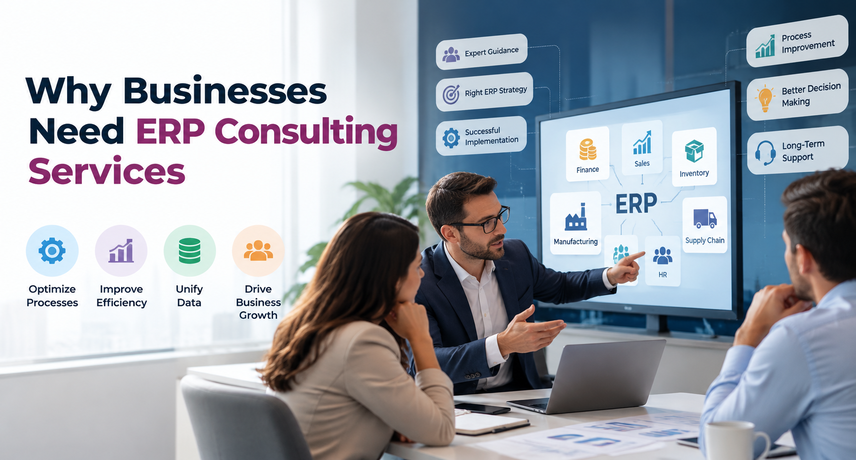
Why Businesses Need ERP Consulting Services
Businesses need ERP consulting services because ERP projects succeed or fail on process design, data quality, and integration decisions, not on software features. An experienced ERP consultant gives your team an independent plan, a proven method, and the technical depth to connect Odoo with the retailers, suppliers, and 3PLs(Third-Party Logistics providers) you trade with.
For U.S. mid-sized and enterprise companies running Odoo, the stakes are higher. Trading partners expect electronic documents, such as EDI 850 purchase orders, 856 advance ship notices, and 810 invoices, on strict timelines. ERP consulting services close the gap between a working Odoo database and a partner-ready operation. This guide from Vraja Technologies explains what the work includes, when to hire, what it costs, and how to choose an ERP consulting company.
What Are ERP Consulting Services?
ERP consulting services are advisory, design, and technical services that help a business select, configure, integrate, and improve an enterprise resource planning (ERP) system. An ERP consultant sits between your operations team and the software and makes sure the system matches how your business actually runs.
ERP software puts accounting, inventory, sales, purchasing, manufacturing, and reporting on one shared database. Odoo, published by Odoo S.A., delivers this through modular apps in two editions: the open-source Community edition and the proprietary Enterprise edition. Because every module can be configured or extended, the decisions made early in the project shape how the system performs for years. A typical ERP implementation consulting engagement covers these areas:
- Needs assessment and business process mapping (as-is and to-be)
- Software selection, fit-gap analysis, and licensing guidance
- Implementation planning, governance, and project management
- Data cleansing and migration strategy
- Integration design for EDI, e-commerce platforms, carriers, warehouses, and tax engines
- Testing, user training, and change management
- Post-go-live support, upgrades, and optimization
What Is the Difference Between an ERP Consultant, an Implementer, and an Odoo Partner?
An ERP consultant advises and designs, an implementer configures and builds, and an Odoo partner is a company authorized by Odoo S.A. to sell and deliver Odoo. A single ERP consulting company often combines all three roles.
The distinction matters when you compare bids. A pure ERP consultant can offer an independent view of scope and platform choice. An implementation firm brings hands-on build capacity. An ERP consulting company that does both, as Vraja Technologies does for Odoo, keeps design decisions and delivery accountable to the same team, provided it documents its recommendations so you can verify them.
Why Do Businesses Need ERP Consulting Services?
Businesses need ERP consulting services to cut project risk, shorten time to value, and avoid costly rework after go-live. Six causes explain most of the demand for ERP consulting.
ERP failures are rarely software failures. Panorama Consulting Group, an independent ERP advisory firm, has reported in its annual ERP surveys that many projects exceed their planned budget or schedule, and that expanded scope and unanticipated technical or organizational issues are leading causes. Thomson Reuters makes a similar point: ERP implementations require specialized knowledge that a company’s IT staff usually lacks, and underestimating the time and expertise involved is one of the biggest mistakes a company can make. Good ERP consulting addresses those causes before they become change orders.
Why Does Odoo Need Governance Even Though It Is Flexible?
Odoo needs governance because its flexibility makes it easy to customize more than you should. Every custom field, workflow, and module becomes something you must test and carry through each upgrade.
Odoo S.A. ships a new major version roughly once a year, and companies that modify the core heavily often find that upgrades become projects of their own. ERP consulting services set rules up front: configure first, extend with isolated modules second, and avoid changing core code. That discipline protects your upgrade path and your budget, and it is a core part of ERP consulting services for Odoo users.
Why Is Electronic Document Exchange a Separate Challenge?
Electronic document exchange is a separate challenge because each trading partner defines its own rules for formats, identifiers, timing, and penalties. Your ERP stores the data, but it does not know what a national retailer or a 3PL expects inside an 856 ship notice.
Retailers and distributors commonly publish implementation guides that specify required segments, product identifiers such as GTIN or UPC, packaging hierarchies, and acknowledgment deadlines. Late, short, or mislabeled shipments can trigger chargebacks. An ERP consultant who understands both Odoo and EDI translates those rules into Odoo workflows, so compliance is built into order, delivery, and invoice processing instead of being handled by hand. Translating partner rules into workflows is a core task in ERP consulting services.
How Does ERP Implementation Consulting Reduce Project Risk?
ERP implementation consulting reduces project risk by forcing hard decisions early: scope, data ownership, integrations, and acceptance criteria. A written fit-gap analysis shows which requirements Odoo meets out of the box, which need configuration, and which need custom development.
Cost estimates built on that analysis are more reliable than estimates built on a software demo. A good ERP consulting company also brings reusable templates for test scripts, cutover plans, and risk logs, which saves time your internal team would otherwise spend inventing them.
Why Does Data Migration Need Expert Planning?
Data migration needs expert planning because bad master data produces bad orders, bad invoices, and rejected electronic documents. Item numbers, units of measure, ship-to locations, and partner identifiers must be clean before they reach Odoo, which is why ERP consulting starts with data profiling.
An ERP implementation consulting team profiles legacy data, defines cleansing rules, assigns business owners, and runs trial migrations. Skipping that work is one of the most common reasons go-live dates slip.
How Do Integrations Multiply Project Complexity?
Integrations multiply complexity because every connected system adds data mappings, error handling, and testing. A mid-sized U.S. distributor may connect Odoo to a warehouse management system, a 3PL, parcel carriers, Shopify or Amazon, a tax engine, and several EDI trading partners.
ERP implementation consulting treats these connections as a designed architecture instead of a pile of one-off scripts. The consultant decides which system owns each data element, how failed messages are retried, and how users see and resolve exceptions.
Why Does User Adoption Depend on Change Management?
User adoption depends on change management because even a well-configured ERP fails if people keep working in spreadsheets. ERP consulting services therefore include role-based training, clear process ownership, and visible leadership support.
Thomson Reuters notes that an ERP changes people’s daily work and company culture, not just technology. An ERP consulting company plans communication, training, and post-go-live support so the new process becomes the normal process.
What Are the Signs You Need an ERP Consultant?
You need an ERP consultant when trading partners reject your documents, month-end close takes more than a week, or your team uses spreadsheets to bridge Odoo and other systems.
Watch for these signs that ERP consulting is overdue, especially if you sell to retailers or distribute through 3PLs:
- Chargebacks or rejections for late, short, or incorrect shipments and invoices
- Staff re-keying purchase orders from email or retailer portals into Odoo
- Manual creation of ship notices, labels, or invoices for each partner
- Inventory counts in Odoo that disagree with your warehouse or 3PL
- A stalled or over-budget Odoo rollout with an unclear remaining scope
- Heavy customization that blocks upgrades
- New trading partners that take weeks to onboard
- Reports that finance and operations dispute every month
If three or more apply, ERP consulting services usually pay for themselves by exposing root causes, so start with a short assessment. ERP implementation consulting can also rescue a stalled rollout by re-baselining scope, data, and plan.
How Do ERP Consulting Services Support Odoo EDI and Electronic Document Exchange?
| Document | X12 code | Typical direction | Odoo record | Why it matters |
|---|---|---|---|---|
| Purchase order | 850 | Retailer to you (or you to supplier) | Sales order or purchase order | Starts the order cycle; errors here cascade |
| PO acknowledgment | 855 | You to retailer | Order confirmation | Confirms quantities and dates |
| Advance ship notice | 856 | You to retailer or 3PL | Delivery order with packaging data | Receiving and chargeback compliance |
| Invoice | 810 | You to customer | Customer invoice | Triggers payment |
| Functional acknowledgment | 997 | Both | EDI log and status | Proves the document was received |
| Inventory advice | 846 | You to partner | Stock levels | Keeps partner availability current |
| Warehouse shipping order and advice | 940 / 945 | Between you and a 3PL | Delivery orders and done quantities | Synchronizes outsourced fulfillment |
Which EDI Integration Approach Fits Odoo?
The right approach depends on partner count, volume, and compliance requirements: marketplace connectors suit a few partners with standard documents, EDI platforms suit growing partner lists, and custom modules suit unusual requirements.
- Marketplace connector: lowest upfront cost. Verify X12 versions, AS2 support, and compatibility with your Odoo version.
- API-based EDI platform: the provider handles translation, partner connections, and monitoring, while Odoo exchanges structured data through its API. Subscription fees apply.
- VAN or traditional EDI provider: familiar to many retailers, but it adds per-connection or per-document costs and often needs a separate mapping layer.
- Custom module: maximum control, with the highest build and maintenance burden.
How Do You Scope an Odoo EDI Project?
Scope an Odoo EDI project by documenting each partner’s requirements, choosing transport and translation methods, mapping fields, and completing partner testing before launch. Experienced ERP consulting teams follow these steps:
- List every trading partner, document type, and volume forecast.
- Collect each partner’s implementation guide, routing guide, and test requirements.
- Select the transport (AS2, SFTP, VAN, or API) and the translation method.
- Map Odoo fields to X12 elements, including item IDs, units of measure, ship-to codes, and packaging hierarchies.
- Build validation rules and an exception queue so errors are visible and fixable.
- Run partner certification tests and correct every rejected document.
- Monitor 997 acknowledgments and error rates after launch, and assign an owner.
What Does ERP Implementation Consulting Include, Step by Step?
ERP implementation consulting typically runs in eight stages: discovery, fit-gap analysis, solution design, build, data migration, testing, training and go-live, and post-launch optimization.
Vraja Technologies applies this sequence in its ERP implementation services for Odoo, and every ERP consulting engagement follows the same stages. Here is what happens at each stage of ERP implementation consulting:
- Discovery: interview stakeholders, map current processes, and list systems, partners, and compliance obligations.
- Fit-gap analysis: compare requirements with standard Odoo and classify each as standard, configuration, or custom.
- Solution design: define the target process, data model, integrations, and security roles.
- Build: configure Odoo apps, develop approved extensions, and build integrations.
- Data migration: cleanse, map, load, and reconcile master and open-transaction data over several trial runs.
- Testing: run unit, integration, and user acceptance tests, plus EDI partner certification.
- Training and go-live: train by role, rehearse cutover, and launch with hypercare support.
- Optimization: review KPIs, tune workflows, and plan upgrades.
Expect a mid-sized ERP implementation consulting project to take several months. MetaOption, writing in MSDynamicsWorld, cites six to twelve months for companies with 50 to 500 users. In practice, integration count and data quality often move that range as much as user count does.
Should You Use ERP Consulting Services or an In-House Team?
Use ERP consulting services when your project includes several integrations, retailer compliance, or multiple entities, and rely on an in-house team alone only for small, single-site projects with few integrations.
Most companies land on a hybrid ERP consulting model. Internal staff own business rules, data, and acceptance testing, while the ERP implementation consulting team supplies method, Odoo expertise, and integration skills. This keeps ERP consulting knowledge in-house after the engagement ends. Our comparison of an Odoo development company vs. an in-house team walks through the trade-offs in detail.
When Does Custom Module Development Belong in an ERP Consulting Engagement?
Custom module development belongs in scope only when standard Odoo cannot meet a business-critical requirement, such as a partner-specific EDI mapping or a unique pricing rule.
Each custom module adds testing and upgrade work, so the ERP consultant should justify it in the fit-gap analysis and keep it isolated from core code. When development is warranted, read how to hire an Odoo developer for custom module development and what to look for in code quality, documentation, and handover.
How Much Do ERP Consulting Services Cost?
ERP consulting services in North America are commonly billed at about $150 to $350 per hour, and total cost depends mainly on user count, integrations, data volume, and customization.
MetaOption, writing in MSDynamicsWorld, reports that mid-sized ERP projects (50 to 500 users) often budget $150,000 to $750,000 overall, with ERP implementation consulting fees frequently cited at 40 to 60 percent of the total. Treat published ranges as directional; the only reliable number is a quote from an ERP consultant based on your scope. These factors move the price of ERP consulting most:
- Number of EDI trading partners and document types
- Quality and volume of legacy data
- Amount of customization and custom module development
- Number of legal entities, warehouses, and currencies
- Training, change management, and post-go-live support
To control spend, ask your ERP consulting company for a fixed-scope discovery phase, a written fit-gap analysis, and milestone-based payments. Then compare the price of ERP consulting services with what manual re-keying, rework, and chargebacks cost you today.
How Do You Choose an ERP Consulting Company?
Choose an ERP consulting company that can show verifiable Odoo project experience, documented integration or EDI work, a written methodology, and references from U.S. clients.
Providers of ERP consulting services vary widely: some are strong in technology but weak in change management, and many specialize in specific platforms. Ask every ERP consulting candidate these questions:
- How many Odoo projects have you delivered in the past two years, and in which industries?
- Can you show a completed EDI or partner integration, including document types and transport?
- Which Odoo versions do you support, and how do you handle upgrades?
- Who will be on my team, and what is their experience?
- How do you decide between configuration, a connector, and custom code?
- What do you deliver at the end of discovery, and who owns it?
- How do you manage change requests and acceptance testing?
- What happens after go-live: support levels, response times, and documentation?
Also ask whether the ERP consulting company earns money from software resale or add-on sales. A reseller can still give sound advice, but you should know where the incentives sit.
What Mistakes Do Companies Make When Hiring ERP Consultants?
The most common ERP consulting mistakes are skipping discovery, customizing Odoo to copy legacy processes, and treating EDI as an afterthought.
- Signing a fixed price on assumptions instead of paying for discovery
- Replicating legacy workflows instead of redesigning them
- Leaving EDI and partner testing until the final weeks
- Naming no internal data owner
- Ending ERP implementation consulting at go-live, with no support or upgrade plan
- Choosing an ERP consultant on hourly rate alone
Good ERP consulting services make each of these mistakes cheap to avoid before kickoff; left alone, they are expensive to fix after go-live.
How Does Vraja Technologies Deliver ERP Consulting Services for Odoo?
Vraja Technologies delivers ERP consulting services for companies that run or plan to run Odoo, covering assessment, ERP implementation consulting, integration, and custom development.
Our ERP consulting services start with a discovery assessment, then moves through fit-gap analysis, design, build, testing, and support. For U.S. companies that exchange documents with retailers, distributors, suppliers, manufacturers, and 3PLs, we treat electronic document exchange as its own workstream with dedicated scope, mapping, and partner testing. As an ERP consulting company focused on Odoo, we document each recommendation so your team can verify it.
Next Step: Scope Your ERP Project With Confidence
ERP consulting services pay off when they are applied early, scoped clearly, and measured against business outcomes such as fewer chargebacks, faster onboarding of trading partners, and a shorter financial close. If your Odoo system needs to exchange documents with retailers, suppliers, or 3PLs, start with an ERP consulting assessment. Contact Vraja Technologies, an ERP consulting company for Odoo, to review your requirements and map the fastest path to a partner-ready Odoo operation.
ERP Consulting Services FAQs
What are ERP consulting services?
ERP consulting services are advisory, design, and technical services that help a company select, implement, integrate, and improve an ERP system. They typically include process mapping, fit-gap analysis, data migration planning, integration design, testing, training, and post-go-live support.
What does an ERP consultant do?
An ERP consultant analyzes your processes, recommends how the ERP should be configured, designs integrations, plans data migration, and guides testing and training. The ERP consulting company acts as an independent guide between your business teams and the software.
When should a company hire an ERP consultant?
Hire an ERP consultant when you face a new implementation, a stalled project, a major upgrade, retailer or 3PL integration requirements, or recurring errors in orders, inventory, or invoices. Earlier ERP consulting is cheaper than rescuing a failing project.
How much do ERP consulting services cost?
In North America, ERP consulting services are commonly billed at about $150 to $350 per hour, according to figures published by MetaOption in MSDynamicsWorld. Total cost depends on users, integrations, data quality, and customization, so request a scoped quote.
How long does ERP implementation consulting take?
Mid-sized projects commonly take six to twelve months, per the same MetaOption estimate. ERP implementation consulting timelines lengthen with multiple entities, many integrations, poor legacy data, or extensive EDI partner testing.
Can Odoo exchange EDI documents with retailers and 3PLs?
Yes. Odoo can exchange X12 or EDIFACT documents through marketplace connectors, API-based EDI platforms, or custom modules. Transports such as AS2, SFTP, and VANs carry the files. Your ERP consultant selects the approach based on partner requirements, and ERP implementation consulting should confirm it before the build begins.
Which EDI documents does Odoo need most often?
U.S. trading partners most often require the 850 purchase order, 855 acknowledgment, 856 advance ship notice, 810 invoice, and 997 functional acknowledgment. Companies working with 3PLs often add the 940 and 945, and inventory feeds use the 846.
Do I need ERP consulting services if I already use Odoo?
Yes, if you are adding trading partners, upgrading versions, expanding to new warehouses or entities, or seeing errors and manual work. A focused ERP consulting assessment can fix design problems without a full re-implementation.
What is the difference between an ERP consulting company and an Odoo development company?
An ERP consulting company focuses on strategy, process design, and implementation governance. An Odoo development company focuses on building code, modules, and integrations. Many firms, including Vraja Technologies, provide both so design and build stay aligned.
How do I know whether an ERP consulting company is qualified?
Look for a provider of ERP consulting services with verifiable Odoo project references, completed integration or EDI examples, a written methodology, named team members, and clear post-go-live support terms. Request a sample discovery deliverable before signing.