
Custom Odoo Development: When Standard Odoo Is Not Enough
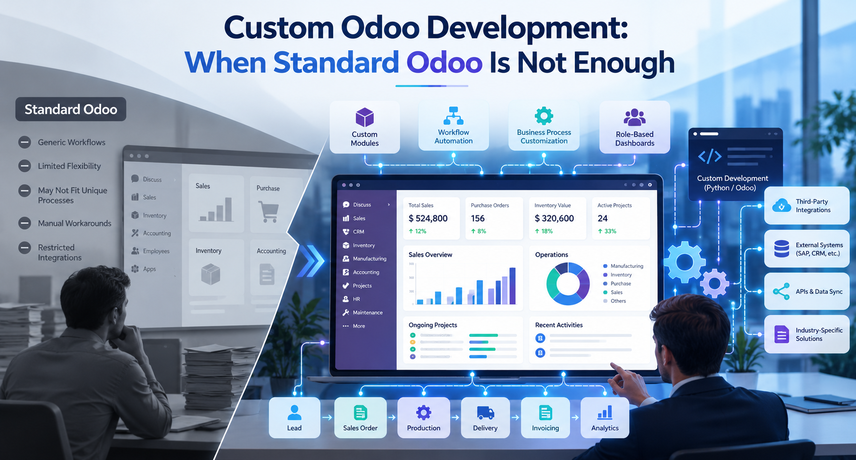
Custom Odoo development is the practice of building new modules, workflows, integrations, automations, and reports on top of Odoo’s standard apps when configuration and Odoo Studio cannot match how your business actually operates. You need it when your approval chains, compliance rules, or connected systems go beyond what standard Odoo does out of the box.
Standard Odoo covers common ERP processes well: sales, inventory, accounting, manufacturing, and CRM. Gaps appear when a mid-sized or enterprise U.S. company needs conditional approvals, customer-specific pricing, EDI with retailers, lot-level traceability, or two-way sync with Salesforce, Shopify, or a 3PL(third-party logistics system) system. At that point, custom Odoo development closes the gap without replacing the ERP. Vraja Technologies delivers Odoo development services and custom Odoo solutions for these cases, and this guide shows how to decide, plan, and scope the work.
What Is Custom Odoo Development?
Custom Odoo development is software engineering done inside the Odoo framework to add or change business functionality that standard modules do not provide. Odoo custom development includes custom modules, new data models, API integrations, automated actions, and custom reports.
Odoo runs on Python and PostgreSQL, with an object-relational mapping (ORM) layer, XML views, and the OWL JavaScript framework for the web client. Developers extend Odoo through custom modules that inherit existing models, views, and logic instead of editing core code. This inheritance design is what keeps custom Odoo solutions maintainable across versions.
Configuration vs. Odoo Studio vs. Custom Code: What Is the Difference?
There are three levels of change in Odoo, and each one costs more to build and maintain than the one before it.
| Level | What It Does | Example | Code Required |
|---|---|---|---|
| Configuration | Uses settings already built into an app | Enable multi-step deliveries | No |
| Odoo Studio | Edits forms, fields, and simple automations | Add an approval status field | No |
| Custom Development | Adds Python, XML, and JavaScript modules and integrations | Build a contract rebate engine | Yes |
The rule is simple: exhaust configuration and Studio before writing code. Teams that skip this order inherit maintenance they did not need, and reputable Odoo development services providers follow it. Hosting also matters. Per Odoo’s documentation, Odoo Online does not support custom modules, so custom code runs on Odoo.sh or on your own servers.
When Is Standard Odoo Not Enough? 8 Warning Signs
Standard Odoo is not enough when a recurring process still needs spreadsheets, manual re-entry, or workarounds after proper configuration. These eight signs are the most common triggers for custom Odoo development among U.S. mid-sized and enterprise buyers:
- Conditional approval chains. Example: purchase orders over $25,000 route to a department head, then the CFO, with different paths by cost center.
- Customer-specific pricing. Contract prices, tiered rebates, and promotion stacking that standard price lists cannot model.
- Integration with systems of record. Salesforce, Shopify, QuickBooks, a payroll platform, or a 3PL warehouse system must exchange data with Odoo automatically.
- EDI with large retailers. Trading partners require ANSI X12 documents such as the 850 purchase order, 856 advance ship notice, and 810 invoice.
- Regulated traceability. Food, pharma, and medical device companies face FDA 21 CFR Part 11 electronic record rules and the FDA Food Traceability Rule under FSMA Section 204.
- Complex manufacturing. Multi-level bills of materials, by-products, and custom scheduling beyond standard MRP logic.
- Multi-state tax and multi-company structures. Since South Dakota v. Wayfair (2018), U.S. sellers can owe sales tax in states where they have only economic nexus, which often requires tax-engine integrations such as Avalara.
- Reporting the standard apps cannot produce. Margin by customer contract, utilization by project, or consolidated KPIs across legal entities.
Quick test: if three or more apply, plan custom Odoo development as part of the project rather than treating it as a later fix.
What Does Custom Odoo Development Include?
Custom Odoo development covers five work types: workflows, integrations, automation, reports, and industry-specific features. Each type of Odoo custom development targets a different kind of gap.
Custom Workflows and Approval Logic
Custom workflows add states, rules, and approvals that match your real process. Custom Odoo solutions for workflows typically add a multi-level approval model, role-based access rules, and email or Slack notifications. The result is fewer off-system approvals and a full audit trail inside Odoo.
Odoo Integrations and APIs
Integration-focused Odoo development services connect Odoo to the other systems your teams use. Odoo exposes external APIs (XML-RPC and JSON-RPC historically, with newer versions adding a JSON-2 API), so confirm which one your version supports. Common U.S. integration targets include QuickBooks, Shopify, Salesforce, ShipStation, UPS and FedEx, Stripe, Avalara, and EDI providers. Good integrations use queues, retry logic, and error logging so a failed sync never silently corrupts data.
Automation and Scheduled Actions
Odoo custom development for automation removes repeated manual work. Odoo supports server actions, automated actions, and scheduled actions (cron jobs), and custom code extends these with logic the standard rules cannot express. Examples include auto-generating invoices from delivery milestones, flagging late vendor shipments, and syncing inventory levels every 15 minutes.
Custom Reports and Dashboards
Custom Odoo solutions for reporting give each team the exact view it needs. Developers build QWeb PDF documents (invoices, labels, certificates of analysis), pivot and graph views, and SQL-based reports, and connect Odoo to BI tools when needed. Define each report’s source fields and owner before development starts.
Industry-Specific Features
Industry-specific Odoo custom development encodes rules that generic ERP cannot cover:
- Manufacturing: lot genealogy, quality checkpoints, and shop-floor tablet workflows.
- Distribution: vendor-managed inventory, cross-docking, and EDI automation.
- Food and life sciences: recall reports and compliance-ready batch records.
- Professional services: rate cards, utilization dashboards, and milestone billing.
How Do You Plan Custom Odoo Development in 7 Steps?
Plan custom Odoo development by mapping the process first, classifying each requirement, and building only what configuration cannot solve. Follow these steps:
- Map the real process. Interview frontline users, not only managers. Document every exception, because exceptions are what break standard flows.
- Classify each requirement. Label it as configuration, Studio, an existing module, or Odoo custom development.
- Check existing modules first. Review the Odoo Apps Store and the Odoo Community Association (OCA) repositories before building custom Odoo solutions that already exist.
- Write measurable acceptance criteria. Example: “Purchase order approval completes in under 24 hours with a full audit log.”
- Build in sprints on a staging copy. Use production-like data and Git version control. Odoo.sh provides staging branches for this purpose.
- Test at three levels. Run automated unit tests, integration tests against sandbox APIs, and user acceptance testing with the people who will use the system.
- Launch, monitor, and review. Watch usage and error logs for 90 days, then decide whether any custom work can be retired in favor of newer standard features.
How Much Does Custom Odoo Development Cost and How Long Does It Take?
Custom Odoo development cost and timeline depend on scope, integrations, and compliance needs, not on user count. Typical planning ranges for Odoo development services are below. Treat them as starting points and confirm them after a discovery phase.
| Scope | Typical Timeline | Main Cost Drivers |
|---|---|---|
| Small Change (Fields, Report, Automation) | 1 to 3 weeks | Number of screens and rules |
| Mid-Size Module (Approvals, Pricing Engine) | 4 to 8 weeks | Business rules, testing depth |
| Integration (EDI, 3PL, CRM) | 3 to 10 weeks | Partner API quality, data volume |
| Multi-Module Vertical Solution | 3 to 6 months | Compliance, data migration, training |
Three factors raise the cost of custom Odoo solutions the most: unclear requirements, third-party APIs with poor documentation, and skipped testing. A fixed-scope estimate for Odoo custom development with a written maintenance plan protects your budget better than an hourly open-ended quote.
How Do You Keep Custom Odoo Solutions Upgrade-Safe?
Keep custom Odoo solutions upgrade-safe by inheriting core behavior, isolating each capability in its own module, and testing every major release on staging. Odoo ships a new major version every year and supports the three most recent versions, so poorly built custom Odoo development becomes expensive fast.
Technical debt in Odoo custom development usually comes from five sources: edited core code, undocumented modules, hard-coded record IDs, unstable integrations, and no automated tests. Use this checklist to prevent it:
- Extend models and views through inheritance. Never edit core files.
- Build one module per business capability so each can be upgraded or retired alone.
- Store all code in Git with peer review and a deployment pipeline.
- Write automated tests for every business rule that touches money, inventory, or compliance.
- Document each module’s purpose, owner, and dependencies.
- Budget for one upgrade-testing cycle every year.
Should You Use an In-House Team or an Odoo Development Partner?
Use an Odoo development services partner for specialized, time-bound, or compliance-heavy work, and use an in-house team when you have continuous roadmap needs and the budget to retain senior Odoo talent. Many U.S. companies combine both: a partner builds and documents the foundation, and internal staff handle small changes. Vraja Technologies can serve as that build partner.
The tradeoff comes down to speed, depth, and continuity. A partner brings tested patterns for Odoo custom development and integrations on day one. An internal hire brings daily context but takes months to recruit and ramp. For a detailed comparison, read this breakdown of an Odoo development company vs an in-house team.
How Do You Choose an Odoo Development Services Partner?
Choose an Odoo development services partner by verifying upgrade discipline, integration experience, documentation standards, and a clear support model. Ask every candidate these six questions:
- Do you recommend configuration or Studio before custom code, and can you explain why in writing?
- How do you structure modules so they survive major Odoo upgrades?
- Which integrations have you built for U.S. systems such as QuickBooks, Shopify, Salesforce, and EDI providers?
- What automated tests and staging process do you use before go-live?
- Who owns the source code, and will you hand over full documentation?
- What does post-launch support cost, and what response times apply?
A provider of custom Odoo solutions that cannot answer all six clearly is a risk to your upgrade path. Vraja Technologies is glad to answer all six in writing.
Why Do U.S. Businesses Choose Vraja Technologies for Custom Odoo Development?
Vraja Technologies provides custom Odoo development focused on workflows, integrations, automation, and reporting for U.S. mid-sized and enterprise businesses. Its Odoo custom development approach follows the principle this guide recommends: customize only where standard Odoo falls short, and document everything built.
Vraja Technologies’ odoo development services cover requirement analysis, custom module engineering, API and EDI integrations, report design, testing, and post-launch support. For teams that also need odoo customization services, Vraja Technologies scopes each change against standard features first, so you pay for custom Odoo solutions only where they add measurable value. You can review the full service scope on the ERP implementation services page.
Next Step
Start with a requirements audit: list every process that still needs a spreadsheet or manual workaround, then classify it as configuration, Studio, or custom code. That list becomes your scope. Vraja Technologie’s Odoo development services team can review it and recommend the smallest set of custom Odoo development work that removes your biggest bottlenecks.
Frequently Asked Questions About Custom Odoo Development
What is custom Odoo development?
Custom Odoo development is the creation of new modules, workflows, integrations, and reports inside the Odoo framework to meet needs that standard Odoo apps and Odoo Studio cannot. Developers use Python, XML, JavaScript, and Odoo’s ORM, and they extend core features through inheritance.
When do I need custom Odoo development instead of Odoo Studio?
You need custom Odoo development when a requirement involves complex business logic, external system integrations, new data models, or compliance rules. Odoo Studio handles simple fields, views, and automations without code, but it cannot build an EDI connector or a multi-condition pricing engine.
Can I run custom modules on Odoo Online?
No. Odoo’s documentation states that Odoo Online does not support custom modules. Custom code runs on Odoo.sh or on-premise, so hosting is a key decision before odoo custom development begins.
How much does custom Odoo development cost?
The cost of Odoo development services depends on scope. Small changes take 1 to 3 weeks, mid-size modules 4 to 8 weeks, and multi-module vertical solutions 3 to 6 months. A discovery phase produces a fixed-scope estimate for your specific requirements.
Will custom Odoo solutions break when I upgrade Odoo?
Not if they are built correctly. Modules that inherit core behavior, have automated tests, and are checked on staging usually upgrade with limited rework. Modules that edit core code or hard-code IDs are the ones that fail.
What are Odoo customization services?
These are professional services that adapt Odoo to a company’s workflows, forms, reports, and integrations. They range from configuration and Studio changes to full custom module engineering.
Can Odoo integrate with QuickBooks, Shopify, Salesforce, and EDI?
Yes. Odoo exposes external APIs, and Odoo development services teams build connectors for QuickBooks, Shopify, Salesforce, shipping carriers, tax engines like Avalara, and EDI providers. Each integration should include retry logic, error logging, and monitoring.
How long does Odoo custom development take?
A small automation or report can ship in 1 to 3 weeks. An EDI or CRM integration typically takes 3 to 10 weeks. Larger industry solutions run 3 to 6 months, depending on testing, training, and data migration.