






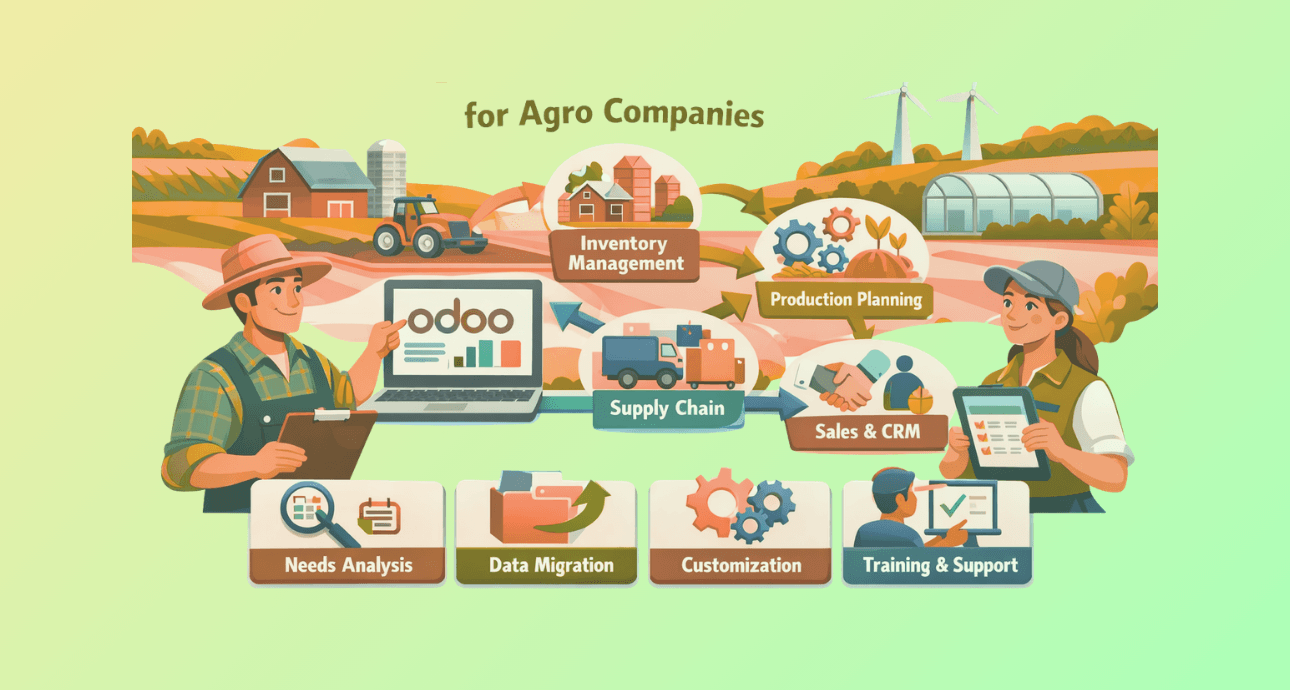
How to Successfully Implement Odoo ERP for Agro Companies (Step-by-Step Strategy)
The agricultural industry is undergoing rapid digital transformation as businesses look for better ways to manage complex supply chains, seasonal procurement cycles, and fluctuating commodity prices. Traditional manual processes and disconnected systems often make it difficult for agro companies to maintain efficiency, traceability, and accurate reporting.
Implementing Agriculture ERP Software such as Odoo allows agro-product companies to centralize procurement, inventory, quality control, processing, and financial management into a single integrated platform. By connecting critical business operations, ERP systems provide real-time visibility across the entire supply chain.
For companies operating in procurement, processing, storage, or export of agricultural products, ERP implementation helps reduce operational errors, improve transparency, and enable data-driven decision making that supports long-term business growth.
Agro Supply Chain Management
Managing the agricultural supply chain involves coordinating multiple stakeholders, including farmers, procurement teams, warehouse operators, processors, logistics providers, and export partners. Without a centralized system, it becomes difficult to maintain transparency and efficiency across these interconnected activities.
Odoo ERP helps agro businesses optimise agro supply chain managementStep -by-step Strategy to implement Odoo ERP
by connecting procurement, inventory, processing, and sales operations within a unified system. This ensures that every product batch can be tracked from the moment it is purchased from farmers to its final delivery to customers or export markets.
Key supply chain benefits of implementing Odoo ERP include:
- Centralized procurement management
- Real-time tracking of product batches
- Automated inventory updates across warehouses
- Improved coordination between procurement, warehouse, and sales teams
- Better demand forecasting and planning
With improved supply chain visibility, agro companies can reduce delays, avoid stock shortages, and improve their ability to respond quickly to market demand changes.
Agro Inventory Management
Inventory management is one of the most challenging aspects of operating an agro-product business. Agricultural products often require specialized storage conditions, seasonal stocking strategies, and strict batch traceability to maintain product quality.
Without a centralized system, companies may struggle with inaccurate stock records, delayed procurement decisions, and difficulty tracking product movement across warehouses.
Odoo ERP provides a powerful inventory management system that enables agro companies to:
- Track inventory across multiple warehouses in real time
• Manage batch and lot numbers for complete product traceability
• Implement FIFO or FEFO inventory valuation strategies
• Monitor stock aging and storage conditions
• Automate reordering rules based on demand forecasts
With better inventory visibility, agro businesses can reduce stock losses, prevent over-procurement, and maintain consistent product quality throughout the supply chain.
Step-by-Step Strategy to Implement Odoo ERP for Agro Companies
1. Conduct a Detailed Business Process Analysis
Before implementing any ERP system, it is essential to analyze the current workflows across the organisation. Agro companies typically have multiple interconnected processes such as procurement from farmers, quality grading, warehouse storage, processing, packaging, and export logistics.
During this stage, businesses should document:
- Procurement workflows from farmers and suppliers
- Quality grading and inspection procedures
- Warehouse storage structures and product movement
- Processing or manufacturing operations
- Sales and export processes
- Financial and accounting workflows
Understanding these workflows helps identify inefficiencies and ensures the ERP system is configured to match real operational needs.
Many companies begin this phase with professional Odoo ERP consulting services to ensure their ERP implementation is aligned with industry best practices.
2. Define the ERP Implementation Scope
Agro businesses often attempt to implement all ERP modules at once, which can make adoption difficult. A phased implementation approach typically produces better results.
Common implementation phases include:
Phase 1 – Core Operations
- Procurement management
- Inventory management
- Accounting and financial tracking
Phase 2 – Operational Optimization
- Warehouse management
- Quality control processes
- Batch and lot traceability
Phase 3 – Advanced Automation
- Manufacturing or processing workflows
- Pricing automation
- Logistics and export documentation
By implementing ERP modules gradually, companies reduce operational disruption while allowing employees to adapt to new systems.
3. Structure Master Data Properly
One of the most important aspects of ERP success is master data structure. Poor data design often leads to inaccurate reporting and operational confusion.
Agro companies must carefully structure the following data within Odoo:
- Vendor and farmer records
- Product categories and grading systems
- Batch and lot identification methods
- Warehouse locations and storage zones
- Procurement pricing rules
Clean and structured data ensures accurate reporting and smooth system performance.
4. Configure Procurement and Quality Workflows
Procurement in agro industries differs significantly from traditional supply chains. Product quality can vary from batch to batch depending on harvest conditions.
Odoo ERP can be configured to manage procurement processes that include:
- Vendor-specific pricing rules
- Quality inspection during goods receipt
- Moisture or quality grading classifications
- Procurement approvals and purchase workflows
These configurations ensure procurement decisions are transparent and traceable across the organization.
5. Implement Lot Tracking and Traceability
Traceability is critical in the agro industry due to food safety standards and export compliance requirements.
Odoo allows companies to implement lot tracking and batch traceability so every product can be tracked across its entire lifecycle.
This includes:
- Procurement batch identification
- Warehouse storage tracking
- Processing and production records
- Shipment tracking for export orders
If a quality issue arises, the company can quickly identify the affected batch and prevent further distribution.
6. Optimize Warehouse Structure and Inventory Flow
Agro warehouses often store large quantities of products for extended periods. Proper warehouse configuration ensures efficient stock movement and accurate inventory reporting.
Odoo enables companies to design optimized warehouse workflows including:
- Storage location hierarchy
- Automated stock transfers
- FIFO or FEFO removal strategies
- Barcode-based product movement
This improves warehouse efficiency and reduces manual tracking errors.
7. Customize ERP Workflows for Agro Processing
Many agro companies operate processing units where raw materials are converted into refined products.
Examples include:
- Paddy processing into rice
- Wheat milling into flour
- Oilseed processing into edible oils
These processes often involve yield variations and by-product generation. Odoo can be customized to handle these workflows through manufacturing configurations and custom development.
Companies requiring industry-specific ERP features can work with experienced developers through
https://vrajatechnologies.com/hire-odoo-developer to build customized solutions.
8. Train Employees and Ensure System Adoption
Even the most advanced ERP system will fail if employees are not properly trained to use it.
Agro companies should conduct structured training programs for:
- Procurement teams
- Warehouse staff
- Production supervisors
- Accounting departments
- Management teams
Hands-on training ensures employees understand how the ERP system supports their daily tasks and improves productivity.
9. Test Workflows Before Full Deployment
Before going live, it is important to thoroughly test ERP workflows using real business scenarios.
Testing should include:
- Procurement transactions
- Inventory movements
- Batch traceability processes
- Production workflows
- Accounting integration
This step helps identify configuration gaps or operational challenges before the system is fully deployed.
10. Monitor Performance and Continuously Improve
ERP implementation is not a one-time project. Continuous monitoring and optimization are essential to maximize long-term value.
After deployment, businesses should regularly review:
- Inventory accuracy reports
- Procurement cost trends
- Production yield performance
- Warehouse efficiency metrics
- Financial reporting accuracy
As ERP technologies evolve, companies can also integrate automation and AI-based insights to further optimize operations. The growing role of ERP automation and integrations is discussed in
https://vrajatechnologies.com/blog/1/odoo-ai-agent-integration-in-2025-the-future-of-erp-edi-and-customization-79.
Financial Visibility and Cost Control
Another major advantage of implementing ERP for agro companies is improved financial transparency. Agricultural businesses often operate with fluctuating procurement costs, seasonal demand, and complex pricing structures.
Odoo ERP integrates procurement, inventory, sales, and accounting data into a single system, allowing businesses to:
- Track procurement costs by supplier or crop type
• Analyze profit margins across different products
• Monitor warehouse carrying costs
• Generate real-time financial reports for better decision-making
With integrated financial data, agro companies gain better control over operational costs and can make strategic decisions with greater confidence.
Conclusion
As agricultural supply chains become more complex and globally connected, digital transformation is no longer optional for agro-product companies. By implementing Odoo ERP, businesses can centralise procurement, inventory management, quality control, and financial operations across a single integrated platform.
This not only improves operational efficiency but also enables better traceability, stronger supplier relationships, and more accurate financial reporting. With real-time insights into procurement costs, processing yields, and sales performance, managers can make faster and more informed decisions that drive long-term growth.
For a deeper understanding of how agro businesses can adopt ERP-driven digital transformation strategies, you can also explore our upcoming article:
Blog 1 – Agro-Product Companies & Digital Transformation with Odoo ERP
This article further explains how ERP systems like Odoo are transforming agricultural supply chains and helping agro businesses operate more efficiently in a rapidly evolving industry.


05 Comments
minoxidil pills amazon
16/05/2026minoxidil pills amazon
minoxidil pills amazon
rash from flagyl
24/05/2026rash from flagyl
rash from flagyl
sildenafil mechanism of action
17/07/2026sildenafil mechanism of action
sildenafil mechanism of action
vardenafil 10 mg tablet reference
24/07/2026vardenafil 10 mg tablet reference
vardenafil 10 mg tablet reference
orlistat bowel side effects
30/07/2026orlistat bowel side effects
orlistat bowel side effects