




Hire Odoo Developer for Custom Module Development: What Businesses Should Know
Hire an Odoo developer for custom module development when standard Odoo apps and configuration cannot support a core business process, and you need code that survives upgrades. Choose a dedicated or hourly developer from an established partner for most projects. Hire in-house only if you have a steady, full-time roadmap.
This guide explains what custom module development involves, how to decide whether you need it, how to contract a developer, and what to budget. It is written for business owners, CTOs, and IT managers at US companies planning Odoo customization, integration, or migration. Vraja Technologies builds custom Odoo modules and lets you hire an Odoo developer on hourly, monthly, or dedicated terms, so the pricing examples below use our published rates.
When Should You Hire an Odoo Developer for Custom Module Development?
Hire one when a business process is unique to you, a required integration does not exist, or standard configuration would force your team into manual workarounds.
Custom development costs more than configuration and adds long-term maintenance, so it should earn its place. A good developer will first confirm that standard apps, settings, or Odoo Studio cannot solve the problem. If they jump straight to code without asking about your process, that is a warning sign.
What Is Custom Module Development in Odoo?
Custom module development is writing an add-on package, usually in Python and XML, that extends or changes Odoo’s behavior without modifying Odoo’s core code.
Odoo is modular. Every app, from Sales to Inventory, is itself a module. A custom module plugs into that structure. Done properly, it inherits and extends existing models and views instead of replacing them, which keeps the system maintainable.
What does a custom Odoo module contain?
A typical module has a manifest file, Python models, XML views, security rules, and optionally data files, reports, and JavaScript components.
- Manifest (__manifest__.py): name, version, dependencies, and the list of files to load.
- Models: Python classes that add fields or logic through Odoo’s ORM.
- Views: XML that defines forms, lists, kanban boards, and search filters.
- Security: access rights and record rules that control who sees what.
- Reports and templates: QWeb-based PDFs and website pages.
- Front-end components: JavaScript, using Odoo’s OWL framework in current versions.
Our Odoo customization services cover each of these layers, from simple field additions to full workflow modules and third-party integrations.
Do You Actually Need a Custom Module?
Not always. Try configuration, Odoo Studio, or an existing app first, and write custom code only for the gaps that remain.
| Your need | Best approach |
|---|---|
| Add a field, rename a label, adjust a report | Configuration or Odoo Studio |
| Standard process with minor variations | Standard apps plus settings |
| An existing app on the Odoo Apps Store fits | Evaluate and install it |
| A unique approval, pricing, or fulfillment workflow | Custom module |
| Integration with a carrier, marketplace, EDI partner, or internal API | Custom module or connector |
| Complex logic that changes core behavior | Custom module, designed carefully |
If you are weighing this tradeoff, our post on Odoo customisation vs standard Odoo walks through how to decide.
What Skills Should an Odoo Developer Have?
A strong Odoo developer combines Python and PostgreSQL skills with deep knowledge of Odoo’s ORM, view system, security model, and deployment workflow.
Look for evidence of all of the following:
- Python proficiency and clean code habits (testing, code review).
- Hands-on use of the Odoo ORM, including inheritance and computed fields.
- XML view customization and QWeb reporting.
- OWL or JavaScript experience for frontend work.
- PostgreSQL basics for performance tuning and data fixes.
- Experience with both Odoo Community and Enterprise.
- Git workflows, staging environments, and Odoo.sh or server deployment.
- Business understanding of the apps being customized (accounting, inventory, sales).
Business knowledge matters as much as code. A developer who understands your warehouse or invoicing process writes simpler, safer modules.
Which Hiring Model Fits Your Project?
For most US businesses, hiring from an Odoo development company is more practical than recruiting, because you avoid the hiring delay, benefits cost, and single-person dependency.
| Model | Best for | Main risk |
|---|---|---|
| Freelancer | Small, one-off fixes | Availability, no backup, inconsistent quality |
| In-house hire | Constant, high-volume development | High fixed cost, slow hiring, key-person risk |
| Odoo development company | Projects, integrations, migrations, ongoing support | Contract and scope clarity |
| Dedicated developer from a partner | Continuous roadmap without payroll | Needs clear priorities from your side |
The US Bureau of Labor Statistics reports a median annual wage of $133,080 for software developers (May 2024), before benefits, recruiting, and overhead. That is why many companies use an Odoo development company or dedicated developers for variable workloads. If you want to compare a partner against a full team on payroll, see our breakdown of an Odoo development company vs an in-house team.
Published Vraja Technologies engagement models
| Plan | Price | What it includes |
|---|---|---|
| Flexible Hourly | $25 per hour | On-demand tasks, certified Odoo developers, transparent time tracking |
| Monthly Commitment | $1,900 per month | 80 hours per month, priority support, dedicated developer for your tasks |
| Dedicated Developer | $3,800 per month | 160 hours per month, project management assistance, weekly progress reports and strategy calls |
| Enterprise | Scope-based | Full implementation, migration, custom workflows, dedicated team |
How Do You Hire an Odoo Developer? A 7-Step Process
Follow these seven steps: define the problem, check standard options, write requirements, shortlist partners, run a paid trial, sign a clear contract, and set up access and reporting.
- Define the business problem. Describe the process, the users, and the outcome you need, not the code you imagine.
- Check standard options. Confirm with a functional consultant that configuration, Studio, or an existing app cannot solve it.
- Write requirements. List inputs, outputs, edge cases, user roles, reports, and integrations.
- Shortlist two or three providers. Check Clutch, GoodFirms, and Odoo Apps Store profiles, and ask for US-based references.
- Run a small paid trial. A 10 to 20 hour task shows code quality, communication, and honesty about estimates.
- Sign a contract with ownership and documentation terms. See the contract section below.
- Set up access and reporting. Grant staging access first, agree on weekly updates, and keep production credentials under your control.
How Do You Vet an Odoo Developer Before Signing?
Ask for proof of delivered modules, review a code sample, and test how the developer reasons about your problem.
Technical questions to ask
- How would you extend an existing model without editing core code?
- How do you handle access rights and record rules for a new model?
- How do you test a module before it reaches production?
- What would you check if a custom report suddenly runs slowly?
- How do you prepare a module for the next Odoo version?
- Can you show a module you built, with its repository structure?
Red flags
- Promises a fixed price without asking detailed questions.
- Edits Odoo core files instead of inheriting.
- No staging environment or version control.
- Refuses to share code ownership or documentation.
- Cannot explain how upgrades will be handled.
- Only freelancer availability with no backup person.
What Should the Contract Include?
The contract should state code ownership, documentation, access control, acceptance criteria, support terms, and confidentiality.
- IP assignment: you own the custom code on payment.
- Repository access: code lives in a repository you control, such as GitHub.
- Acceptance criteria: a written list of what “done” means, with testing sign-off.
- Documentation: a short technical and user guide for each module.
- Warranty period: bug fixes at no cost for a defined window after go-live.
- Security: NDA, least-privilege access, and no shared production passwords.
- Change control: how scope changes are priced and approved.
- Continuity: what happens if the assigned developer leaves.
Why Hire Odoo Developers From Vraja Technologies?
Vraja Technologies is a certified Odoo partner that provides in-house Odoo developers for custom modules, integrations, migration, and support, with onboarding typically within 24 to 48 hours.
Conclusion
Hire an Odoo developer when a process is truly unique, an integration is missing, or workarounds are costing you time, and pick a model that matches your workload. Start with configuration, write custom code only where needed, and protect yourself with clear contracts and upgrade-safe design.
Frequently Asked Questions
How much does it cost to hire an Odoo developer?
It depends on the hiring model. At Vraja Technologies, published rates start at $25 per hour, $1,900 per month for 80 hours, or $3,800 per month for a dedicated developer at 160 hours. A US-based full-time developer costs far more once salary, benefits, and overhead are included.
Should I hire a freelancer or an Odoo development company?
Use a freelancer for small, one-off fixes and a company for anything business-critical. A company provides backup developers, QA, documentation, and continuity if someone leaves.
What is a custom module in Odoo?
It is an add-on package that extends Odoo with new fields, logic, views, reports, or integrations without changing core code. Every standard Odoo app is built the same way.
How long does custom module development take?
Small changes take hours to days; workflow modules take weeks; integrations vary by API complexity. Timelines depend on scope clarity, testing cycles, and how quickly your team gives feedback.
Do I need Odoo Enterprise to use custom modules?
No. Custom modules run on both Community and Enterprise. Community may need more custom work to match features that Enterprise includes.
Will customization break my Odoo upgrades?
Not if the code is built correctly. Modules that inherit rather than overwrite core logic upgrade more smoothly, though every custom module still needs testing on each new version.
Who owns the custom code?
It should be you. Put IP assignment and repository access in the contract before work starts.
Can I hire an Odoo developer part-time?
Yes. Hourly and monthly plans suit part-time needs. A dedicated developer suits a continuous roadmap.
Can an Odoo development company work in US time zones?
Yes, if it plans for overlap. Vraja Technologies supports EST and PST working windows along with IST and GMT.
Can an Odoo developer handle third-party integrations?
Yes. Integrations with shipping carriers, payment gateways, marketplaces, EDI systems, and accounting tools are common Odoo development services.
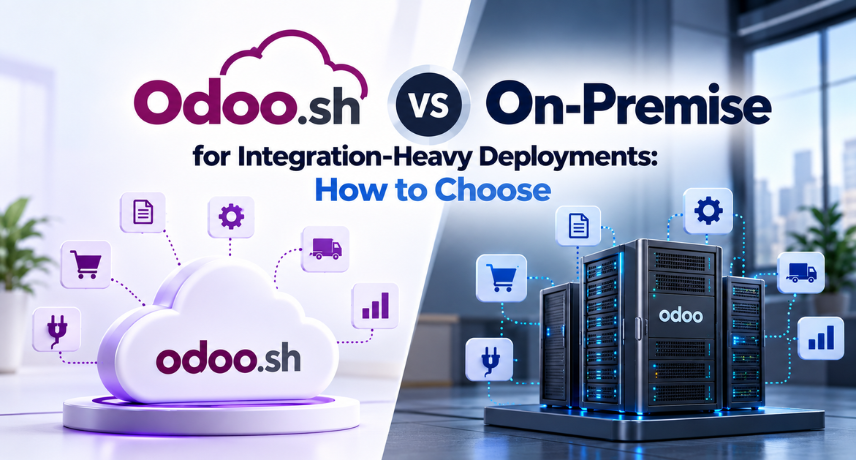
Can your developers work on Odoo.sh projects?
Yes. Our team works with Odoo.sh, GitHub repositories, staging branches, and production deployments.
How do I know a developer is good before committing?
Run a small paid trial and review a code sample. Ask technical questions about inheritance, security rules, testing, and upgrades.