




07/08/2026
No Comments
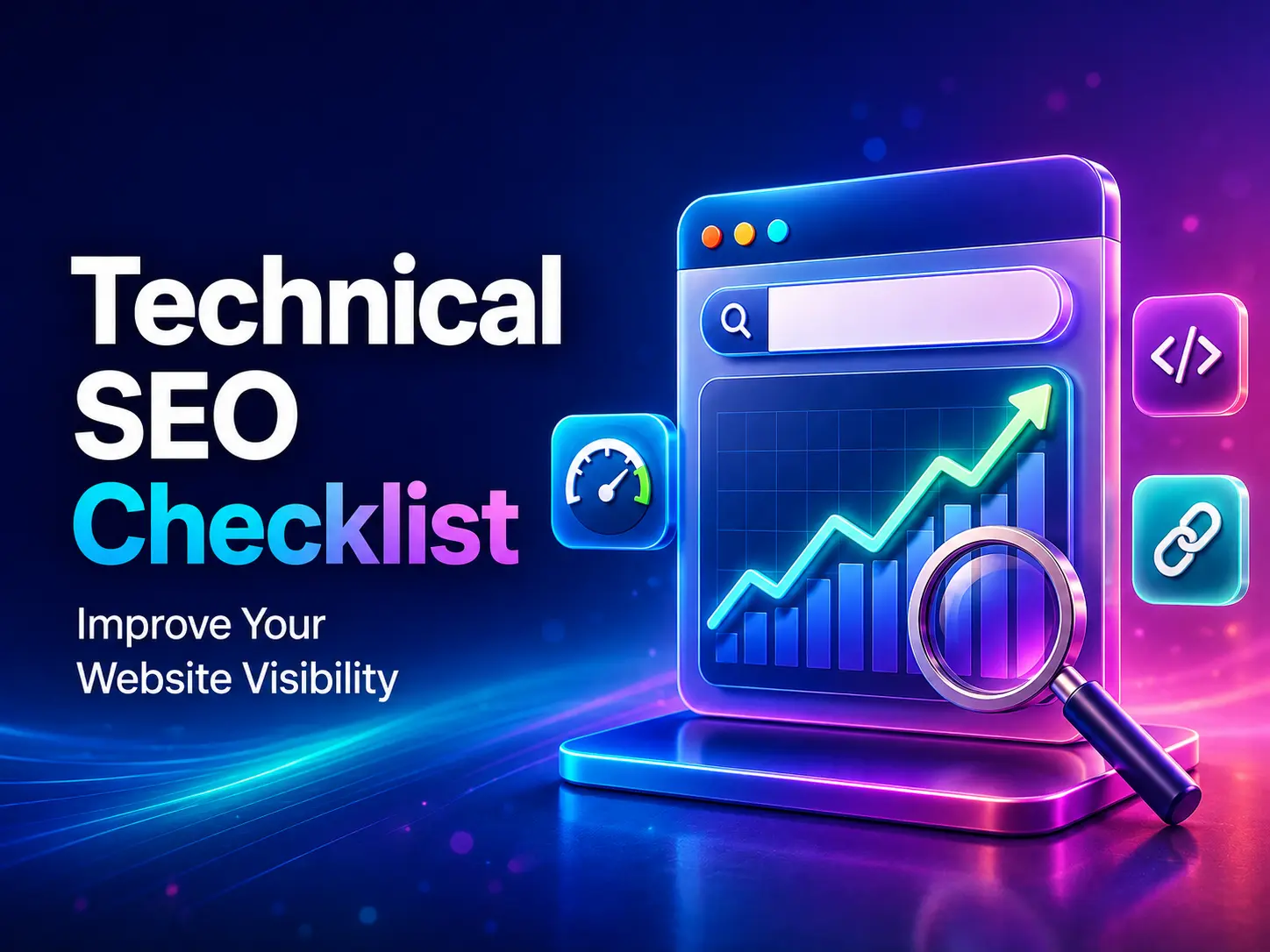
Technical SEO Checklist: Essential Steps to Improve Your Website Visibility
A visually attractive website is not enough to rank well on Google. Search engines must also be able to crawl, understand, index, and evaluate your website correctly.
This is where technical SEO becomes important. Technical SEO focuses on improving the technical structure and performance of a website so search engines can access its pages easily and users receive a faster, safer, and more convenient browsing experience.
In this guide, we will explain the most important technical SEO steps you should follow to improve your website visibility, search engine rankings, and overall performance.
What Is Technical SEO?
Technical SEO is the process of optimizing the technical elements of a website so search engines can crawl, understand, and index its pages properly.
It includes areas such as:
- Website speed
- Mobile responsiveness
- URL structure
- Page indexing
- XML sitemaps
- Robots.txt
- Meta tags
- Heading structure
- Schema markup
- Internal linking
- HTTPS security
- Broken links and redirects
Technical SEO does not replace good content. Instead, it creates a strong foundation that helps your content perform better in search results.
Essential Technical SEO Steps to Improve Website Visibility
Not every automotive customer uses every message. The required message set must be confirmed during the EDI onboarding process.
1. Use SEO-Friendly URLs
Your website URLs should be simple, descriptive, and easy to understand.
For better SEO and readability, use hyphens (-) instead of underscores (_).
Recommended URL
`example.com/odoo-shipping-integration`
Avoid
`example.com/odoo_shipping_integration`
Hyphens clearly separate words and make URLs easier for both users and search engines to read.
Additional URL recommendations include:
- Keep URLs short and meaningful.
- Include the main keyword naturally.
- Avoid unnecessary numbers and special characters.
- Use lowercase letters.
- Avoid repeating the same keyword.
- Do not include dates unless the content is date-specific.
- Avoid long category and folder structures.
Important Note for Existing URLs
Do not change an existing indexed URL only to replace underscores with hyphens unless necessary. Changing a live URL can affect existing rankings, backlinks, and traffic. When a URL must be changed, create a 301 redirect from the old URL to the new URL.
You can read Google’s URL structure recommendations here: Google URL Structure Best Practices
2. Improve Website Page Speed
Website speed is important for both user experience and search engine visibility.
A slow website can cause visitors to leave before the page finishes loading. It can also make it more difficult for search engines to crawl a large number of pages efficiently.
Use Google PageSpeed Insights to test your website: Google PageSpeed Insights
The tool analyzes both mobile and desktop performance and provides recommendations for improvement.
Common Page Speed Improvements
- Compress large images.
- Use WebP or AVIF image formats.
- Enable browser caching.
- Minify CSS, JavaScript, and HTML files.
- Remove unused CSS and JavaScript.
- Reduce the number of third-party scripts.
- Use lazy loading for images and videos.
- Improve server response time.
- Use a content delivery network.
- Avoid unnecessary plugins.
- Optimize fonts.
- Preload important website resources.
You should also review your website’s Core Web Vitals, which evaluate loading performance, visual stability, and page responsiveness.
Do not focus only on receiving a perfect score. Prioritize improvements that create a faster and more stable experience for real users.
3. Add a Unique Meta Title to Every Page
The meta title tells search engines and users what a page is about. It commonly appears as the clickable title in search results.
Every important page should have a unique and relevant meta title.
Example : Odoo Shipping Integration Services | Vraja Technologies
Meta Title Best Practices
- Include the main keyword naturally.
- Keep the title clear and relevant.
- Avoid keyword stuffing.
- Make every page title unique.
- Add the company name when appropriate.
- Match the title with the actual page content.
- Place the important keyword near the beginning.
Avoid using the same title, such as “Home” or “Services,” across multiple pages.
4. Add a Unique Meta Description to Every Page
A meta description is a short summary of the page content. It can appear below the page title in search results.
Although Google may sometimes create its own description, adding a well-written meta description gives search engines a useful summary of the page.
Example: Integrate FedEx, UPS, DHL, USPS, and other shipping carriers directly with Odoo. Automate rates, labels, tracking, and shipment management.
Meta Description Best Practices
- Clearly explain what the page offers.
- Include the main keyword naturally.
- Use action-oriented language.
- Make every description unique.
- Avoid copying the same description across pages.
- Give users a reason to click.
- Keep the description relevant to the page.
Meta titles and descriptions should be reviewed regularly, especially for important service, product, category, and landing pages.
5. Correct the Heading Structure
Headings help visitors scan your content and help search engines understand the relationship between different sections.
Each page should normally have one main H1 heading, followed by properly organized H2 and H3 headings.
- H1: Main page title
- H2: Main section
- H3: Subsection
- H2: Another main section
- H3: Related subsection
Avoid Incorrect Structures
- Using multiple H1 headings without a clear reason
- Moving directly from H1 to H4
- Using headings only to increase font size
- Repeating the same heading several times
- Using headings that do not describe the content below them
You can inspect the heading structure of a webpage using the Web Developer Chrome extension: Web Developer Chrome Extension
After installing the extension:
1. Open the webpage you want to review.
2. Click the Web Developer extension.
3. Open the Information section.
4. Select “View Document Outline.”
5. Review the order of H1, H2, H3, and other headings.
The heading structure should be logical and easy to understand.
6. Add Schema Markup to Important Pages
Schema markup is structured data added to a webpage to help search engines understand its content more accurately.
Depending on the page, schema can provide information about:
- The organization
- Services
- Products
- Articles
- Frequently asked questions
- Breadcrumbs
- Reviews
- Events
- Local businesses
- Job postings
- Software applications
Schema does not guarantee enhanced search results, but it gives search engines clearer information about the page.
Recommended Schema Types
Homepage: Organization or LocalBusiness schema
Service Page: Service schema
Product Page:Product schema
Blog Article: Article or BlogPosting schema
FAQ Section: FAQPage schema, when the content meets applicable search engine guidelines
Navigation Path: BreadcrumbList schema
Software or Odoo Application Page:SoftwareApplication schema
How to Generate Schema Markup: You can use the following tool to create JSON-LD schema markup:
Schema Markup Generator by TechnicalSEO.com
General process:
1. Select the appropriate schema type.
2. Enter the requested business or page information.
3. Generate the JSON-LD code.
4. Copy the generated schema.
5. Add it to the relevant webpage.
6. Test the page before publishing.
You can also review available schema types and properties on: Schema.org
How to Validate Schema Markup: Use Google’s Rich Results Test to check whether a page is eligible for supported rich results: Google Rich Results Test
You can also validate general Schema.org structured data using:Schema Markup Validator
After implementation, monitor structured data reports inside Google Search Console to identify errors or warnings.
Schema Implementation Best Practices
- Add schema only for information visible on the page.
- Use the correct schema type.
- Do not add fake ratings or reviews.
- Keep names, addresses, phone numbers, and business details consistent.
- Avoid adding irrelevant properties.
- Update schema whenever page information changes.
- Test the final live URL after publishing.
7. Create and Submit an XML Sitemap
An XML sitemap provides search engines with a list of important website URLs.
It is especially useful for:
- Large websites
- New websites
- Websites with many products or services
- Websites with limited internal linking
- Websites that frequently publish new content
A sitemap is commonly available at: `example.com/sitemap.xml`The sitemap should include only important, canonical, and indexable URLs.
Avoid including:
- Redirected URLs
- Error pages
- Duplicate pages
- Noindex pages
- Test pages
- Admin pages
Submit the sitemap through Google Search Console under the Sitemaps section. Google Search Console
8. Check the Robots.txt File
The robots.txt file provides crawling instructions to search engine bots. It is commonly located at: `example.com/robots.txt`
Review the file carefully to ensure important pages are not blocked accidentally.
For example:
text
User-agent: *
Disallow: /admin/
Sitemap: https://example.com/sitemap.xml
Do not use robots.txt as the main method for removing sensitive or unwanted pages from Google. A blocked page may still appear in search results if other pages link to it.
Use proper authentication for private content and a `noindex` directive for pages that should not appear in search results.
9. Make Sure Important Pages Are Indexable
A page cannot receive organic search traffic if search engines cannot index it.
Check important pages for:
- Accidental noindex tags
- Canonical tags pointing to another page
- Robots.txt restrictions
- Login requirements
- Redirect problems
- Server errors
- Duplicate content
- Soft 404 errors
Use the URL Inspection tool in Google Search Console to check whether a page is indexed.
The tool can show:
- Whether Google has indexed the URL
- The selected canonical URL
- Crawling information
- Mobile usability information
- Structured data status
- Reasons why a URL may not be indexed
10. Add Canonical Tags
Canonical tags help search engines identify the preferred version of a page when similar or duplicate URLs exist.
Example:
<link rel=”canonical” href=”https://example.com/technical-seo-checklist”>
Canonical tags are useful when the same content is accessible through:
- URLs with tracking parameters
- Filtered category pages
- HTTP and HTTPS versions
- URLs with and without a trailing slash
- Printer-friendly pages
- Product variations
- Duplicate category paths
Every indexable page should generally have a self-referencing canonical tag unless another page is intentionally selected as the preferred version.
11. Improve Mobile Responsiveness
A website should work properly on mobile phones, tablets, laptops, and desktop computers.
Check the following elements:
- Text should be readable without zooming.
- Buttons should be easy to tap.
- Content should fit within the screen.
- Forms should work properly.
- Menus should be easy to use.
- Images should resize correctly.
- Pop-ups should not block important content.
- Page speed should remain acceptable on mobile connections.
Always review the mobile version of important pages instead of checking only the desktop design.
12. Use HTTPS and Fix Security Issues
HTTPS protects data transferred between the user’s browser and the website.
Your entire website should use HTTPS.
Check for:
- Expired SSL certificates
- HTTP pages that are still accessible
- HTTP resources loaded on HTTPS pages
- Mixed-content warnings
- Incorrect redirects
- Multiple versions of the same website
All variations should redirect to one preferred version, for example: https://www.example.com/
or https://example.com/
Do not allow HTTP, HTTPS, www, and non-www versions to operate as separate websites.
13. Find and Fix Broken Links
Broken links create a poor user experience and may prevent search engines from accessing important pages.
Common broken-link problems include:
- Deleted pages
- Incorrect URLs
- Old blog links
- Removed products
- Changed page slugs
- Broken external references
- Missing images or documents
When an important page is moved, create a 301 redirect to the most relevant replacement page.
Do not redirect every deleted page to the homepage. When no relevant replacement exists, returning a proper 404 or 410 response may be more appropriate.
Useful website crawling tools include: Screaming Frog SEO Spider Ahrefs Webmaster Tools Google Search Console
14. Improve Internal Linking
Internal links connect one page of your website to another.
A strong internal linking structure helps users discover related content and helps search engines understand which pages are important.
Internal Linking Best Practices
- Link related blogs to relevant service pages.
- Link service pages to appropriate case studies.
- Use descriptive anchor text.
- Avoid anchor text such as “click here.”
- Make important pages reachable within a few clicks.
- Fix orphan pages that have no internal links.
- Add breadcrumbs on larger websites.
- Avoid adding too many unnecessary links.
Example Instead of:
“Click here to learn more.”
Use: Learn more about our Odoo shipping integration services.
The anchor text should clearly explain the destination page.
15. Optimize Images
Large and unoptimized images can reduce website speed.
Before uploading an image:
- Resize it to the required display dimensions.
- Compress the file.
- Use WebP or AVIF when supported.
- Add descriptive file names.
- Add relevant alt text.
- Avoid uploading unnecessarily large files.
- Enable lazy loading for below-the-fold images.
Recommended Image File Name : `odoo-shipping-integration-dashboard.webp`
Avoid :`IMG_45897.webp
Example Alt Text: `Odoo shipping integration dashboard displaying carrier rates`
Alt text should describe the image naturally. Avoid adding unnecessary keywords to every image.
Decorative images that provide no meaningful information may use empty alt text.
16. Remove Duplicate and Thin Content
Search engines may struggle to identify the most relevant page when several pages contain nearly identical information.
Common causes of duplicate content include:
- Multiple service pages targeting the same keyword
- Product filter URLs
- Printer versions
- HTTP and HTTPS versions
- Copied manufacturer descriptions
- Repeated location pages with only the city name changed
- Duplicate blogs
- URL tracking parameters
Each important page should provide useful and original information.
Pages with very little value should be improved, combined with another page, redirected, excluded from indexing, or removed depending on their purpose.
17. Add Breadcrumb Navigation
Breadcrumbs show users where they are within the website structure.
Example: `Home > Services > Odoo Integration > Shipping Integration`
Breadcrumbs improve navigation and help search engines understand the relationship between website sections.
For better implementation, combine visible breadcrumb navigation with BreadcrumbList schema markup.
18. Review Redirects and Redirect Chains
A redirect sends visitors and search engines from one URL to another.
Use a 301 redirect when a page has permanently moved.
Avoid redirect chains such as: `Page A → Page B → Page C → Page D`
Instead, Page A should redirect directly to the final destination.
Also review:
- Redirect loops
- HTTP-to-HTTPS redirects
- www and non-www redirects
- Old campaign URLs
- Changed product URLs
- Deleted category pages
Too many unnecessary redirects can affect page speed and make website maintenance difficult.
19. Check Website Status Codes
Every website URL returns an HTTP status code.
Important status codes include:
200: The page is working normally.
301: The page has permanently moved.
302: The page has temporarily moved.
404: The page was not found.
410: The page has been permanently removed.
500: The server experienced an error.
503: The service is temporarily unavailable.
Important pages should normally return a 200 status code.
Regularly monitor 404, 500, and redirect errors using Google Search Console or a website crawling tool.
20. Optimize JavaScript-Based Content
Some websites load important content through JavaScript.
Search engines can process JavaScript, but excessive or poorly implemented JavaScript may create crawling, rendering, or performance problems.
Make sure important information such as the following is available to search engines:
- Main page content
- Product descriptions
- Internal links
- Headings
- Pricing information
- Navigation
- Canonical tags
- Meta titles and descriptions
Where possible, use server-side rendering, static rendering, or properly optimized modern frameworks for important SEO pages.
21. Add Hreflang Tags for Multilingual Websites
Websites targeting multiple countries or languages should consider hreflang implementation.
Hreflang tags help search engines understand which language or regional page should be shown to a user.
For example:
- English page for the United States
- English page for the United Kingdom
- French page for France
- Dutch page for Belgium
Hreflang tags must be implemented carefully. Each language page should reference the other available versions and include a self-reference.
Incorrect hreflang implementation can cause the wrong page to appear in regional search results.
22. Connect Google Search Console
Google Search Console is one of the most important tools for technical SEO.
- It helps you monitor:
- Search performance
- Indexed pages
- Crawling errors
- Sitemap status
- Page experience
- Core Web Vitals
- Structured data
- Security issues
- Manual actions
- Mobile usability
- Search queries and click-through rates
Website owners should review Search Console regularly instead of checking it only when traffic decreases.
23. Set Up Website Analytics
Analytics tools help you understand how visitors use your website.
Google Analytics can provide information about:
- Website traffic
- Landing pages
- User engagement
- Traffic sources
- Conversions
- Devices
- Countries
- User journeys
Technical SEO data from Search Console should be reviewed together with user behavior and conversion data from analytics.
High rankings are valuable only when the traffic generates meaningful enquiries, purchases, registrations, or other business results. Google Analytics
24. Regularly Audit Your Website
Technical SEO is not a one-time activity.
Website changes, plugin updates, content removal, redesigns, migrations, and development work can create new technical issues.
A regular audit should review:
- Indexing status
- Page speed
- Broken links
- Redirects
- Meta titles
- Meta descriptions
- Heading structure
- Schema errors
- Canonical tags
- XML sitemap
- Robots.txt
- Mobile usability
- Duplicate content
- Internal links
- Security and HTTPS
A small website may be reviewed every few months, while a large eCommerce or frequently updated website may require more frequent monitoring.
Recommended Technical SEO Tools
Google PageSpeed Insights
Use it to test website speed, Core Web Vitals, and performance recommendations. https://pagespeed.web.dev/
Google Search Console
Use it to check website indexing, crawling, search performance, sitemaps, and structured data. https://search.google.com/search-console/
Google Rich Results Test
Use it to test supported structured data and rich-result eligibility. https://search.google.com/test/rich-results
Schema Markup Validator
Use it to validate general Schema.org markup. https://validator.schema.org/
Schema Markup Generator
Use it to generate JSON-LD schema for organizations, services, products, FAQs, articles, and other page types. https://technicalseo.com/tools/schema-markup-generator/
Web Developer Chrome Extension
Use it to review page headings, images, links, forms, and document structure. https://chromewebstore.google.com/detail/web-developer/bfbameneiokkgbdmiekhjnmfkcnldhhm?pli=1
Screaming Frog SEO Spider
Use it to crawl your website and identify broken links, missing metadata, duplicate pages, redirect chains, and indexing problems. https://www.screamingfrog.co.uk/seo-spider/
Technical SEO Checklist
Before completing your technical SEO audit, confirm that:
- Important URLs use short and readable structures.
- Hyphens are used instead of underscores in new URLs.
- Every important page has a unique meta title.
- Every important page has a unique meta description.
- Each page has a logical heading structure.
- Website speed has been tested on mobile and desktop.
- Images are compressed and properly named.
- Important pages are mobile-friendly.
- The website uses HTTPS.
- An XML sitemap is available and submitted.
- The robots.txt file is configured correctly.
- Important pages are indexable.
- Canonical tags are implemented correctly.
- Broken links and redirect chains are fixed.
- Internal links connect related content.
- Schema markup is added and validated.
- Multilingual pages use hreflang where required.
- Google Search Console is connected.
- Website analytics and conversions are being tracked.
- Technical SEO audits are performed regularly.
Final Thoughts
Technical SEO creates the foundation for better search engine visibility.
Good content, backlinks, and keyword optimization are important, but they may not produce the expected results when search engines cannot properly crawl, render, understand, or index the website.
Start by reviewing your website speed, URL structure, metadata, headings, schema markup, indexability, mobile performance, internal linking, and security.
Technical SEO improvements should also support real users. A website that is fast, easy to navigate, mobile-friendly, secure, and well organized is more likely to attract visitors, generate engagement, and convert traffic into business enquiries.
By following this technical SEO checklist and monitoring your website regularly, you can build a stronger foundation for long-term organic visibility and search performance.